A slammed bumper on a steep Ozark driveway is a different job than the same car on a level lot off Glenstone. Ground clearance, drivetrain, wheel condition, and how much room the truck has to work decide the load, not the badge on the fender. A flatbed often gives more control. A wheel-lift can still be the only truck that fits.
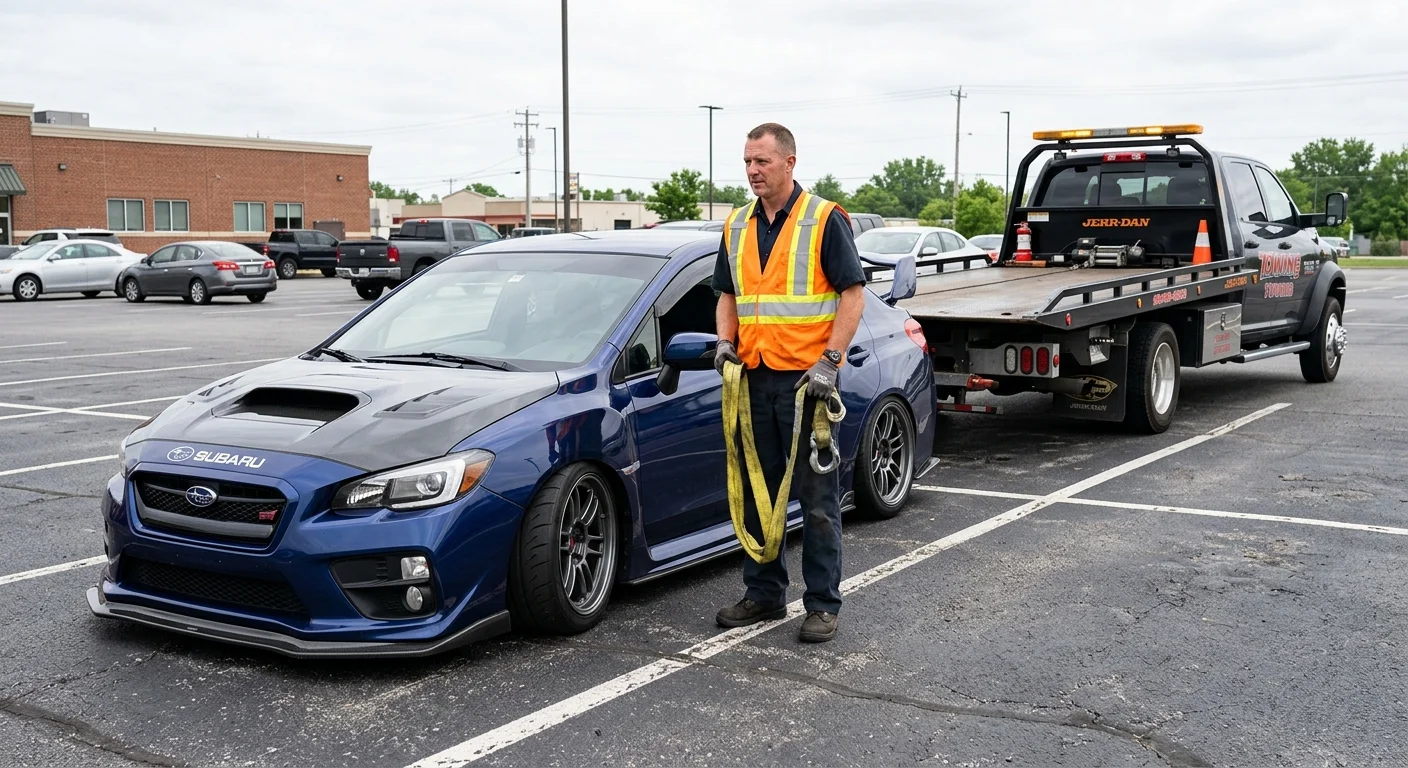
Ground clearance shapes the loading plan
Lowered cars fail at the first inch of the load, not at highway speed. A splitter, a foam-backed lip, an aftermarket undertray, or a sitting-low exhaust can meet the steel of a tilted bed or the face of a wheel-lift yoke. That contact is the scrape people worry about. It is not a guaranteed outcome. A dispatcher also cannot rule it out from make and model alone.
A flatbed, often called a rollback, tilts its deck toward the pavement. The operator winches or rolls the car onto the bed, then raises the deck so all four wheels leave the road. Nothing is supposed to drag during the haul. The catch for a low-clearance car is the breakover at the tail of the bed. The steeper that meeting point, the more the nose and the rocker can kiss metal. Some operators carry extra ramps or cribbing to flatten that meeting point. Some beds sit lower than others. None of that is a promise that every Springfield rollback will clear every kit.
A wheel-lift slides a yoke under two tires and lifts that end. The other two tires stay on the pavement and roll. That yoke still has to pass under the bumper and the valance. On a car that already sits on the bump stops, there may be no path for the yoke without lifting the nose first, using dollies, or switching methods. Dollies, when the operator has them, can get the remaining wheels off the road. They add steps. They do not erase a lip that is already on the ground.
Ride height is not the same from Nixa to downtown. A level pad at a shop on Kearney is the easy case. A crowned gravel drive in Christian County, a steep apron off US-160, or a speed-hump lot near the MSU Springfield campus changes the angle before the truck even tilts. Fall 2025 enrollment on that campus was 25,238. Those lots stay tight. Lowering a car or a truck also cuts the gap to oil pans, after-cat piping, and plastic aero. Those parts take the hit first. Tell the operator what you lowered, coils or bags, and whether the car will still roll.
Do not treat flatbed towing for lowered cars as automatic. A bed that cannot square up, or a deck that meets the pavement too steep, can still scuff the same lip a wheel-lift would. The loading plan starts with the gap you can see from the curb.
Drivetrain and wheel condition still matter
Clearance is only half the call. The drivetrain still has to survive the miles between the pin and the shop.
If the car is all-wheel drive, four-wheel drive, hybrid, or electric, rolling two tires on the pavement can stress a transfer case, a center differential, or a motor tied to a hub. That is why so many owner’s manuals steer those cars toward a full-off-the-ground load. It is also why our flatbed vs. wheel-lift guide treats drivetrain as a separate question from ride height. A slammed front-wheel-drive Civic and a slammed AWD WRX are not the same tow.
Wheel condition matters just as much. A bent rim, a locked caliper, a broken CV, or a tire that will not hold air cannot safely trail behind a wheel-lift. The rolling end has to roll. After a curb strike on Campbell, a parking-garage pillar downtown, or a deer-season nick on a two-lane toward Republic, assume the damaged corner may not be the one you want on the pavement. Collision work often belongs on a bed for that reason, not because the body shop asked for a prettier arrival.
Manual transmissions, aftermarket axles, and welded diffs also change what “neutral” even means. If you cannot confirm the car will freewheel, say so. The operator would rather winch onto a bed than drag a locked hub down Glenstone.
Exotic and classic towing is the service lane for cars with lips, wide fitment, and paint you cannot replace at a chain store. The same care shows up in our note on classic-car towing in Springfield. A lowered daily is not automatically a collector car. It still shares the loading problem: low, wide, and easy to scuff if someone rushes the first pull.
Missouri does not require towing coverage on a liability-only policy. If you carry a roadside rider, ask that program what equipment it will send. The method still has to match the car, even when someone else is paying the bill.
Pickup access can rule out an easy approach
Even the right truck fails if it cannot square up to the car.
Downtown Springfield eats space. Parallel pins, garage ramps, and lots tucked off Park Central do not always leave a rollback room to tilt a long bed. A wheel-lift is shorter in that setup. That is access, not a verdict that wheel-lift is safer for a splitter. The operator may still need to roll the car to a wider aisle, a loading dock, or the street before any method is honest.
Campus and apartment garages near MSU add height bars and tight turns. A deck that needs to tilt may not clear a beam. Tell dispatch the garage name, the floor, and whether a height bar is in the way. Photos of the approach beat a guess.
I-44 through the Glenstone-to-Kansas Expressway stretch is a heavy freight cut, with 65,000-plus vehicles a day and about 15,000 semi-trucks in that mix. Kansas Expressway at I-44 was North America’s first diverging diamond interchange, in 2009. Shoulders there are not a shop floor. A tilted bed takes a long, straight shadow. If the car is on a narrow shoulder, in a gore, or against a guardrail, the operator may have to winch it to a wider pad first. MoDOT’s Motorist Assist / Emergency Response patrol, based at the Transportation Management Center of the Ozarks, can help with freeway visibility. It does not tow your car to a shop. Check the MoDOT Traveler Information Map for incidents, then treat the load plan as a separate job.
South of town, US-65 funnels Branson traffic, in a range of roughly 9-10 million visitors a year. A lowered car that dies on a grade, a tourist-lot speed bump, or a steep drive in Hollister is an approach problem as much as a clearance problem. Republic and the US-60 side add gravel and farm aprons. Ozark and Nixa add those steep residential cuts. Same metro. Different first ten feet.
Private lots and HOA drives can also box a truck in with cars on both sides. If you can move neighboring vehicles, do it before the operator arrives. If you cannot, say that on the call so the method is chosen for the hole that actually exists.
The vehicle manual controls approved transport
The owner’s manual is the last word on approved transport. Not a forum. Not a guess from a similar year. Not a house rule we invent for a brand.
Open the towing or vehicle-recovery chapter. Look for flatbed, dolly, wheel-lift, and any ban on towing with wheels on the ground. Many electric and AWD manuals require all four wheels off the pavement, or they allow a short move only under stated limits. Those limits live in your book. They do not live in this article. If the car is electric or hybrid, read that chapter before anyone hooks a yoke. If the manual says transport mode, air-suspension jacking mode, or a specific tow eye, have that ready.
Air suspension that will not rise is a lowered-car problem with extra teeth. Bags that are down sit the chassis even closer to the ramp. If you can wake the system and raise it, do that before the truck lines up. If the battery is dead and the body is on the stops, describe that. The operator plans ramps, a winch line, and a slower pull from that fact, not from a brochure ride height.
Aftermarket coilovers, chopped springs, and stretched tire fitment are your modifications. The factory manual may not mention them. That does not give anyone a free pass to ignore the factory drivetrain rules. It means clearance is worse than the book assumed. Say what is non-stock.
A statewide ban on lowered cars is not in Missouri’s towing statutes (RSMo Chapter 304). Inspection, registration, and what a safety station will pass are a Missouri Department of Revenue motor vehicle question. We could not confirm a single statewide ride-height number that makes a car illegal to own. Do not treat a tow method as a legal ruling.
If two methods both sit inside the manual, the operator still chooses based on damage and access. Ask which method they plan to use, and why. If the manual forbids wheels on the ground, say so before a truck is dispatched.
What to photograph before requesting a quote
A number is only as good as the photos. The operator who does the work sets the price. You get that number before anyone is dispatched. Blurry night shots of a bumper do not show the gap that will make or break the load.
Shoot these before you call:
- A side-on shot from the ground that shows how much air is under the lip, the rocker, and the exhaust.
- A front three-quarter that shows splitters, canards, and the approach to the tires.
- The wheels, including any bent rim, missing lug, or tire sitting on the wheel well.
- The path the truck would use: driveway slope, garage door height, parked cars, a speed bump, a curb, or a shoulder.
- The dash or a plate that names make, model, year, and drivetrain if you know it. AWD, FWD, RWD, or electric.
Add a short note: bags or coils, whether it rolls, whether it starts, whether you have keys, and where it has to go. A shop on Battlefield is a different haul than a storage unit in Strafford. Distance does not change the loading physics. It does change how long a bad method would spin a drivetrain.
If you are on a public right-of-way, stay out of traffic and let the operator set cones and lighting. Do not crawl under the car to help with the yoke.
Those pictures let dispatch match you with an independent local operator who actually has a bed, ramps, or a wheel-lift that can work the pin. Quick Tow Springfield is a referral line. We do not own the truck. We line up the operator who does.
When to call us
When the car will not raise, will not roll, or sits in a hole a rollback cannot square up to, stop experimenting with straps in the driveway. Call us at (417) 221-8911. The line takes calls 24 hours a day, every day. A notice plays, then the call is recorded, and we dispatch an independent local operator to you.