A car may still be towable when its electronic parking brake won’t release. The operator must first assess the brake state, wheels, drivetrain, and pickup access. Don’t force the car to roll or copy a release method from another model.
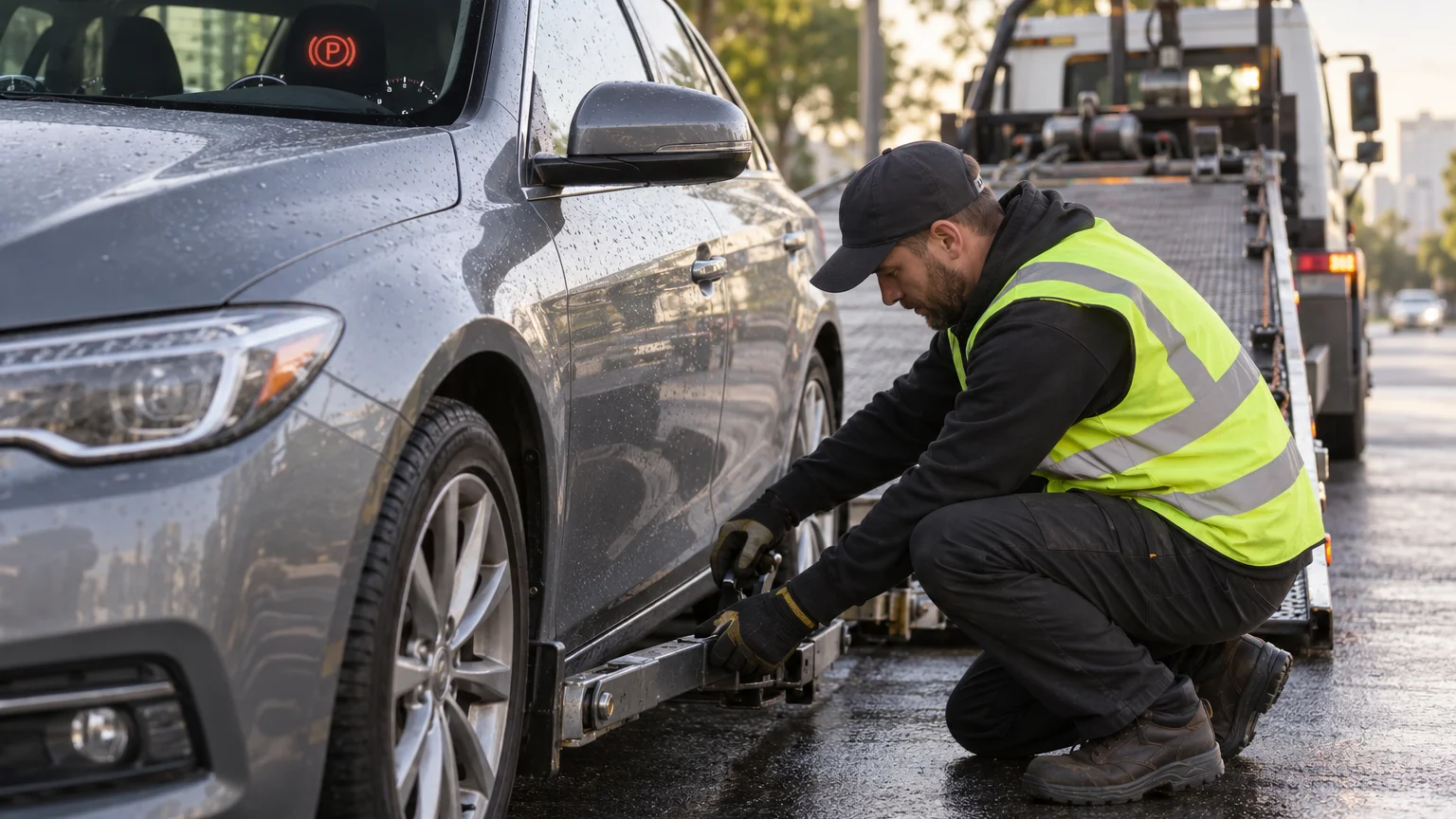
A stuck electronic brake changes how the car can move
An electronic parking brake failure can leave one or more wheels unable to roll normally. That condition changes how an operator approaches the pickup. It doesn’t automatically make the car impossible to tow.
Tell the referral service that the electronic parking brake won’t release. Don’t describe the problem only as “the car won’t move.” The operator needs to distinguish a brake problem from a transmission, steering, or access problem.
A warning light also doesn’t reveal the complete condition. The system may show a message while the wheels still roll. In another case, the affected wheels may remain locked. Don’t push the car to test them. Report what happened during normal operation and let the operator assess the vehicle.
Location matters around Springfield. A disabled car beside I-44 presents a different pickup than one inside a downtown garage. A car on a gravel road outside Rogersville may have limited working space. A driveway near Nixa or Ozark may also have a slope. Mention the surface, slope, traffic, and nearby obstacles when requesting service.
If you’re stopped along I-44 or US-65, focus first on your surroundings. You can check current incidents and road conditions through the MoDOT Traveler Information Map. Don’t attempt a brake release while exposed to moving traffic.
The operator may consider wheel-lift towing or another approach after inspecting the vehicle. The correct choice depends on which wheels can move and which must stay off the road.
Neutral and released brakes aren’t the same condition
Neutral concerns the transmission. The electronic parking brake concerns the braking system. One can be available while the other remains engaged.
A dashboard showing Neutral doesn’t confirm that every wheel rolls freely. Likewise, a released parking-brake indicator doesn’t prove the transmission can be shifted correctly. Give the operator both pieces of information.
Start with what you can observe from the driver’s seat. Does the gear display show Park, Neutral, or another position? Is the parking-brake indicator still illuminated? Does the dashboard show a written warning? Does the engine start, or does an electric vehicle enter its normal ready state?
Record those details without experimenting. Repeated button presses may erase the sequence that led to the warning. Trying to push the car can also create movement where you don’t expect it.
If the transmission won’t enter Neutral, that’s a separate condition. Our guide to a car that won’t shift into Neutral explains what information matters for that pickup. A vehicle can have both problems at once, so don’t assume one explains the other.
Don’t copy a shift-release or brake-release sequence from an unrelated vehicle. Model years, trim levels, and drivetrains can differ. A video for a similar-looking car isn’t the same as instructions for your exact vehicle.
The operator will use the reported conditions when planning the job. Final method selection happens after the vehicle and pickup area can be assessed.
Wheel position and access shape the towing method
The operator needs to know which wheels appear locked. Electronic parking brakes commonly involve the rear braking system, but the exact design is model-specific. Don’t identify the affected wheels by assumption. Describe only what you’ve observed.
Wheel direction matters too. Tell the operator if the front wheels are turned toward a curb, wall, ditch, or parked vehicle. Mention any damaged tire, collapsed suspension, or steering warning you can see. Don’t crawl beneath the car to inspect it.
Access can change the practical options. A flat surface with open space differs from a narrow garage stall. Low ceilings, tight turns, gate clearance, and nearby columns should be disclosed before dispatch. The same applies to an underground garage near downtown Springfield or a crowded lot near the Missouri State University campus.
Outdoor pickups vary across the metro. A paved lot in central Springfield isn’t the same as an Ozarks gravel drive. Mud, soft shoulders, slopes, and low-water crossings can limit positioning. Along the US-65 corridor toward Branson, also mention whether the car sits near traffic or behind a barrier.
A flatbed towing operator may assess whether the vehicle can be loaded without making locked wheels travel on the roadway. A wheel-lift operator may evaluate which end can be raised and how the remaining wheels must be handled. Neither method should be selected from the brake warning alone.
For a broader comparison, see flatbed versus wheel-lift towing. In this situation, the meaningful question isn’t which method sounds better. It’s which method fits the exact wheel condition, drivetrain, and access.
The owner’s manual controls model-specific steps
There isn’t one universal electronic parking brake release procedure. Use the current owner’s manual for the exact make, model, and model year. Check the towing and parking-brake sections before trying any normal control sequence.
Some instructions may depend on the vehicle’s operating state. Others may contain warnings about towing, wheel contact, or transport preparation. Follow the manual’s wording. Don’t substitute instructions from a different year or trim.
Avoid online directions that tell you to remove brake components, power a motor directly, dismantle interior trim, or crawl under the vehicle. Those are repair procedures, not general roadside steps. Quick Tow Springfield doesn’t diagnose or repair electronic braking systems.
If the manual provides a normal driver-level release process, follow it only where the car is safely secured. A released brake can allow movement on a slope. Stop if the warning persists or the instructions don’t match the car.
The same caution applies to a weak or disconnected battery. Don’t assume a jump will release the brake. Don’t assume a charged electric-vehicle traction battery confirms every other electrical system is operating. The manual controls the next appropriate step.
Whether the car can be driven after an electronic parking brake warning also depends on that specific vehicle and fault. A warning symbol alone can’t settle that question. Check the manual and arrange qualified mechanical diagnosis.
Repair pricing can’t be confirmed from the warning message. The cause hasn’t been diagnosed, and shops set their own charges. Ask the repair facility to inspect the system and explain its estimate before approving work.
What to photograph before requesting a tow
A short set of photos can help describe the pickup accurately. Take them only from a safe position. Don’t stand in a traffic lane or step onto an active shoulder for a better angle.
Start with the complete dashboard. Capture the parking-brake indicator, gear display, and written warning together. If the message changes, photograph each version. Don’t clear the warning before recording it.
Next, photograph the car from each accessible corner. Show wheel direction and the space around the vehicle. Include curbs, walls, garage columns, gates, or nearby parked cars. A wider image often explains access better than a close-up.
Photograph the make and model badge if it’s visible. Include any drivetrain badge, but don’t rely on the badge as the complete specification. The vehicle identification details and owner’s manual remain better references for the exact configuration.
Also record these details in your message:
- The vehicle’s make, model, and model year
- Whether the keys are available
- What the gear display shows
- The exact parking-brake warning
- Whether the vehicle starts normally
- Which wheels are known to be locked
- The surface, slope, and available working space
- The pickup location and intended destination
Don’t claim a wheel is free because it looks normal. Say “unknown” when you haven’t confirmed something. That helps the independent operator prepare without relying on a guess.
Quick Tow Springfield connects callers with independent local operators. The operator chooses the towing method and sets the price. You’ll get the number before anyone is dispatched.
When to call us
Call when the electronic parking brake won’t release through the manual’s normal steps, the warning remains, or the car can’t be moved safely. The line takes calls 24 hours a day, and we can line up an independent local operator to assess the pickup. Call us at (417) 221-8911.