A steering failure doesn’t automatically make a car impossible to tow. The wheel position, suspension condition, clearance, and available loading space determine what an independent operator can safely attempt.
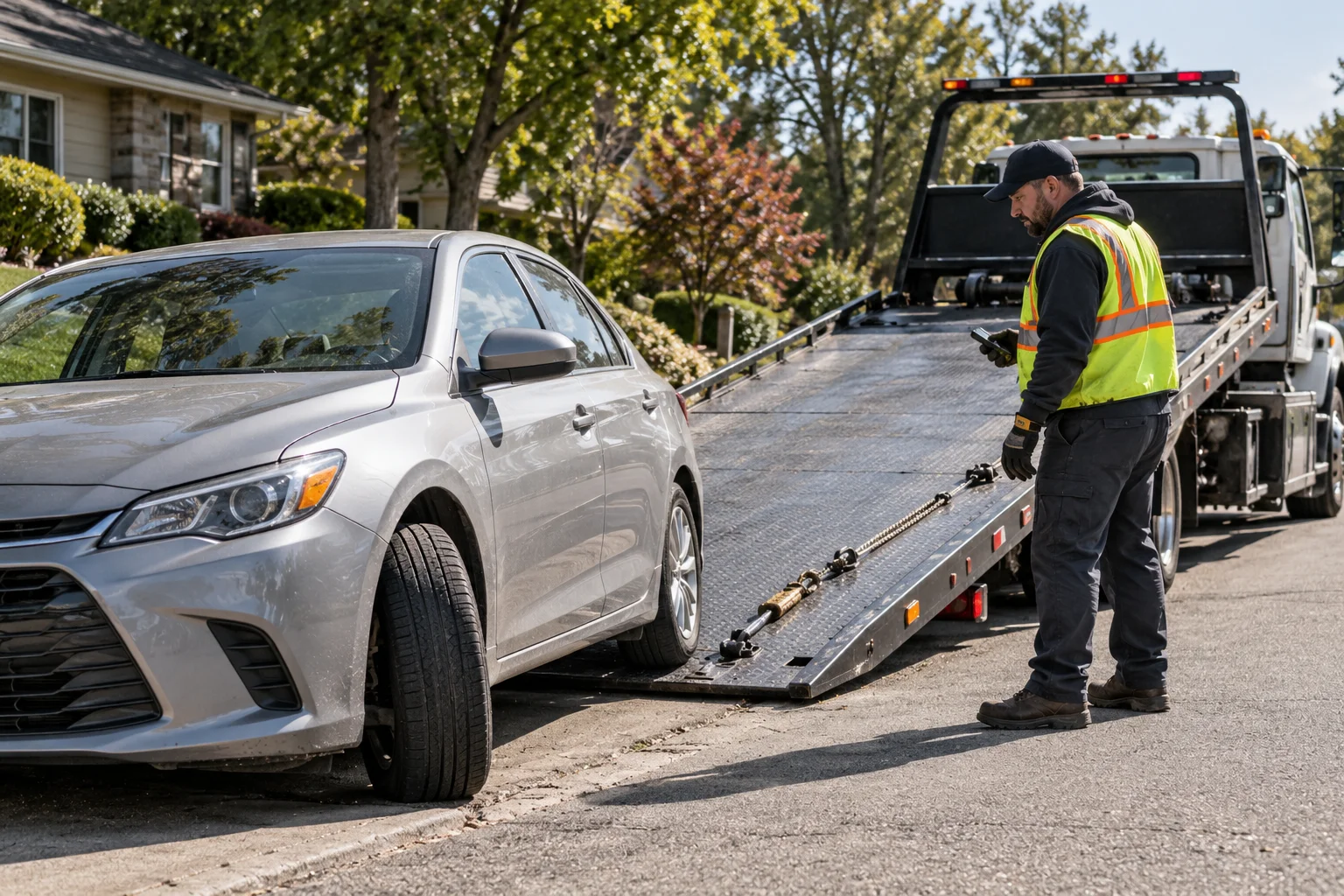
Broken steering changes loading and unloading
A car that can’t steer presents a loading problem first. Its front wheels may point straight, turn together, or sit at different angles. The steering wheel may also move without changing the tires’ direction.
Those details affect how the vehicle follows the operator’s intended path. A car with straight wheels may track differently from one with a front tire turned toward the curb. The operator must also consider what happens when the car comes off the towing equipment.
Don’t force the steering wheel or push the car into traffic. That can change its position without revealing what failed. Leave the vehicle where it rests unless an emergency official directs otherwise.
Tell dispatch whether the steering wheel turns. Describe what each front wheel is doing. Mention any recent impact, curb strike, pothole hit, or sudden noise. These observations help the operator prepare without treating them as a diagnosis.
Location matters around Springfield. A disabled car in a wide parking lot offers different working space than one beside downtown traffic. A shoulder along I-44 or US-65 adds passing vehicles and limited room. Check the MoDOT Traveler Information Map for reported incidents and current road conditions when you’re away from the car.
A tow may still be possible, but the operator chooses the final method on scene. That decision follows the car’s condition, wheel position, and surrounding space.
Wheel direction and suspension damage aren’t the same
Wheels turned to one side don’t prove that the suspension is damaged. Likewise, a steering wheel that won’t respond doesn’t identify the failed part. Steering and suspension components work near each other, but they aren’t interchangeable problems.
Look at the car without crawling underneath it. Note whether one wheel appears farther forward or backward than the other. Check whether a tire leans, touches the body, or sits unusually close to the wheel opening. Report any visible fluid, loose material, or fresh impact damage.
These are observations, not a roadside diagnosis. Don’t pull on a wheel or straighten it by force. An operator needs the vehicle’s resting condition, not a modified version of it.
A steering problem can also exist alongside wheel or suspension damage. That combination changes which parts can bear weight during loading. It may call for a different approach than a car whose wheels are merely turned and intact.
If the trouble followed a collision, explain where the impact occurred. Our accident recovery and winch-out service covers situations where positioning and access matter as much as transport. The operator will inspect the vehicle before deciding how to move it.
This issue also differs from a transmission lock. A vehicle that won’t shift may have straight, steerable wheels but still resist rolling. Our guide to a car that won’t shift into neutral explains that separate equipment-selection problem.
A flatbed still needs workable access
A flatbed tow for steering failure is often worth discussing, but the word “flatbed” doesn’t settle the job. The operator still needs a workable approach, enough surrounding room, and a path that accounts for the wheels’ fixed direction.
The vehicle may not follow a straight loading line. Low clearance, body damage, a steep driveway, or a nearby curb can further restrict movement. A front wheel turned sharply toward an obstacle can make a wide space feel much smaller.
Downtown Springfield parking presents one kind of access problem. A crowded lot near the Missouri State University campus presents another. In Nixa or Ozark, a disabled car may sit on a sloped driveway. Around Webster County, gravel surfaces and narrow rural roads can affect where equipment can be positioned.
Give dispatch a full location description. Say whether the car is nose-in, parallel parked, inside a garage, against a curb, or blocked by other vehicles. Mention gates, overhead structures, soft ground, and steep grades. If the car is on a traffic lane or narrow shoulder, state that first.
Our flatbed towing service can connect you with an independent operator who evaluates those conditions. The operator may choose a flatbed or another method after seeing the vehicle. This flatbed versus wheel-lift guide explains the basic differences, but it can’t replace an on-scene inspection.
Don’t attempt to guide the car onto towing equipment yourself. Broken steering removes predictable directional control, which is exactly what the operator must account for.
The owner’s manual controls model-specific handling
Vehicle designs differ. The owner’s manual is the best starting point for model-specific towing instructions. Check the roadside assistance, emergency towing, or vehicle transport section if you can reach it safely.
The manual may identify approved lifting points, transport settings, or restrictions tied to the drivetrain. Follow its wording rather than advice written for another model. Two cars that look similar may have different procedures.
Tell dispatch the year, make, model, and drivetrain if known. Also mention whether it’s electric, hybrid, all-wheel drive, front-wheel drive, or rear-wheel drive. Don’t guess when you aren’t sure. The operator can confirm the relevant details before selecting a method.
Electronic parking brakes, steering locks, and transport modes can complicate the situation. A dead battery or missing key may add another layer. Report those facts without trying random control combinations. Improvised steps can create a second problem while leaving the steering failure unresolved.
Keep the manual available for the operator. A printed copy may be in the glove compartment. A manufacturer may also publish a model-specific digital version. Use the manufacturer’s instructions for your exact vehicle and model year.
The manual doesn’t diagnose the steering failure. It helps define how the vehicle should be handled during transport. Repair decisions belong with a qualified repair facility after the car reaches its destination.
What to photograph before dispatch
A few clear photos can show wheel position and access better than a long explanation. Take them only from a safe place. Don’t stand in traffic, step into an active lane, or crawl under the vehicle.
Start with one photo showing the entire car and its surroundings. Include the curb, parking lines, driveway, shoulder, nearby vehicles, or garage opening. The operator needs to understand where equipment could be positioned.
Then photograph both front wheels from outside the car. Capture their direction and their position inside each wheel opening. If damage is visible, take a wider photo before taking a closer one. The wider view gives the close-up context.
Photograph the steering wheel position through an open door or window. Include the dashboard if warning lights are visible. Don’t turn controls merely to improve the picture.
Also capture:
- The front and rear clearance beneath the car
- Any wheel touching the body or curb
- Visible collision damage near the steering or suspension area
- The path into and out of the location
- The vehicle identification details needed to confirm the exact model
Photos don’t replace an inspection. They help dispatch describe the job accurately and help the operator arrive with useful context. Conditions can still look different on scene.
Send only relevant images. Avoid including faces, personal documents, house numbers, or unrelated license plates when they aren’t needed. Pair the photos with a short description of what happened and where the car sits.
When to call us
This stops being a do-it-yourself move when the car won’t steer predictably, a wheel sits at an unusual angle, or safe loading access is uncertain. We’ll line up an independent local operator to inspect the situation and select the towing method. The line takes calls 24 hours a day, and calls are recorded after a notice. Call us at (417) 221-8911.