An axle problem can leave a utility trailer unable to roll on US-60. The next step may be recovery, transport, or another service chosen by the operator. That decision depends on the trailer, cargo, damage, and shoulder access.
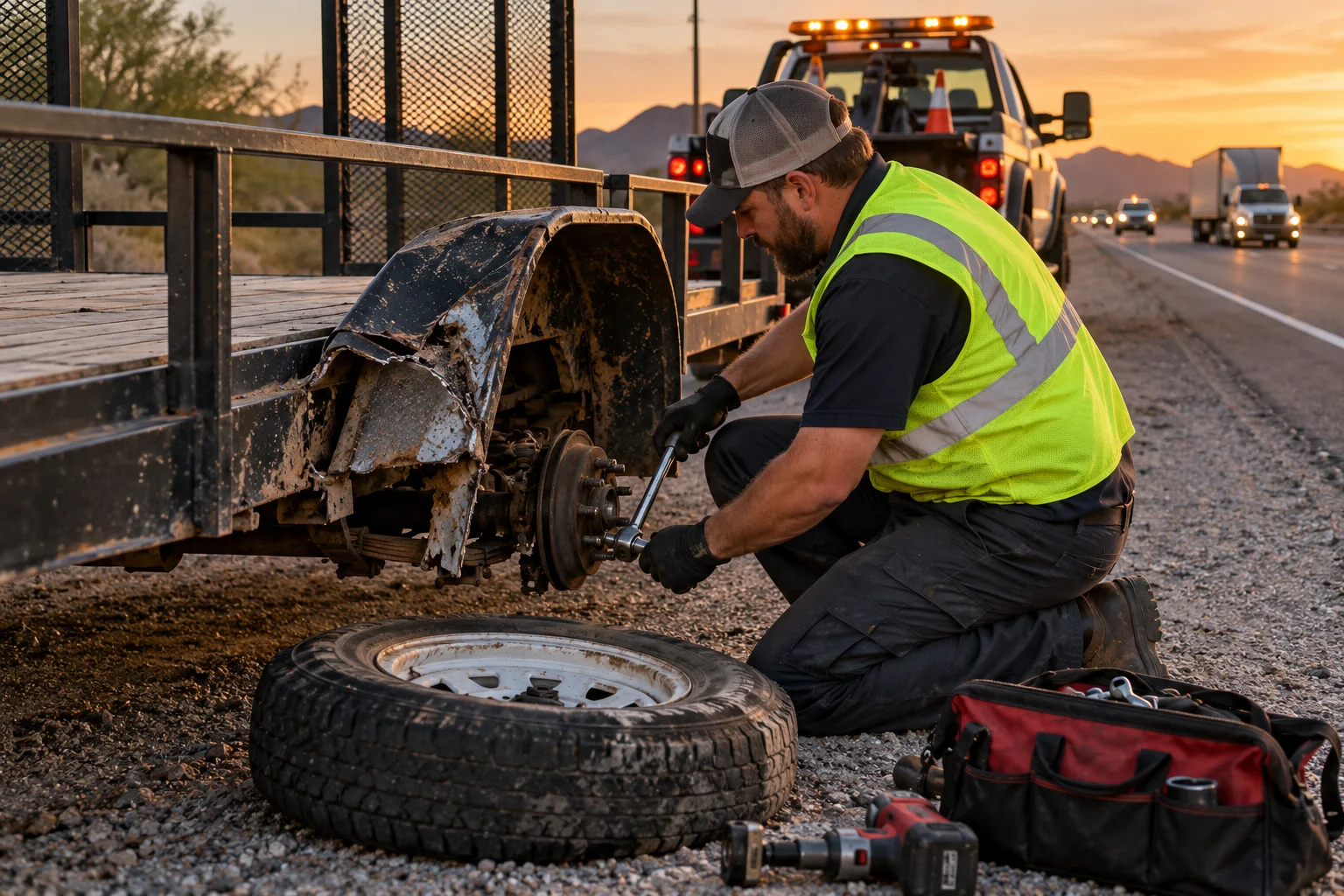
Describe the tow vehicle and trailer separately
Start by treating the tow vehicle and trailer as two separate units. A working pickup doesn’t mean the attached trailer can leave under its own wheels. Likewise, a disabled tow vehicle may need service even when the trailer still rolls.
Tell the operator what’s pulling the trailer. Give the vehicle type, whether it runs, and whether it can move without the trailer. Mention any visible damage near the hitch or rear of the vehicle.
Then describe the trailer itself. Say whether it’s an open utility trailer, enclosed cargo trailer, equipment trailer, or another design. Report the number of axles and which side appears affected. Read the manufacturer label if you can reach it without entering traffic. Share the listed trailer details exactly instead of estimating its weight or capacity.
The hitch arrangement also matters. Describe the coupler, safety chains, wiring connection, and any jack or support at the tongue. Report whether the trailer remains connected to the tow vehicle.
These details help an independent operator assess both units. One may need transport while the other stays mobile. In other cases, they may need to be handled together or moved in stages.
Our RV and trailer towing service covers referral requests involving several trailer types. The operator, not Quick Tow Springfield, decides what service and equipment fit the specific setup.
An axle problem can stop the trailer from rolling
“Axle failure” can describe several different observations. The wheel may lean, bind, drag, sit out of position, or contact another part of the trailer. A hub or suspension area may also look damaged. Those signs don’t confirm the failed component.
Tell the operator what you can see and hear. Avoid naming a mechanical cause unless a qualified person has already identified it. “The roadside wheel is tilted and won’t turn” is more useful than guessing that the axle snapped.
Report that the trailer doesn’t track or roll normally. The operator determines whether it can be loaded, repositioned, or handled through another recovery plan.
Useful observations include:
- Which wheel area appears affected
- Whether the tire is present and inflated
- Whether the wheel turns, drags, or sits at an angle
- Whether any part rests on the pavement
- Whether the trailer frame looks level or twisted
- Whether fluids, loose parts, or cargo are on the road
A utility trailer differs from a travel trailer or boat trailer. Its load may be exposed, unusually shaped, or tied to a job site. That changes the request. Our articles about a travel-trailer tire failure on US-65 and a boat-trailer breakdown near Table Rock Lake address those distinct situations.
Cargo condition changes the operator request
Cargo is part of the recovery assessment. Tell the operator what the trailer carries, how it’s positioned, and whether anything shifted after the failure. A mower, compact machine, building material, debris, or loose job-site load creates different access questions.
Don’t estimate cargo weight. Share a documented figure only if it appears on equipment paperwork, a readable data plate, or another reliable record. If you don’t know, say that clearly. Photos can help show the cargo’s size and position without turning a guess into a fact.
Report how the load is secured. Describe visible straps, chains, binders, gates, ramps, or enclosure doors. Say whether any securing point appears loose or damaged.
The operator also needs to know whether cargo has reached the shoulder or a travel lane. Include any scattered material when describing the scene.
A shifted load may affect how the trailer can be approached or moved. The operator may need a different plan than a routine trailer tow. If the trailer has left the pavement, sunk into soft ground, or contacted a ditch, the request may involve accident recovery or a winch-out.
Quick Tow Springfield connects callers with independent local operators. We don’t diagnose the axle, select equipment, or set the operator’s price. You’ll receive the price before anyone is dispatched.
US-60 shoulder access shapes the recovery plan
Location details matter along US-60 between Springfield, Rogersville, and the outlying towns. “On US-60” isn’t enough for an operator to find the correct approach. Direction of travel and the trailer’s position can change how the scene is reached.
Share your direction of travel first. Then give the nearest town, exit, intersection, business, or visible marker. A map pin can help when roadside signs aren’t nearby. Say whether you’re east or west of Rogersville, not simply “near Springfield.”
Describe where both units stopped. The trailer may be on the outside shoulder, beside the median, partly in a lane, on an entrance ramp, or beyond the paved edge. Mention a guardrail, ditch, slope, narrow shoulder, soft ground, or blocked approach if you can see one.
Also report which side has the damaged wheel area. A traffic-side problem presents different access than a shoulder-side problem. The operator needs that detail before planning where to position equipment.
Check the MoDOT Traveler Information Map for current traffic, camera, and incident information. Conditions can change while you wait. The map doesn’t replace direct details about your trailer or exact stopping position.
Tell the operator if the trailer is affecting a travel lane or the available shoulder.
Precise access information helps distinguish a straightforward transport request from a roadside recovery. The responding operator makes that determination after reviewing the scene details.
What to photograph before requesting help
Photos give the operator a clearer view before dispatch. Photograph only what’s available from your current position.
Start with a wide image showing the tow vehicle and entire trailer. Include their position relative to the shoulder, pavement, ditch, slope, or guardrail. This helps explain access better than a close-up alone.
Next, photograph the affected wheel area from available angles. Capture what’s visible around the tire, wheel, hub, suspension, and trailer frame. The goal is documentation, not diagnosis.
Include these views when they’re available:
- The complete trailer from the front and rear
- The affected wheel area and the opposite side
- The hitch, coupler, chains, and tongue
- The cargo and its visible securement
- Any shifted, loose, or fallen material
- The manufacturer label and readable equipment plates
- The shoulder and the operator’s likely approach
- Nearby signs or landmarks that confirm the location
Send the original images without drawing over important details. Add a short description of what changed before the trailer stopped. Note any sound, dragging, leaning, or sudden movement you observed.
Accurate photos and plain descriptions help the operator assess whether recovery, trailer transport, or another service fits.
When to call us
Call when the trailer won’t roll normally, cargo has shifted, or the wheel area can’t be assessed without entering traffic. The line takes calls 24 hours a day, and we can line up an independent local operator after gathering the trailer, cargo, hitch, and location details. Call us at (417) 221-8911.