A failed travel-trailer tire on US-65 creates two possible calls. Roadside help may fit when the reported problem stays with the tire. Visible wheel, axle, fender, or running-gear damage calls for a trailer-towing evaluation.
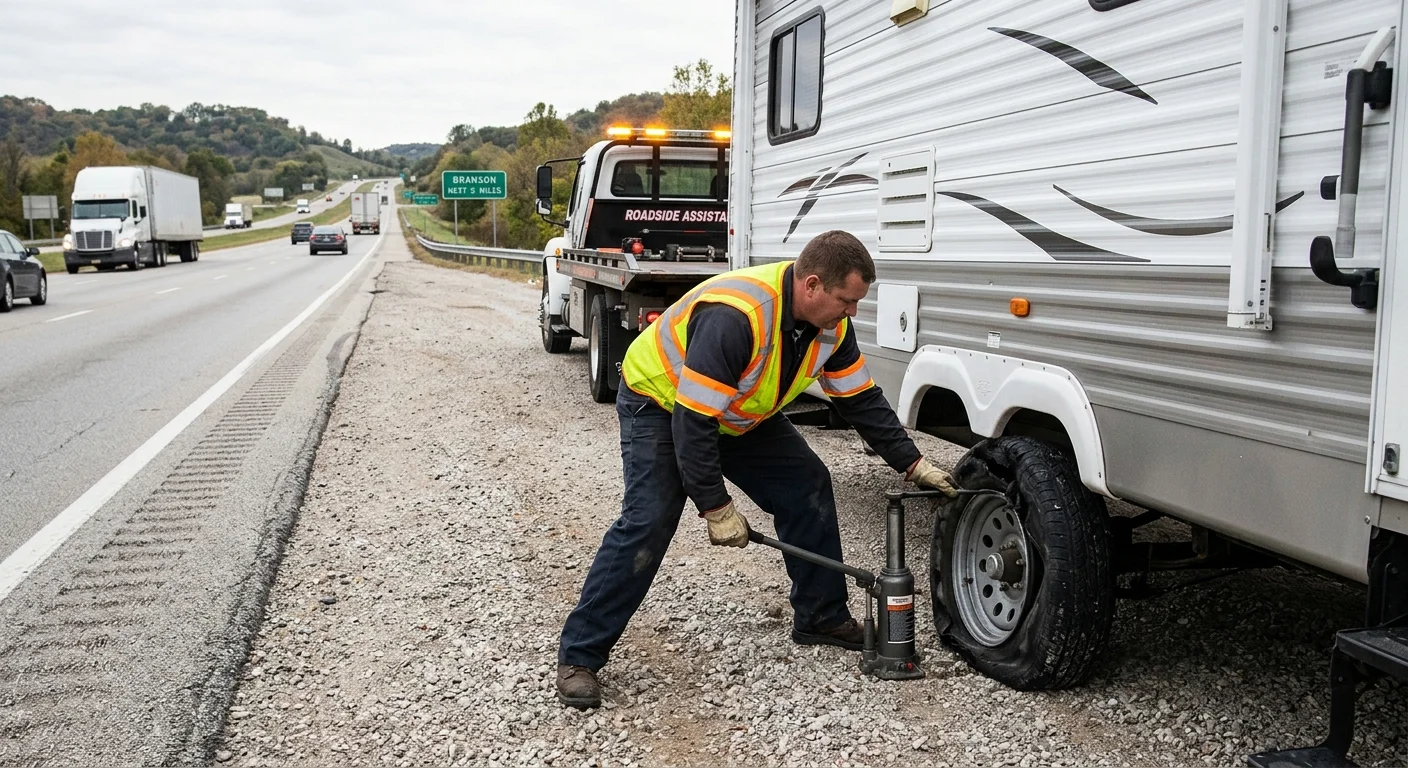
A tire call can become a trailer tow
Start by describing what happened, not what service you think you need. Tell the dispatcher that a travel-trailer tire failed. Then explain what you can see without guessing about hidden damage.
A tire-only report may begin as a roadside-assistance request. That description changes when the trailer no longer appears ready to roll. A missing wheel, bent-looking part, damaged fender, or trailer sitting unusually low gives the operator a different problem to assess.
Your available spare also matters. Say whether you have one and whether it matches the trailer. Don’t describe an old or unfamiliar spare as usable unless you can confirm that from its markings and condition. The operator can decide whether roadside service remains a workable option.
Travel trailer tire blowout towing isn’t the same as towing the pickup. The disabled unit may be the trailer while the tow vehicle still runs normally. That distinction needs to be clear from the first message.
Don’t assume that every roadside operator handles travel trailers. Quick Tow Springfield matches callers with independent local operators based on the details provided. Accurate information helps us seek the right type of response.
We couldn’t confirm a standard local price for travel-trailer tire service. The operator doing the work sets the price. You’ll get that number before anyone is dispatched.
The same decision applies when the failure happens near Springfield, Ozark, Hollister, or Branson. The trailer’s condition determines whether the request stays roadside or moves to RV and trailer towing.
Wheel, axle, and fender condition change the decision
The failed tire is only one part of the description. The wheel, axle area, fender, and nearby trailer body help define the call. Report what’s visible and leave the mechanical conclusion to the operator.
Start with the wheel. Say whether it remains attached and appears upright. Mention any visible bend, crack, missing piece, or contact with the trailer. If you can’t see the wheel clearly, say that instead of guessing.
Next, describe the trailer’s position. Is it level, leaning, or sitting lower near the failed tire? Does that corner appear closer to the pavement? These observations help an operator understand the scene before dispatch.
Look at the fender and body from a distance that doesn’t require reaching near damaged parts. Report visible dents, loose panels, torn material, or anything hanging near the wheel opening. Don’t try to diagnose whether that damage is cosmetic.
The axle area deserves its own description. Say whether anything looks shifted, bent, detached, or unusually close to the road. Avoid declaring the axle safe or unsafe. A photo and a plain description are more useful than a confident guess.
Also report whether the trailer moved after the failure. Give only what you know, such as where it stopped and whether the wheel still turned. Don’t test it for the sake of answering that question.
A request often changes when the damage extends beyond replaceable tire service. At that point, an operator may need to assess transportation for the trailer instead. Our Branson corridor RV breakdown guide explains how location and vehicle details shape that broader call.
Describe the tow vehicle and trailer separately
Dispatch needs two vehicle descriptions. One covers the pickup, SUV, or other tow vehicle. The second covers the travel trailer. Combining them into one vague description can hide the detail that determines the operator match.
For the tow vehicle, provide the make, model, and model year if known. Say whether it runs and whether it has visible damage. Explain whether the trailer remains connected to it. Don’t call the tow vehicle disabled unless it has its own problem.
For the trailer, provide the manufacturer and model if available. Share the length and weight shown on its labels or paperwork. If those figures aren’t available, say they couldn’t be confirmed. Don’t estimate them from appearance.
Describe the trailer’s axle arrangement in plain language. You can report the number of visible axles and which tire failed. For example, identify the driver or passenger side and the tire’s position. A photo can support that description.
Tell the dispatcher about anything attached to the trailer. That includes rear racks, bicycles, cargo carriers, or other visible extensions. Mention slide-outs or steps only as they’re currently positioned. Don’t assume an operator already knows the layout from the model name.
Hitch information also belongs in the initial description. Say whether the trailer remains coupled and whether any hitch component appears damaged. If you use a weight-distribution setup, mention it. The operator can ask for any additional detail needed.
This separation prevents a common misunderstanding. A running pickup doesn’t mean the trailer can continue. Likewise, a tire failure on the trailer doesn’t automatically mean the pickup needs towing. Each unit has its own condition, dimensions, and destination.
If transportation is needed, the repair destination matters too. Name the destination you’ve chosen, but don’t assume a shop can accept the trailer. Repair availability and equipment limits couldn’t be confirmed for every shop along this corridor.
US-65 shoulders and Branson destinations affect the plan
US-65 connects Springfield with Ozark and the Branson area. It also carries drivers toward Hollister, Table Rock Lake, and other Ozarks destinations. Your precise location on that corridor matters more than saying only “near Branson.”
Share your direction of travel first. Then provide the nearest visible exit, interchange, mile marker, business, or landmark. If you stopped after passing an exit, explain that sequence. A location pin can help confirm which side of the divided highway you’re on.
Describe the trailer’s position in relation to the road. Say whether the full combination is outside the travel lane or whether any part remains near it. Mention a slope, guardrail, narrow space, or soft ground if visible. These are scene details, not mechanical diagnoses.
You can check current incidents, traffic, and camera information on the MoDOT Traveler Information Map. Conditions can change between Springfield and Branson, so use current information instead of relying on an earlier trip.
MoDOT’s Motorist Assist and Emergency Response Program is a scheduled freeway courtesy patrol, not an on-demand towing service. It shouldn’t be treated as a replacement for arranging roadside help or trailer transportation.
Your destination changes the dispatch conversation. A trailer headed to a Branson campground has a different endpoint from one returning to Springfield. Give the campground, repair location, storage location, or other destination you’ve actually selected.
Confirm that the destination can receive the trailer before presenting it as final. We couldn’t verify universal repair availability, access hours, or trailer-size limits along US-65. Those details come from the destination itself.
Distance also affects an operator’s price. For more context, read what affects RV towing cost near Branson. The operator still sets the actual price for your request.
What photos help before dispatch
Clear photos can replace several uncertain descriptions. Take them only from places you can already access without handling damaged components. The goal is to show the scene, not prove your own diagnosis.
Begin with a wide photo of the full combination. Include the tow vehicle, hitch area, trailer, and failed-tire side when possible. This view shows how the units sit together and whether the trailer appears level.
Next, photograph the failed tire and wheel. Capture the entire wheel opening, not only the damaged rubber. A close detail may help, but it shouldn’t replace the wider view.
Take another photo of the fender and nearby trailer body. Include loose or displaced material in the frame. If marks continue forward or behind the wheel opening, show that area too.
A straight view along the trailer’s side can reveal its current stance. A second view from the opposite side gives useful comparison. Don’t label a difference as axle damage unless an operator confirms it.
Photograph the hitch connection as it currently sits. Include the visible coupler, attached hardware, and front of the trailer. Don’t disconnect or reposition anything just to improve the image.
Labels and paperwork can answer specification questions. Send a readable photo of the trailer identification label, tire markings, and any documented weight information you have. Cover personal information that isn’t needed for dispatch.
A location screenshot can also help. It should show your position, travel direction, and nearby exit or landmark. Add a short written note because map pins can land on the wrong carriageway.
Send the smallest useful set of clear images. Five focused photos usually explain more than a long stream of duplicates. If part of the trailer can’t be seen, state that plainly. An operator can decide what else is needed before accepting the request.
When to call us
Call when the problem no longer looks limited to a roadside tire request, or when you need an operator to assess trailer transportation. The line takes calls 24 hours a day, and Quick Tow Springfield can match your request with an independent local operator. Call us at (417) 221-8911.