A disabled RV on US-65 near Branson needs a safe position first. Move fully out of traffic if the rig can still move safely, then report its type, location, wheel condition, and hitch status. For RV towing near Branson, MO, those details help us find an independent operator prepared for the actual rig.
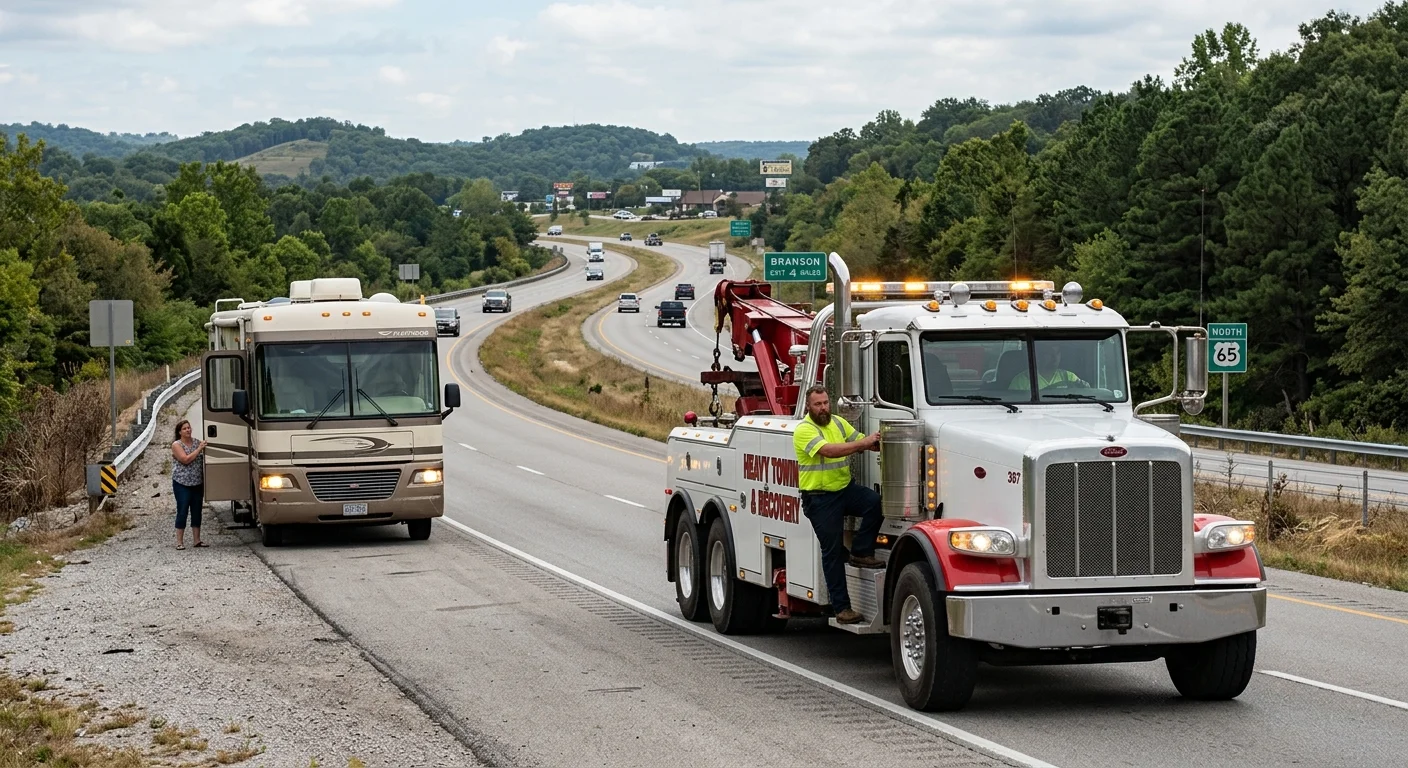
Get the rig out of traffic if it can move
Use the nearest safe exit or wide pullout when the RV still responds normally. Don’t keep driving if a wheel looks tilted, a tire has separated, or parts are dragging. Moving farther could turn a roadside tow into a more involved recovery.
Turn on the hazard lights and set the parking brake. Keep passengers and pets away from moving traffic. If leaving the RV would place anyone closer to traffic, stay inside with seat belts fastened. Call 911 when there’s an injury, fire, immediate collision danger, or an unstable position.
Your location needs more detail than “near Branson.” Share whether you’re traveling north or south on US-65. Add the nearest exit, mile marker, bridge, business, or readable road sign. A dropped map pin can settle confusion when several access roads appear nearby.
Check the MoDOT Traveler Information Map for current incidents, cameras, and road conditions. That can help you explain a closure or blocked approach. It can also show whether reaching the RV requires a different direction.
If you’ve reached Hollister or Branson, describe the exact driveway or parking area. Say whether the rig is level, angled, or partly in a lane. Don’t unhitch a trailer on a shoulder unless an operator directs you. Don’t crawl under the rig to inspect it beside traffic.
Once the scene is stable, contact a service that handles RV and trailer towing. The operator still needs to confirm that the rig and roadside position fit the equipment being sent.
Motorhome, travel trailer, or fifth wheel changes the truck
“RV” isn’t enough information for dispatch. A motorhome, travel trailer, and fifth wheel present different towing problems. The operator needs the actual configuration before selecting equipment.
A motorhome is one powered vehicle. Report its year, make, model, overall length, axle count, and weight rating from its label. Don’t estimate the weight. A clear photograph of the manufacturer’s data plate is more useful.
Explain which part failed. The operator should know whether the engine starts, the transmission shifts, and the steering responds. Report damaged tires, bent wheels, low body clearance, leaking fluid, or an air suspension that won’t rise. Mention any vehicle being towed behind the motorhome.
A travel trailer creates two separate questions. Is the tow vehicle disabled, or is the trailer itself damaged? Report whether they remain connected. Describe the hitch, safety chains, electrical connection, jack position, and visible damage. Include the trailer’s axle count and weight rating from its label.
A fifth wheel needs details about both the pickup and trailer. Tell dispatch whether the kingpin remains seated in the hitch. Report damage around the hitch, truck bed, landing gear, axles, and tires. Don’t separate the two units when the hitch area looks twisted or loaded unevenly.
Slides and awnings should be fully retracted when their mechanisms still work. Report anything that won’t close. The operator needs to account for the RV’s current shape, not its normal travel shape.
Photographs can answer several questions quickly. Send both sides of the rig, the damaged area, the hitch connection, and the available space around it. The independent operator makes the final equipment decision after reviewing the information.
Why US-65 grades and tight shoulders matter
US-65 connects Springfield with the Branson corridor through Ozarks terrain. Grades affect how a disabled rig sits, while tight shoulders reduce the working area beside traffic. A long motorhome may be outside the lane yet still leave little space around its driver’s side.
Tell dispatch whether the RV points uphill or downhill. Note if it leans toward a ditch, guardrail, curb, or soft shoulder. If the unit left the pavement, say how many wheels are off the hard surface. Don’t describe a ditch recovery as a normal tow.
Approach direction matters too. An operator may need room to position beyond the RV before beginning work. Median barriers, ramps, bridge approaches, and crowded exits can change that approach. Accurate location photos help the operator review those limits before dispatch.
Branson receives roughly 9 to 10 million visitors a year. That volume can make the corridor busy, especially around major Branson access points. A shoulder that looks manageable from inside an RV may offer less working room once doors, compartments, or towing equipment must open.
Near Hollister and Branson, mention whether you’re still on US-65 or have turned toward 76 Country Boulevard. Those aren’t interchangeable locations. Include the road name shown on your map and the entrance you used.
MoDOT’s Motorist Assist and Emergency Response Program is a scheduled freeway courtesy patrol based in Springfield. It isn’t a call-out towing service and doesn’t tow vehicles to a shop. An RV that needs removal still requires a towing operator.
If your trip continues north and the breakdown happens on Springfield’s interstate corridor, use our guide for drivers who broke down on I-44 in Springfield. The location details differ, but the need for an exact direction and safe position remains.
What the operator needs before dispatch
Start with the precise location. Share a map pin, travel direction, nearest exit, and visible landmark. Tell dispatch whether the RV is on pavement, gravel, grass, or a slope. Mention barriers, low branches, tight entrances, and any blocked lane.
Next, identify every connected unit. A motorhome may be pulling a car. A pickup may still be attached to a fifth wheel. A travel trailer may have a boat or cargo rack behind it. Don’t leave out another vehicle because it appears undamaged.
Have these details ready:
- The year, make, model, length, and axle count
- The weight rating shown on the rig’s label
- The number and condition of damaged tires or wheels
- Whether steering, brakes, and transmission controls respond
- Whether the engine runs or the electrical system has power
- Whether slides, steps, jacks, and awnings are retracted
- The hitch type and whether the connection looks damaged
- Any fluid leak, smoke, burning smell, or loose body panel
- The number of passengers, pets, and mobility needs
- The planned destination and whether it has confirmed access
Describe symptoms without diagnosing them. “The rear wheel is leaning inward” helps more than guessing that an axle broke. “The engine stopped while climbing” is better than naming an unconfirmed fuel problem.
Don’t start dismantling the RV while waiting. Removing driveshafts, releasing brakes, or working with suspension systems belongs with the operator handling the move. If another person already changed something, explain exactly what was done.
Quick Tow Springfield is a referral service. Our line is answered 24/7 and we match drivers with independent local operators. We don’t own the towing equipment, employ the driver, or set the operator’s price.
You’ll get the number before anyone is dispatched. The independent operator sets that price. Ask what work the number covers and what conditions could change it after the operator inspects the RV.
Keep your phone available after leaving the details. If the map pin is inaccurate or the rig description changes, correct it before dispatch. A trailer that has come loose needs a different conversation than one that remains securely connected.
Choosing a destination off the Branson corridor
Choose the destination before the operator begins the move. “Take it somewhere nearby” leaves important questions unanswered. The receiving property must accept the RV, have room for unloading, and handle the part that failed.
Motorhomes can involve two different repair categories. The chassis includes the engine, steering, brakes, and running gear. The coach includes the living-area systems. A shop that handles one side may not handle the other.
Travel trailers and fifth wheels create another split. The pickup may need automotive repair while the trailer needs an RV or trailer facility. Those units may need separate destinations. Tell dispatch if that’s the situation before equipment is assigned.
A Branson or Hollister destination may fit a problem found close to the corridor. A Springfield destination creates a longer move and should be planned as such. Our long-distance towing service page explains how those referrals work. Our guide to long-distance towing costs from Springfield also explains the details that affect an operator’s price.
No current repair shop, campground, or storage policy was supplied for this page. We won’t invent one. Call the intended destination directly and confirm that it accepts your exact RV type.
Give the receiving location the year, make, model, length, and reported problem. Ask where the operator should enter and unload. Confirm access if the destination sits near 76 Country Boulevard or behind a gated entrance. Don’t assume an after-hours drop is allowed.
A campground isn’t automatically a repair destination. A parking area isn’t automatically approved for an unattended trailer. Get permission from whoever controls the property. Record the contact name and unloading instructions for the operator.
If the first destination declines the RV, choose another before dispatch. That avoids sending a disabled rig toward a property that can’t receive it. The final address should be exact, confirmed, and reachable by the towing setup selected for the job.
When to call us
Call when the RV can’t move safely, has damaged running gear, or needs transport to a confirmed destination. Our line takes calls 24 hours a day, and calls are recorded after a notice. Call us at (417) 221-8911, and we’ll use your details to line up an independent local operator.