The selector stays in park. The keys are in your hand. The car still will not roll. Yes, a car can be towed if it will not go into neutral. The operators we dispatch still load it. They pick the method from your owner’s manual, the drivetrain, the wheels, and the space around the car.
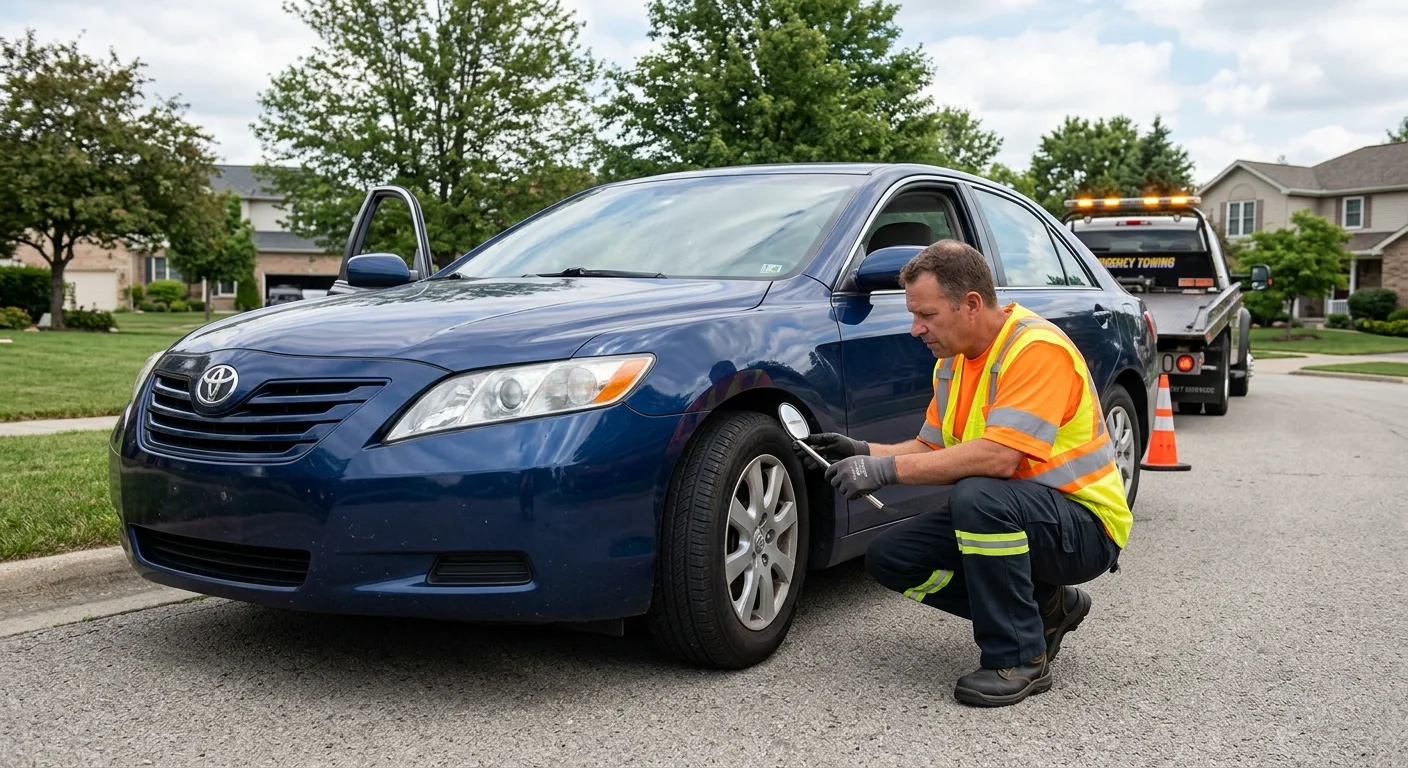
Why neutral matters during loading
Neutral is a loading tool. When a transmission sits in park, many cars hold the drivetrain so the drive wheels will not turn. A method that needs those wheels to roll then stops short. That is why operators ask about the selector before a truck is sent.
You can still move a car that never reaches neutral. Neutral matters when a wheel tied to the drivetrain will travel on the pavement. If those wheels stay off the ground for the trip, the selector can stay in park. A flatbed tow keeps every wheel off the road once the car is on the bed. The operator still has to get it onto that bed first.
Those first few feet are the real work. A car in an open lot off Glenstone, with space behind the bumper, is one kind of job. A car nosed into a downtown Springfield garage stall is another. On the I-44 shoulder between Kansas Expressway and Glenstone, slope and traffic change the plan again. Neutral would let some cars roll toward a lift or up a bed. Without it, the operator plans around locked wheels.
Do not push a car that will not go into neutral. Park is built to hold the vehicle in place. Friends at the bumper will not free a locked drivetrain. A strap to another personal car is a bad idea on Battlefield, on a Nixa driveway, or in an Ozark cul-de-sac. Leave movement to the operator who brings the truck.
Keep people out of travel lanes. Tell dispatch the car will not roll. Wait for the operator to say which wheels they will support.
Keys and selector movement don’t tell the whole story
You have the keys with you. The engine may even crank. The selector still will not move, or it moves in your hand while the dash stays in park. Those are different symptoms. The operator needs the one you can see, not a guess about the failed part.
A live key does not always free the shifter. Many late-model cars use an electronic selector. The battery can run the radio and still refuse a shift request. A cable can bind. A parking mechanism can stay engaged. An electronic parking brake can hold after you think you released it. Name what you see. Skip the diagnosis.
Stay out of the console. Do not pry the shifter, pull trim, or hunt for a hidden override because a video said it would help. Manufacturer steps differ by year and trim. A shortcut that works on one sedan can break another. Forcing the selector can turn a tow into a repair the operator did not plan to do.
Steering lock is a separate check. With the key present, the wheel may still sit turned against a curb on Walnut. It may sit locked off-center in an MSU lot. Report that. A wheel that will not straighten changes how a lift or a winch lines up.
If a warning light or a message appeared when you tried to shift, photograph the dash. A clear photo beats a memory of the icon. If nothing appeared, say that too. A quiet dash is still information.
Drivetrain, wheel position, and access shape the method
The independent operator chooses the method on scene. Drivetrain is the first split. Front-wheel drive, rear-wheel drive, all-wheel drive, and four-wheel drive do not load the same way. A wheel that can stay on the pavement on one car may be a drive wheel on another. That is why a generic “hook the front” instruction fails.
Wheel-lift towing supports one axle and lets the other pair travel on the road. That only fits when the wheels left down can roll without fighting the drivetrain or the parking mechanism. If those wheels are the ones locked in park, a wheel-lift may be the wrong tool for this car. The operator may use a bed, add supporting gear, or change the approach. That call is theirs.
A flatbed versus wheel-lift comparison explains the equipment in plain language. It does not pick the truck for you. A lowered car, a tight Republic driveway, or a stall under a low beam can rule a bed out even when the transmission is stuck. A wide lot near Kearney can make the same car simple. Access is as real as the shifter.
Look at the wheels before anyone arrives. Note whether they point straight, turn into a curb, or sit against a wall. Mention a flat, a cracked rim, or a wheel that looks collapsed. A car on gravel off US-60 needs a different path than a car on the deck of a Springfield garage. Slope matters. So does the distance from the nearest place a truck can sit without blocking a lane.
If you are in a live lane on I-44 or US-65, treat that as a traffic problem first. Call 911 when people are in danger. For cameras and incidents, use the MoDOT Traveler Information Map. MoDOT Motorist Assist can add visibility on the freeway. That patrol does not tow cars to a shop.
Ozark, Nixa, and downtown Springfield are different jobs. A quiet cul-de-sac gives the operator room to line up. A one-way block near Park Central Square may not. Say how much open pavement sits in front of and behind the car. That one detail often decides the first piece of equipment the operator reaches for.
The owner’s manual controls model-specific instructions
Your manual outranks a forum post and a well-meant neighbor. Manufacturers write towing, transport, and shift-lock pages for the exact vehicle. Look under towing, vehicle transport, emergency, or parking brake. If the glovebox copy is there, keep it out for the operator. A photo of the page is enough when the book has to stay with the car.
Use the year, model, and trim. A similar body from two years earlier can carry a different procedure. If you do not have the paper manual, check the automaker’s official site or app for that exact model year. Skip instructions written for a cousin vehicle.
Electric and hybrid models add their own language. Transport mode, tow mode, and neutral are not interchangeable words across brands. Follow the page for your car. If the procedure needs a charged 12-volt system and yours is dead, say so. Do not invent a substitute step.
Share what you found. Share what you could not complete. “The manual wants the selector in neutral, and it will not move” is a complete report. The operator then plans loading that respects that limit. The goal is a method that matches the book.
If the manual and the first plan you hear do not agree, stop and say so before the car moves. A calm pause on a Battlefield Road shoulder beats a drivetrain surprise at the shop.
What to tell the operator before dispatch
Give the facts you can see from the driver’s seat and the pavement. Make, model, and year. Keys are with you. The selector will not go into neutral. Whether the engine runs. Whether any wheel will roll if the car is unbraked. Whether the parking brake released. Where the car sits, and where it needs to go.
Add the scene. Nose-in against a wall. Parallel on a downtown block. On a slope in a Nixa driveway. In a covered garage with a low entrance. On the shoulder of I-44. In an open lot with a full truck-length of space. Mention nearby traffic, a ditch, a curb, or a second vehicle boxing you in.
Send photos if you can: the selector, the dash, each wheel, and the space in front and behind. Those pictures cut down on wrong equipment showing up. Stay out from under the car. Do not try to load it yourself.
Ask the operator to say the plan in plain words once they arrive. Which wheels will be supported. Whether anything has to change before the car moves. If you have a manual page that conflicts with that plan, hold it up and talk it through. You asked for professional judgment. You still own the car.
Stay clear of the truck while it lines up. Keep pets and kids off the pavement. If the car is in a travel lane, wait in a safe place off the road until the operator takes over the scene.
When to call us
Once the selector will not move and the car will not roll, stop trying to free it yourself. Call us at (417) 221-8911. The line takes calls 24 hours a day, and calls are recorded after a notice plays. We match you with an independent local operator, and you get the number before anyone is dispatched.