A disabled food truck needs more than a standard towing request. For food truck towing in Springfield, MO, dispatch needs the vehicle platform, wheel condition, installed equipment, clearance, and exact location before matching the job with an operator.
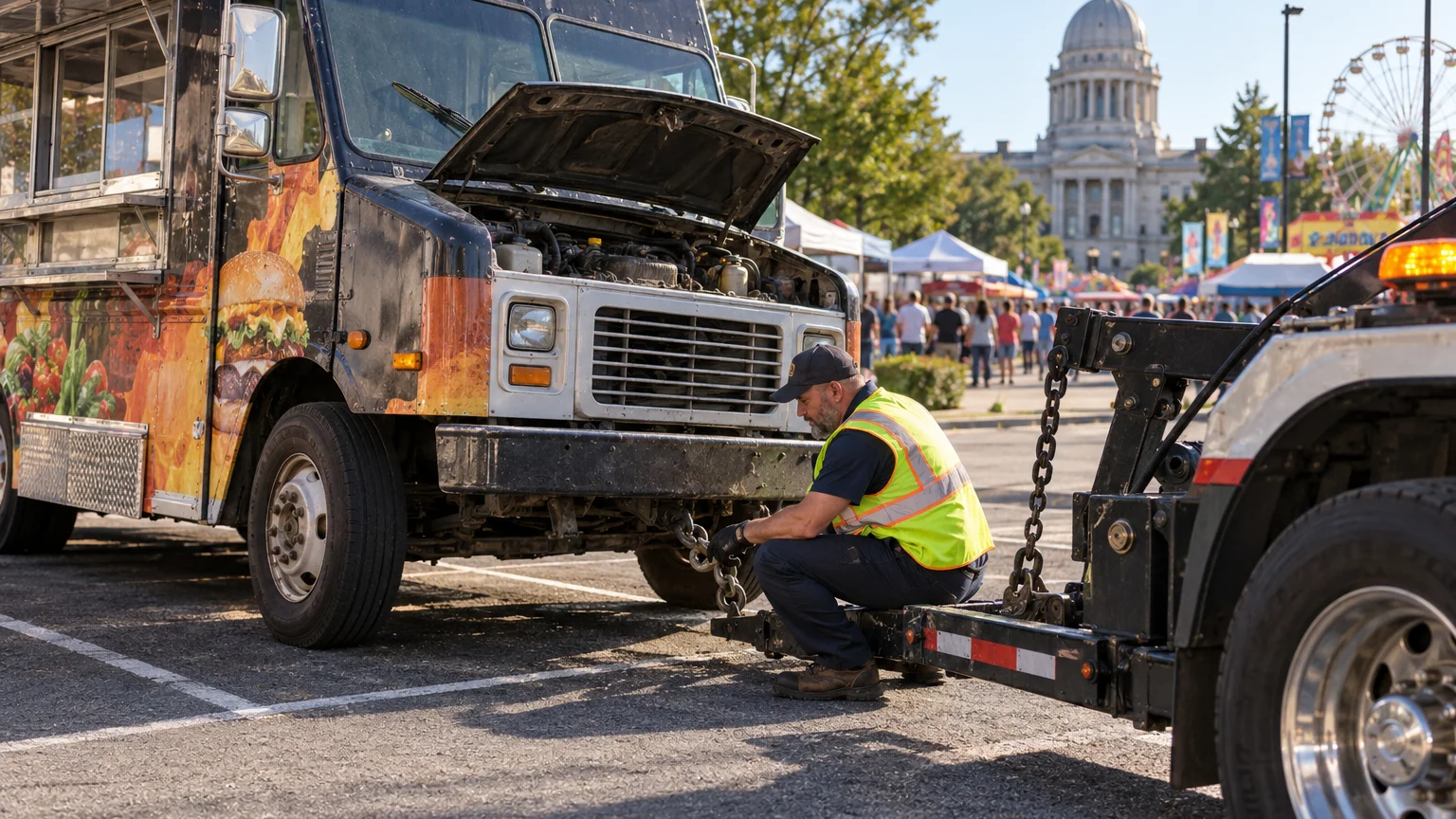
The vehicle platform matters more than the kitchen branding
Start with the truck underneath the kitchen. The business name and menu don’t tell an operator what must be moved.
Food trucks can be built on different commercial vehicle platforms. Some began as vans. Others use a step-van, pickup, cutaway, or larger truck chassis. A trailer-based kitchen presents another request entirely. Dispatch needs the original vehicle information, not only the food truck’s public-facing name.
Send the make, model, model year, and any chassis badge you can find. Include a clear photo of the complete vehicle from each side. A photo of the manufacturer label may also help the operator review the request. Don’t guess at a vehicle specification you can’t confirm. Say that it’s unknown and provide pictures instead.
The correct service can’t be chosen from appearance alone. A compact food truck and a larger modified commercial vehicle may need different loading arrangements. That’s why a food truck request may be reviewed for heavy-duty towing even when the vehicle doesn’t resemble a semi.
This also separates the job from a typical work-van breakdown. A work van usually carries tools or materials inside its original body. A food truck may have a service window, roof equipment, counters, tanks, cooking equipment, and other permanent changes.
Tell dispatch whether the vehicle drives under its own power. Report whether the engine starts and whether the transmission shifts. These details help an independent operator decide what equipment may fit the job. The operator makes the final classification after reviewing the information provided.
Cargo and installed equipment change the request
Describe what remains inside the truck. Food, containers, water, cooking equipment, refrigeration equipment, and supplies can affect how the operator evaluates the vehicle. Dispatch doesn’t need your full inventory. It needs a clear picture of what’s installed and what may move.
Separate permanent equipment from loose cargo. Note anything that’s already shifted, leaning, leaking, or unsecured. Don’t hide a condition because it seems unrelated to the breakdown. The operator needs to know what the vehicle is carrying before accepting the request.
Report exterior additions as well. Common examples may include roof-mounted equipment, vents, signs, awnings, serving shelves, steps, bumpers, and rear-mounted components. Give their location and current position. Say whether an awning or service panel is open, closed, stuck, or damaged.
Fuel and energy details also belong in the request. Tell dispatch what systems are present and where they’re mounted. If the vehicle carries separate cylinders, tanks, batteries, or a generator, identify them without guessing at their size. Send close photos of their mounting points and current condition.
Don’t remove or reposition installed systems merely to make the truck look tow-ready. Instead, tell dispatch what can’t be moved. The independent operator can review those limits before the job is assigned.
Food condition and event obligations remain the owner’s responsibility. We can’t confirm a universal food-handling rule for every breakdown. Requirements may depend on the product, equipment, and business operation. Check with the authority that oversees your business if the breakdown affects food storage or service.
The useful dispatch question is simple: what’s attached, what’s loose, and what has changed since the truck stopped?
Wheel condition determines whether the truck can roll
A food truck that starts but won’t roll presents a different problem from one with a dead engine. Check each wheel area from a safe position and report what you can see.
Tell dispatch whether every tire is inflated. Note a missing wheel, damaged rim, locked wheel, or tire that has separated from the rim. Report visible damage near the axle, suspension, steering, or wheel opening without trying to diagnose it. Photos are more useful than a confident guess.
The parking brake and transmission position matter too. Say whether the parking brake releases and whether the transmission can shift into neutral. If the keys are missing, locked inside, or unavailable, include that fact. Tell dispatch if the steering wheel is locked or if the front wheels point sharply to one side.
Ground clearance can change after a breakdown. A collapsed suspension component, damaged step, hanging panel, or low rear bumper may reduce the space beneath the truck. Photograph the lowest visible point from the side. Include a wider image showing how the vehicle sits on the pavement.
Don’t describe the food truck as “easy to roll” unless you’ve confirmed it. A vehicle may appear level while one wheel remains locked. Conversely, an engine problem doesn’t always mean the wheels are damaged. Dispatch needs each condition reported separately.
This is also where the request differs from box-truck towing on US-60. Similar-looking commercial bodies can have different chassis, modifications, wheel conditions, and clearances.
If the truck left the pavement, say how far. Report mud, gravel, a curb, a drainage edge, or a soft shoulder. A tow and a recovery aren’t always the same request. Clear photos help the operator decide which situation applies.
Event lots and road shoulders need different access
Location details should describe the truck’s surroundings, not just its street address. A food truck parked in a Springfield event lot creates a different access problem from one stopped along I-44 or US-65.
In an event lot, describe the entrance and exit. Note gates, removable barriers, tight turns, parked cars, vendor tents, overhead signs, low branches, and nearby structures. Tell dispatch which end of the food truck faces the open drive. If another vendor blocks the most direct approach, say so before an operator is sent.
Name the person who controls access. That may be the food truck owner, event organizer, property manager, or lot representative. Don’t assume a gate will remain open. Confirm the meeting point and explain any access instruction you received from the property contact.
Downtown Springfield locations may require a different description. Identify the street, nearest cross street, direction of travel, and whether the truck sits in a parking lane, loading area, alley, or private lot. Mention nearby vehicles that limit working space.
For a highway or shoulder breakdown, give the road, direction, and nearest exit or visible landmark. Share a map pin when possible. The MoDOT Traveler Information Map provides current traffic, camera, and incident information for Missouri roads.
A shoulder problem may also need emergency towing coordination. Dispatch still can’t promise an arrival window. Traffic, location, access, and operator availability all affect the request.
Springfield’s road network changes quickly beyond the city. A location near the Kansas Expressway and I-44 interchange isn’t the same as a rural road outside Republic. US-65 toward Ozark, Nixa, and the Branson corridor presents another set of access details. Give the exact location rather than saying “south of Springfield.”
What the business owner should send before dispatch
A short, organized message helps dispatch match the request. Begin with the business owner’s name and a working contact method. Then give the food truck’s exact location and intended destination. If you haven’t chosen a destination, say so.
Send these vehicle details in plain language:
- Original make, model, and model year
- Chassis or platform information shown on the vehicle
- Whether it’s self-propelled or trailer-based
- Whether the engine starts
- Whether the transmission shifts into neutral
- Whether the parking brake releases
- Condition of all wheels and tires
- Position of the steering wheels
- Key availability
- Visible damage beneath or around the vehicle
- Installed exterior and roof equipment
- Loose, shifted, leaking, or damaged cargo
- Lowest visible clearance point
- Ground surface and available approach space
Add photos from the front, rear, and both sides. Include each wheel, the lowest body point, and any damaged area. Take one wide photo that shows the surrounding lot or shoulder. If overhead clearance looks limited, include the obstruction in the image.
Tell dispatch what happened without diagnosing the failure. “The engine stopped while driving” is more useful than naming an unconfirmed engine problem. “The left rear wheel won’t turn” is clearer than saying the axle is broken when you don’t know.
Identify any deadline, but don’t expect an arrival promise. For example, tell dispatch when an event closes its gate or when the property contact plans to leave. That information helps the operator evaluate access. It doesn’t create a guaranteed response window.
The operator sets the price for the work. You get the number before anyone is dispatched. Describe the entire situation before that point, since missing equipment, blocked access, or a non-rolling wheel can change the request.
Keep the truck available for inspection. Don’t send an outdated photo from before the breakdown. Current pictures let the operator review the vehicle as it sits now.
When to call us
Call when the food truck can’t move safely under its own power or needs commercial towing equipment. We’ll use your vehicle, wheel, equipment, and access details to line up an independent local operator, and the line takes calls 24 hours a day. Call us at (417) 221-8911.