The right tow setup depends on what can roll without causing trouble. A flatbed carries the whole car, while a wheel lift raises one axle. Neither method is automatically better for every vehicle or location.
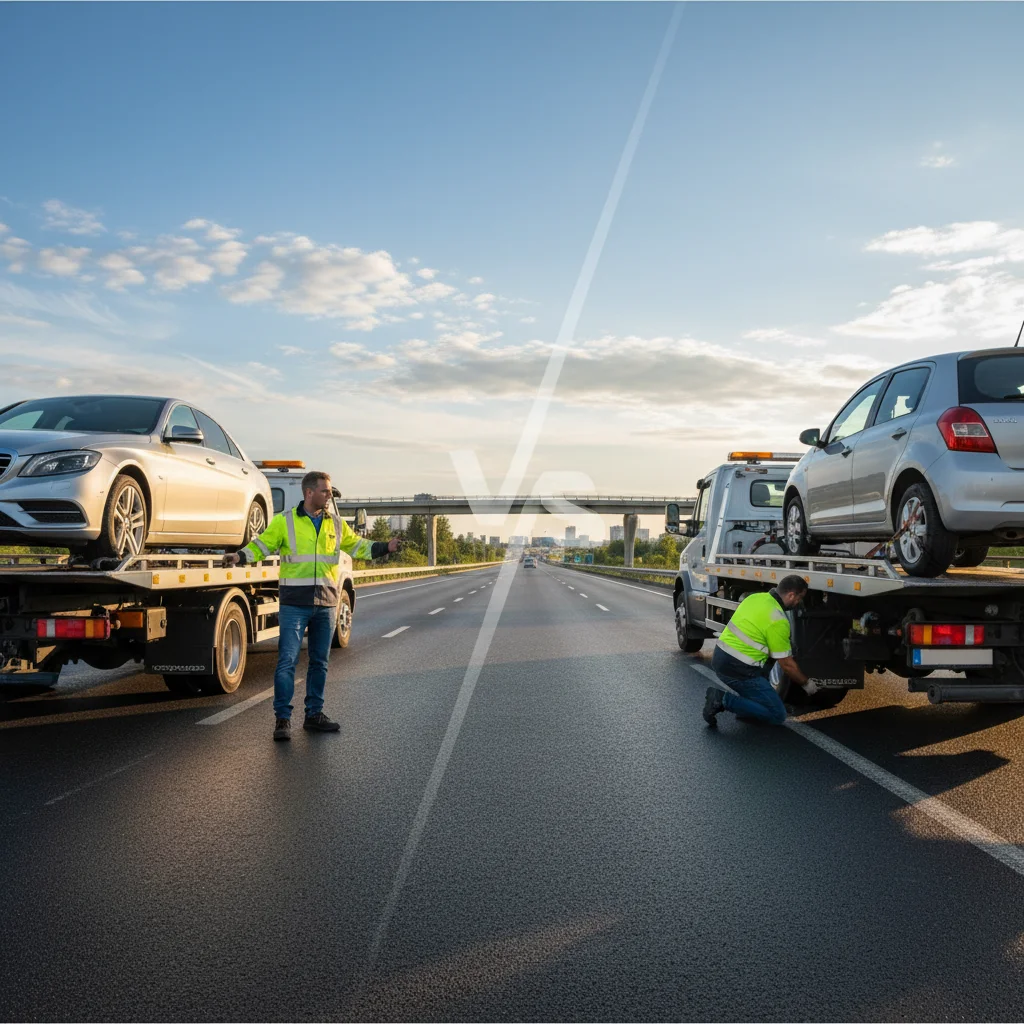
What each truck actually lifts
A flatbed carries the vehicle with all four wheels off the road. The operator angles the bed, loads the car, and secures it for transport. This approach separates the tires, wheels, and drivetrain from the pavement during the trip.
Our flatbed towing service connects drivers with operators who can assess that loading process. A flatbed is often considered when the car shouldn’t roll, has limited clearance, or needs a specific transport method. The final decision still depends on the vehicle and pickup site.
A wheel lift raises either the front or rear axle. The other two wheels remain on the road during transport. Its lifting assembly supports the tires instead of pulling the vehicle by a bumper.
Wheel-lift towing can work well when the raised axle matches the drivetrain requirements. The wheels left down must also be able to roll as the manufacturer allows. Their tires, suspension, and steering condition all matter.
Location changes the calculation. A flatbed needs suitable space for its loading angle. That space may be available along a wide commercial lot near Glenstone Avenue. It may be tighter inside a downtown garage or a narrow Republic driveway.
This is the basic flatbed vs wheel-lift towing distinction: one carries the entire car, while the other carries one axle. The operator then matches that difference to your vehicle, its condition, and the space around it.
Drivetrain and wheel condition decide most of it
Start with the drivetrain. Tell the operator whether the car is front-wheel drive, rear-wheel drive, all-wheel drive, or four-wheel drive. Don’t guess based only on the badge. Trim levels of the same model may use different drivetrains.
With a wheel lift, the operator needs to know which wheels drive the car. That helps determine which axle could be raised and whether the remaining wheels may roll. The current owner’s manual is the authority for your specific vehicle. Check its towing or roadside-emergency section when available.
Neutral isn’t a universal answer. A car may shift into neutral but still have manufacturer restrictions on how it can be moved. Electronic parking brakes, locked steering, and vehicle-specific transport settings can also affect the plan. Describe what the car is doing instead of trying to diagnose it over the phone.
Wheel condition matters just as much. Report a flat tire, bent wheel, broken suspension part, or wheel that won’t turn. Mention whether the car was in a collision. A vehicle that looks level can still have damage near one corner.
The operator also needs to know whether the steering responds. A car with wheels turned hard toward a curb presents a different loading situation than one pointing straight. Missing keys can change what can be unlocked, released, or shifted.
These details matter across Springfield’s road network. A disabled car beside I-44 presents different access than one in an Ozark shopping center. A car on a gravel lane outside Rogersville differs from one near the Kansas Expressway interchange. The tow method has to fit both the vehicle and the pickup position.
Low clearance, EVs and all-wheel drive
Low clearance makes loading geometry important. Tell the operator about lowered suspension, a long front splitter, side skirts, or other parts close to the pavement. Photos can help show the distance between the body and the ground.
A flatbed may be the likely choice when the entire vehicle needs to ride above the roadway. However, the operator still has to inspect the approach. A steep driveway, parking structure, ditch edge, or uneven shoulder can change how the vehicle can be loaded.
Classic and collector cars deserve the same careful description. Age alone doesn’t determine the truck. Ground clearance, tire condition, steering, brakes, and manufacturer guidance all shape the decision. Our guide to classic car towing in Springfield explains what owners should share before transport.
Electric vehicles require model-specific instructions. Don’t assume every EV uses the same tow setting. The current owner’s manual should identify the approved transport method and explain any transport mode. A dashboard setting doesn’t override the manual’s limits.
Tesla owners can review our Springfield guide to Tesla flatbed towing before calling. Have the exact model and model year ready. Also report whether the vehicle has power and whether the display responds.
All-wheel-drive vehicles need similar care. Tell the operator the drivetrain rather than requesting a truck based only on preference. The operator can compare the vehicle details with its current transport instructions.
Pickup conditions remain part of the choice. US-65 shoulders, Branson-bound traffic, Ozarks gravel roads, and low-water crossing approaches don’t offer identical working space. Give a precise location and explain where the car sits. The operator makes the final equipment decision after reviewing those details.
When a wheel lift keeps the job simpler
A wheel lift can be a practical choice when the vehicle and location allow it. It may need less straight loading room than a tilted flatbed. That can matter in parking structures, compact lots, alleys, and narrow residential drives.
The car still needs the right conditions. The axle left on the road must be able to roll as the manufacturer permits. The tires and wheels on that axle also need to be described accurately. Steering position and parking-brake status matter too.
For example, a vehicle parked tightly between other cars may not offer a clear flatbed approach. A wheel-lift operator may have another workable setup. The same can apply near crowded apartment lots or downtown Springfield parking areas. That doesn’t mean a wheel lift is always the answer in confined spaces. The operator needs to see the access and understand the vehicle.
Don’t treat the simpler setup as a promise about price or timing. Quick Tow Springfield doesn’t set the operator’s prices. The independent operator provides the price before anyone is dispatched.
Distance alone doesn’t settle the equipment question either. A short trip can still require a flatbed when wheel condition, drivetrain instructions, or clearance calls for one. A longer trip doesn’t automatically rule out a wheel lift if the vehicle manufacturer allows that transport method.
The useful question isn’t which truck is better overall. It’s which setup fits this car in this position. Accurate details help the operator answer that before heading toward you.
What to say before anyone is dispatched
Begin with the exact location. Include the road, direction of travel, nearby exit, business name, or parking level. Around Springfield, “on I-44” isn’t precise enough. Say whether you’re near Glenstone, Kansas Expressway, or another marked exit.
Describe the car next. Give its year, make, model, and trim when known. State the drivetrain if you can confirm it. If you can’t, say so. The operator can ask for another detail or direct you to the owner’s manual.
Then explain the vehicle’s current condition:
- Does the engine start?
- Can the transmission shift into neutral?
- Does the steering wheel turn?
- Is the parking brake engaged or stuck?
- Are any tires flat, missing, or visibly damaged?
- Does each wheel appear straight?
- Is the car lowered or fitted with low bodywork?
- Was it involved in a crash?
- Are the keys present?
- Is an EV screen or transport setting available?
Describe the ground around the car as well. Mention a ditch, mud, gravel, curb, steep driveway, low garage ceiling, or blocked access. In the countryside outside Springfield, include narrow lanes and low-water crossing approaches. Near Nixa or Ozark, say whether you’re on US-65, a frontage road, or inside a business lot.
A photo can clarify wheel position, body clearance, and available loading space. Take it only when you can do so without stepping into traffic. If you’re already away from moving vehicles, the MoDOT Traveler Information Map can show current traffic and incident information on Missouri routes.
Say where the vehicle needs to go. A repair shop, home driveway, dealer, or another destination may have different access. Mention gates, garage entrances, or limited unloading space before dispatch.
You don’t need to choose the truck alone. Give the facts and let the independent operator select the method. The operator confirms the towing approach and price before dispatch.
When to call us
If the car won’t roll, steer, or clear the ground normally, stop trying to move it yourself. Our line takes calls 24 hours a day, and calls are recorded after a notice; we’ll take the details and line up an independent local operator, who confirms the method and price before dispatch. Call us at (417) 221-8911.