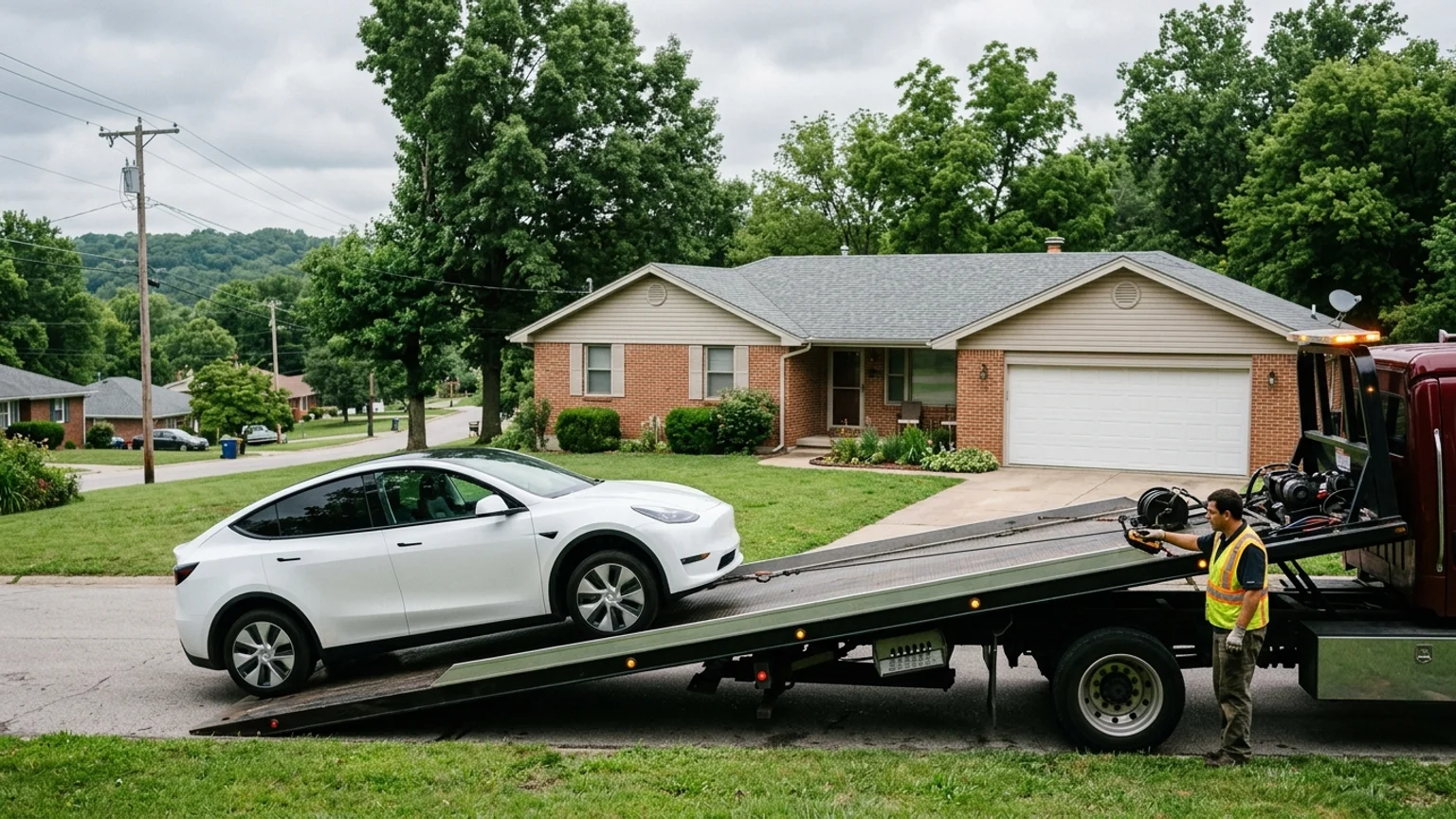
Tesla flatbed towing isn’t a preference, it’s what the drivetrain requires. A wheel lift leaves two tires rolling, which can turn parts of the electric drivetrain. For routine road transport, the clear choice is a flatbed carrying all four wheels.
Tesla flatbed towing starts with the drivetrain
A gasoline car and a Tesla can look similar from the curb. Underneath, they handle forced wheel movement differently.
An electric motor remains mechanically connected to the wheels it drives. When those wheels turn, the motor turns with them. That can generate electrical current and send it through systems that weren’t expecting it during a tow. Turning the car off doesn’t make that mechanical connection disappear.
That distinction answers the common question, “Can Teslas be towed normally?” They can be transported, but they shouldn’t be dragged with driven wheels on the pavement. A standard wheel lift raises one axle and leaves the other rolling. That setup doesn’t provide the isolation an electric drivetrain needs.
A flatbed changes the situation. The operator loads the complete vehicle onto a level carrying deck. Once secured, none of the Tesla’s wheels must rotate with road speed. The truck carries the car instead of making the car roll behind it.
This also matters when the battery is empty or the car won’t respond. A powerless screen doesn’t tell an operator how the drivetrain is positioned. The exact loading procedure can differ by model and condition. The operator should identify the model and follow its current manufacturer instructions.
Our Tesla and EV towing service connects Springfield-area drivers with operators equipped for that job. Tell us it’s a Tesla immediately. That one detail affects the truck, loading plan, and information the operator needs.
Tow dollies and tow bars are not a workaround
A tow bar keeps the disabled car rolling behind another vehicle. That directly conflicts with the goal of keeping a Tesla’s wheels stationary. It also turns a roadside problem into a moving vehicle combination that the driver must control.
Small consumer dollies aren’t a simple answer either. They add more attachment points, more moving parts, and more chances for a tire to contact the road. Improvised equipment can also shift while crossing uneven pavement or entering a ramp.
Professional wheel dollies are different equipment. An operator may use them during a specific recovery when the current manufacturer procedure permits it. They can also help reposition a car before loading. That doesn’t make a wheel lift alone the right transport method.
The useful distinction is simple:
- A wheel lift alone leaves one axle on the road.
- A tow bar leaves the vehicle’s wheels rolling.
- A flatbed carries the whole car above the road.
- Specialized dollies require the correct equipment and procedure.
Our guide to flatbeds compared with wheel lifts explains where each truck type fits. Wheel lifts remain useful for many conventional vehicles. They aren’t the default choice for transporting a Tesla.
Don’t try to solve the problem by guessing which axle is safe to roll. Tesla models and configurations differ. The car may also have collision damage, locked wheels, or a failed electrical system. Those conditions change how it can be positioned and loaded.
If a flatbed can’t approach the car directly, tell the operator before dispatch. A narrow garage, steep driveway, gravel shoulder, or blocked parking space may require a different recovery plan. The answer should come from the operator and the current manufacturer instructions, not a roadside experiment.
What a clean load looks like on a Springfield shoulder
Good Tesla flatbed towing begins before the cable moves. The operator needs enough working room to lower the deck and align it with the car. That can be difficult on a narrow shoulder or beside fast traffic.
I-44 is the clearest local example. More than 65,000 vehicles use its Glenstone-to-Kansas Expressway segment each day. About 23 percent are semi-trucks. Standing beside a disabled car there puts you close to heavy, fast-moving traffic.
Move away from traffic if you can do so safely. Don’t stand between the Tesla and the flatbed. If the vehicle can’t leave a live lane, contact 911. You can also check the MoDOT Traveler Information Map for current incidents, traffic, and road conditions.
A proper loading plan keeps the car controlled from pavement to deck. The operator identifies the exact model, checks its current transport procedure, and selects the approved loading points. Soft straps help secure the vehicle without treating exposed bodywork as an attachment point.
Low ground clearance affects the deck angle. A dead or damaged Tesla may also need extra positioning work before it can roll onto the bed. That means loading can take longer than hooking up an ordinary sedan. It isn’t a reason to drag the car or rush the setup.
Location changes the approach. Near the Kansas Expressway diverging diamond, traffic arrives from several directions. Along US-65 toward Branson, speed and limited shoulder space matter. On gravel roads outside Springfield, a flatbed needs firm ground and enough distance to ramp out.
The same mechanical answer applies in every location. All four wheels should travel off the pavement. The local road decides how the operator creates room to do that. Our flatbed towing page explains how we match the vehicle and location with an equipped operator.
What to say in your message when you call
Start with the words “Tesla” and “flatbed.” Don’t wait until the end of the message to mention the vehicle is electric. The truck type is part of the first dispatch decision.
Our line begins with a greeting and recording notice, then takes your message. Calls are recorded and transcribed after that notice. Leave the details in a calm, clear order:
- Your Tesla model, if known
- Your exact location and direction of travel
- Whether the car is in a traffic lane or parking space
- Whether any wheels appear locked or damaged
- Whether the vehicle responds to its controls
- Whether collision damage or debris blocks loading
- Whether the tow destination has been selected
- Any access problem, including a garage or gravel shoulder
Road descriptions matter around Springfield. “I-44 westbound near Kansas Expressway” is more useful than “near the highway.” On US-65, include your direction and the nearest confirmed exit. In a parking structure, include the posted clearance if you can read it without leaving a safe place.
Don’t guess about damage you can’t see. Say what happened and what the car is doing now. A curb strike, flooded crossing, empty battery, and collision can require different loading decisions.
Remove loose valuables if you can access them safely. Keep the key card, phone key, or other available access method with you. Don’t crawl beneath the vehicle or force a locked wheel. The operator can determine the next step after reviewing the car’s condition.
The operator sets the price. You get the number before anyone is dispatched. Our guide to EV tow costs in Springfield explains which job details can affect that number without promising a flat rate.
When to call us
Call when the Tesla can’t move safely under its own power or would need its wheels dragged. We’ll use your recorded details to line up an independent local operator with suitable flatbed equipment, and the line takes calls 24 hours a day. Call us at (417) 221-8911.