A rear tire that goes down on US-65 south of Battlefield is a different problem than a car sitting on a spare. You’ve got two wheels, no spare on most bikes, and a machine that will not sit on three corners while you think. The useful call is motorcycle flat tire towing or roadside help, and that choice starts with the wheel, the road, and your owner’s manual.
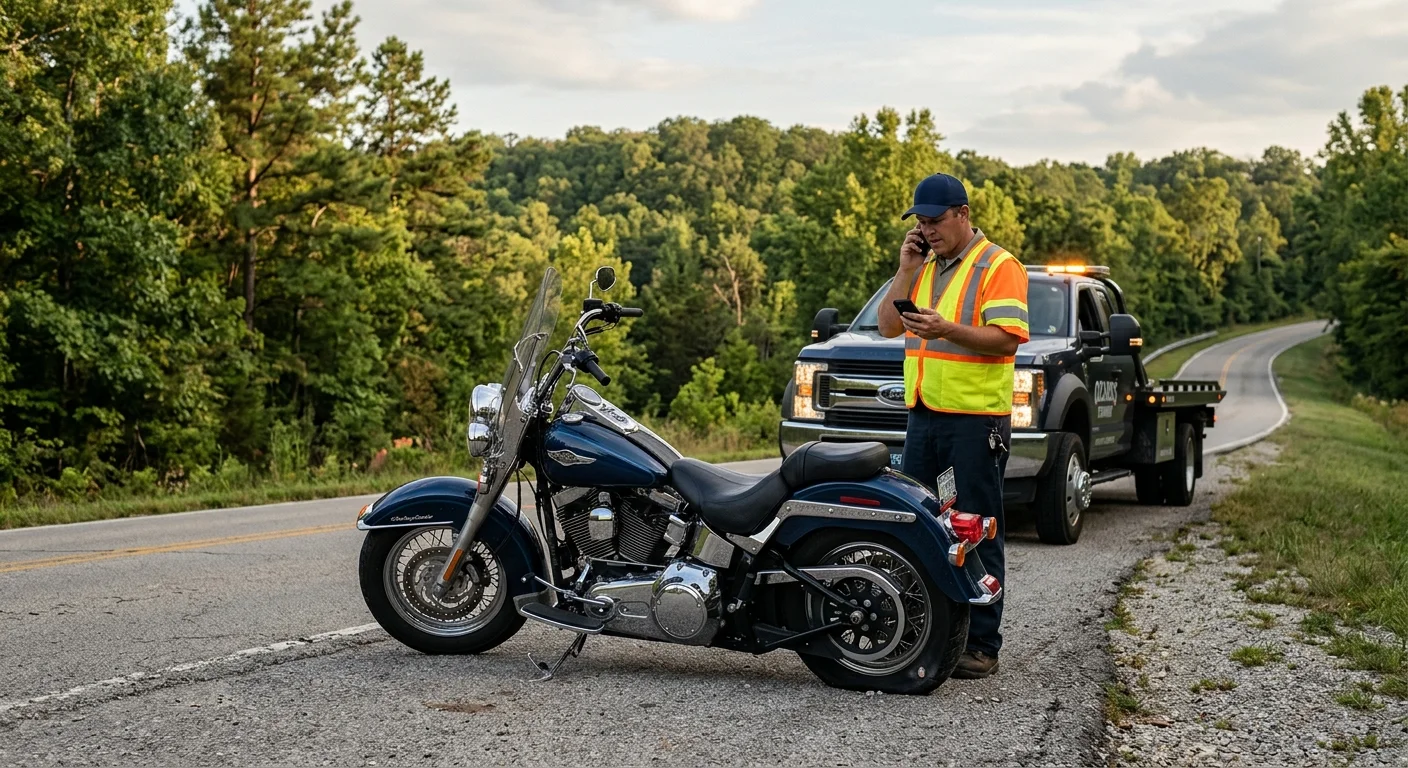
A motorcycle tire call isn’t a car tire call
A car with a flat can sit on four corners while someone works. A motorcycle is a balance machine. Once a tire is down, the bike is harder to hold, harder to roll, and easier to drop. That is why motorcycle towing is its own request, not a smaller version of a car tire job.
Most cars carry a spare or at least a space-saver. Most motorcycles do not. If you’re on I-44 through Springfield, or on a two-lane toward Nixa or Ozark, you usually cannot mount a spare and roll. The question is whether the bike can be helped in place, or whether it has to leave the road on a truck.
Roadside assistance for a car tire is often a change-out. For a motorcycle, on-scene help is narrower. The operator who arrives can say what they can do on that shoulder. They cannot promise a plug, a tube, or a shop-level repair from the truck. If that work is not available on scene, the next step is transport.
A car can sometimes creep a short distance on a ruined tire. Doing that on a motorcycle loads the remaining tire, the rim, and your ability to steer. This page is not telling you to ride it in. If the tire is down, treat the bike as disabled until you and the operator agree on a plan.
The Springfield metro is not one road type. A flat in a lot off Glenstone is a different pickup than a bike on the US-65 funnel toward Branson, where roughly 9-10 million visitors a year share the corridor. Same symptom, different access. Name the town and the road.
For cars, we already walk through mobile flat tire repair or a tow in Springfield. A motorcycle needs its own details, because the machine and the pickup are different.
Wheel condition changes the transport request
Before anyone is dispatched, the useful fact is the wheel, not just “it’s flat.”
A tire that lost air and still sits round on an undamaged rim is one kind of call. A rear tire with a torn sidewall, a cracked rim, or a wheel that no longer turns true is another. The second kind is a transport request. Riding or rolling on a bent wheel can make the damage worse. We are not going to walk you through a repair. Your shop and your owner’s manual own that part.
Front versus rear matters for the operator. A flat rear tire changes how the bike sits and how it will be moved. A flat front tire changes steering, and how far you can even roll the bike onto a paved shoulder. Tell dispatch which end is down.
Photos help. One of the tire where it meets the road. One of the rim. One of the whole bike from the side, so the operator can see if it is on the sidestand, on a crash, or in the grass. That is the same habit we ask for in motorcycle breakdown towing details: show the machine, don’t just name the symptom.
If the wheel will not rotate, say so. If the bike is on its side, say so. If you already tried to move it and the rim dug into chipseal or gravel, say that too. Those notes change whether the operator plans a simple load or a recovery-style pickup. We do not publish strap lists or loading steps here. The operator who does the work follows their own equipment and your bike’s limits.
Do not guess at a shop diagnosis over the phone. “Rear tire down, rim looks straight, I’m on a paved shoulder on Kansas Expressway” is enough to start. “I think it’s a nail and you can plug it” is a guess. Leave the method to the person who sees it.
Road surface and shoulder access shape the pickup
Ozarks roads are not one surface.
A paved shoulder on I-44, including the Glenstone-to-Kansas Expressway stretch, gives an operator room to set up off the travel lane. Kansas Expressway at I-44 is North America’s first diverging diamond interchange, and that geometry still crowds a disabled bike if you stop in the wrong place. A motorcycle on the white line with no shoulder is a tighter job. If you can get the bike fully out of the lane without riding the flat, do that. If you cannot, stay with it in a visible, safe spot and say that the lane is involved.
Gravel is common once you leave Springfield city streets for Christian County and the farm roads around Ozark, Nixa, and Republic. Soft gravel, a crown in the road, and a drop to the ditch all change how a two-wheeler can be approached. Low-water crossings and narrow Ozarks lanes add the same problem: the truck needs a place to sit that is not in oncoming traffic. Webster County two-lanes and the US-60 towns out toward Aurora work the same way. Say gravel if it is gravel.
Downtown Springfield, around Campbell and Grand or along Glenstone, is curb, driveways, and traffic. Campbell and Grand is the city’s highest-crash intersection in the 2025 crash set, so a stopped bike there is a visibility problem, not just a tire problem. The operator needs to know if you’re in a lot, on a side street, or against a curb with no bike lane. A Republic or Battlefield residential street is quieter, but still needs a clear description of driveways and parked cars.
If you’re on the state system, MoDOT’s Traveler Information Map shows incidents and lane conditions. On the interstate, MoDOT Motorist Assist is a freeway courtesy patrol based at the Transportation Management Center of the Ozarks. It can help with visibility. It does not tow a motorcycle to a shop. Do not wait on that patrol as if it were a wrecker. The City of Springfield also runs a volunteer Motorist Assist Program through SPD’s volunteer unit. That program is roadside cover, not a tow. Never treat either as a shop run.
Tell dispatch the surface in plain words: paved shoulder, gravel, grass, chipseal, wet, or on a slope. Mention guardrail, a ditch, or a mailbox if those are in the way. Those details shape the pickup more than the word “flat” does.
The motorcycle manual controls model-specific guidance
Your owner’s manual is the authority for your bike. This page is not.
Some motorcycles have a center stand. Some do not. Some fairings sit low. Some bags hang wide. Some wheels are easy to see. Some are buried behind plastic. None of that is something a dispatch page can invent for every make. If the manual says do not operate the bike with a deflated tire, follow that. If it describes a specific way the bike should be supported, that is the manufacturer’s instruction, not ours.
We will not tell you to remove a wheel on the shoulder. We will not tell you to ride to the next exit on a shredded rear. We will not list torque specs, tube sizes, or tire pressures. Those live in the manual and at the shop that knows the bike.
What you can do is read the sections on tires, stands, and transport before you need them, and keep a photo of the VIN and the tire size in your phone. When you call, the make, model, year, and those tire sizes let the operator know they are lining up motorcycle equipment, not a car wheel-lift by habit.
If the manual is silent on towing, that silence is useful too. It means you should not invent a method. Ask for motorcycle towing and let the operator explain how they will move this bike, on this road, with the wheel in the condition you described.
Aftermarket parts matter. A lowered suspension, a custom exhaust that sits low, or bags that block a lift point are facts the operator needs. They are not a reason to skip the manual. They are extra constraints on top of it.
Missouri does not require towing coverage on a motorcycle policy. Roadside help is an optional add-on set by your insurer. Check your own policy if you have a rider. State law does not decide whether this call is covered.
What the rider should share before dispatch
Give the person taking the message a picture of the scene, not a vibe.
Start with location. An I-44 mile marker, a US-65 exit, a named street in Springfield, or the last town you passed toward Branson, Hollister, or on US-60. “South of Ozark on a gravel road off the highway” is better than “somewhere in the Ozarks.”
Then the bike: year, make, model. Color helps when the operator is looking for you. Say if it is a cruiser, sportbike, dual-sport, or trike, because those sit and load differently. We still will not prescribe the load. We will get the right kind of operator on the request.
Then the failure: front or rear, air gone or still holding some, rim straight or not, sidewall intact or torn. Say whether the bike is upright. Say whether you can hold it or it is already down.
Then access: paved or gravel, shoulder width, slope, traffic speed, night or day. If you have a photo of the tire, the wheel, the road surface, and the space beside the bike, send those. That set lets an independent local operator decide help versus transport before they roll.
Say where you want the bike to go if it cannot be helped on scene: a Springfield shop, a garage in Nixa, a dealer, or home. The operator sets the price for that run. You get the number before anyone is dispatched. Quick Tow Springfield is a referral service. We match you with an independent local operator. We do not own the truck and we do not set the total.
If anyone is hurt, or the bike is in a live lane after a crash, that is a different call. Use 911. A flat tire on a quiet shoulder is the job this page is for.
When to call us
Once the tire is down and the bike cannot be moved on its own, this stops being a do-it-yourself job. Call us at (417) 221-8911. The line takes calls 24 hours a day, every day. Calls are recorded after a notice plays, and we dispatch an independent local operator to you.