Fall rain on Greene County gravel can put water over a crossing that was dry at breakfast. A car stuck in a low water crossing, or just beyond it, is a wait-or-recover call from high ground. Stay there and treat moving water as the hazard.
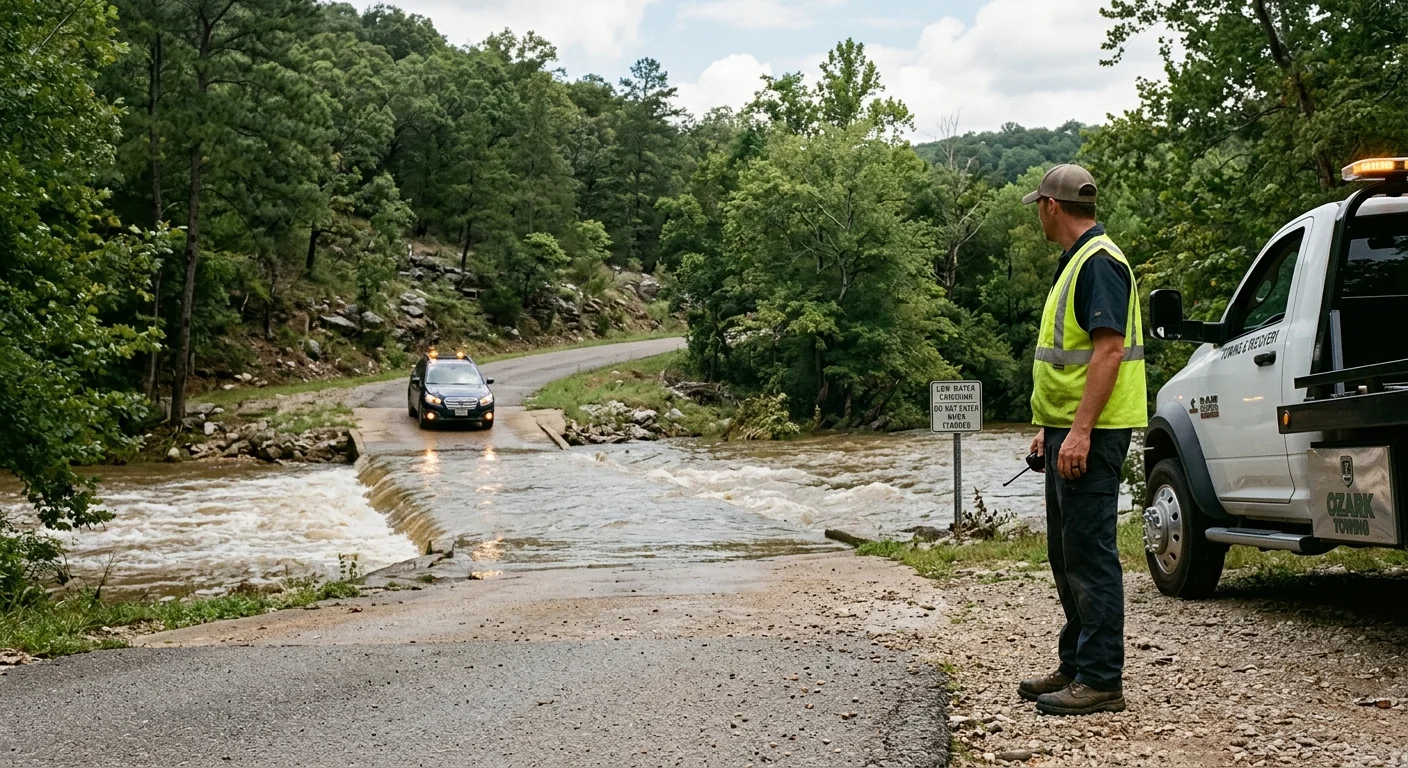
Do not walk or drive back into moving water
If you already made it to the far bank, stay there. If you stopped short of the water, stay there too. Walking back in for a bag or a bumper check is how people get swept. Moving water hides drop-offs, scrap, and the next rise.
Don’t drive through it a second time. Another pass won’t free a car stuck in a low water crossing. It can stall the engine or shove the car sideways. Put the hazards on from dry ground. Get every passenger to high ground. If someone is still inside a car in rising water, call 911. That’s a rescue. It comes before any tow request.
Missouri State Highway Patrol and the county emergency offices handle water-over-the-road calls. A specific Greene County or Christian County low-water procedure could not be confirmed. Check with those offices for the road you’re on. Springfield’s volunteer Motorist Assist Program offers roadside cover in town. MoDOT’s Motorist Assist / Emergency Response is a freeway courtesy patrol based at the Transportation Management Center of the Ozarks. Neither tows a car off a farm-road crossing. Read the MoDOT Motorist Assist program page if you’re on a state freeway. A gravel dip south of Nixa is a different system.
If you’re on a numbered state route, the MoDOT Traveler Information Map can show closures and incidents. Many Greene and Christian County gravel roads never appear there. Your pin and your photos will do more than a map refresh.
Keep kids and pets with you on the bank. Keep the group on one side of the water.
A stuck car and a flooded car are different jobs
A car that nosed into a crossing and stopped with a dry cabin is a recovery problem. A car that took water over the floor, into the air intake, or through the doors is a flooded car. Those are different jobs.
Don’t restart it to see what happens. Don’t pop the hood in standing water. Don’t hook a strap to a bumper and pull from a pickup on the bank. A car stuck in Ozarks mud is soil, ruts, and traction. A ditch recovery is a slope and a shoulder. A low-water crossing is current, a hidden bottom, and electronics that may already be wet.
From high ground, say what you can see. Water at the rockers. Water at the windows. Water still moving. Water already dropping. An independent recovery operator needs that split before they roll. Flooded car recovery in the Ozarks often means the car comes out on a flatbed after an accident-style recovery.
Tell dispatch if the cabin is dry. Tell them if you smelled wet carpet or saw water at the seats. That split is how they know whether this is a simple winch or car in water towing in Springfield MO.
If the engine ingested water, moving the car under its own power can do more damage. Let the operator decide how it leaves. You need to stay dry and describe the scene.
Cabin dry, tires in the dip, current gone: still wait. Water can return after a cell moves through Nixa or Ozark while you stand in sunshine. The watershed is bigger than the puddle in front of you.
Greene and Christian County crossings are not interstate shoulders
Downtown Springfield, the I-44 freight spine, and a low-water crossing off a gravel road in Christian County are three different recoveries. On I-44 you have lanes, a shoulder, and often a MoDOT camera. On a farm road south of Ozark you may have one lane of concrete, no lighting, and trees tight to the bank.
Republic, Nixa, and Ozark sit on different road networks than Kearney and Glenstone. A truck that can work a Battlefield Road shoulder may not fit a narrow crossing with no turnaround. Distance includes whether the operator can stage on high ground without blocking the only way in.
Don’t stand in the travel lane to flag traffic. Rural Ozarks roads run fast between the trees. If a second car is on dry pavement, park it well off the path with hazards on. If your only car is in the water, you’re a pedestrian. Get back from the edge.
Fall rain on Greene County gravel is common enough that this question comes up without a named storm. If water is over the crossing, treat the road as closed. We could not confirm a published water-depth rule for Greene or Christian County crossings. If it’s over the road, you don’t drive it, and you don’t wade it.
US-65 south of Springfield funnels toward Branson, with roughly 9-10 million visitors a year. That corridor is a freeway. The crossings that trap cars are usually the county and farm roads that feed it. If you left US-65 for a shortcut and found water, say that in the request.
Recovery and towing may be two separate requests
Getting the car out of the channel is recovery. Moving it to a shop, a driveway, or a lot is towing. They can happen in one visit. They’re still two parts of the work. The operator prices them as the scene requires.
You get the number before anyone is dispatched. Quick Tow Springfield does not set that number. We’re a referral line. We match you with an independent local operator. We don’t own wreckers. We don’t run a yard.
Ask for accident recovery when the car has to be winched or lifted off a bottom, a bank, or a flooded pad. A winch out from a low-water crossing in Missouri is a recovery request first. Ask for emergency towing when the car is already on pavement and only needs a ride. If you’re not sure, describe the scene so the request can be sorted.
A flooded car often needs a flatbed once it’s on dry ground. Fluids, electronics, and a locked drivetrain change how it loads. Don’t assume it will roll. Tow it as a disabled vehicle and let a shop inspect it.
If law enforcement closes the road, follow that. We could not confirm a county-by-county script for who must call the wrecker at a flooded crossing. If a deputy or a trooper is on scene, ask them what they need from you.
Personal belongings stay with the car in a normal tow. If you already have your people, keys, and ID on the bank, that’s enough.
What photos and location details to share from high ground
Stand where you will not slide in. Then shoot what the operator cannot see from a map pin.
Photograph the crossing from upstream and downstream if you can do it from the bank. Show the water line on the car: tires, rockers, doors, hood, windows. Show whether water is moving or standing. Show the approach: gravel, concrete pad, drop into the channel, trees, fence, and any place a truck could stage. Show the plate if it’s visible from dry ground. Don’t climb on the car.
Drop a map pin. Then say the nearest town, the road name on the sign, the last paved road you left, and which side of the water you’re on. South of Ozark, off the farm road, east bank is better than near Springfield. A run that starts on Kearney is not a run that starts on a Christian County gravel lane.
Name landmarks you can actually see: a church, a low-water crossing sign, a bridge you didn’t make, a cemetery, a farm gate. Skip a creek name if you’re not sure. A wrong creek name sends the truck to the wrong dip.
Tell them occupancy: nobody in the car, pets out, engine off, keys with you. Tell them if 911 already has the road. Tell them whether the water rose while you watched. Fall cells in this part of the Ozarks can reload a crossing after it looks like it dropped.
If you have signal, stay on high ground until the operator is in contact. Keep the call factual. Depth as over the hubcaps or at the door is enough. We will not quote equipment ratings.
When to call us
Once people are on high ground and the car is in the crossing, this is no longer a neighbor-with-a-chain job. Call us at (417) 221-8911. The line takes calls 24 hours a day, every day, a notice plays, the call is recorded, and we dispatch an independent local recovery operator to you.