A vehicle that has left the pavement may need recovery, transport, or both. Recovery returns the car from the ditch to an accessible surface. Towing carries it away when it can’t continue under its own power.
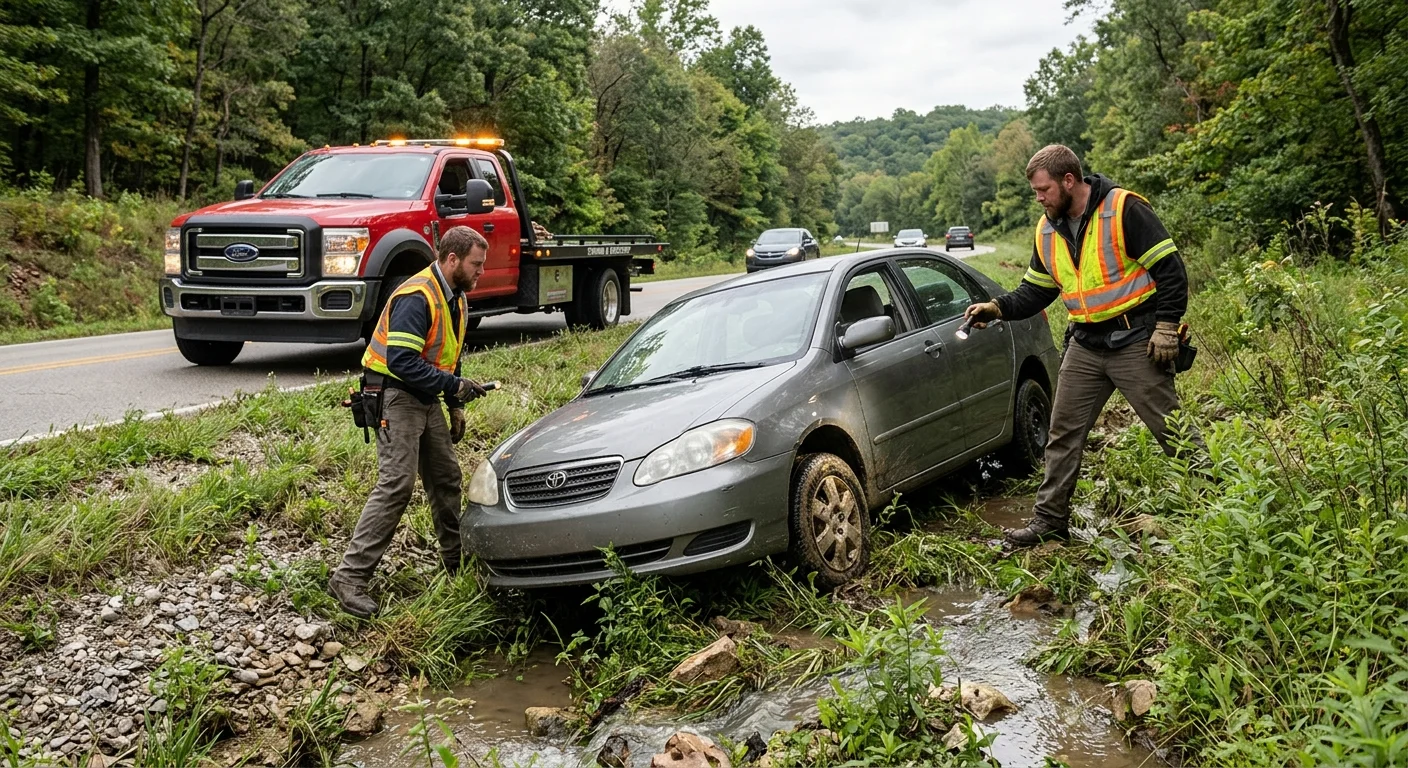
Start with the car’s exact position
The deciding detail isn’t simply whether the tires are muddy. It’s where the car rests relative to the road, shoulder, slope, and nearby obstacles.
Start with a plain description. Say whether all four wheels left the pavement. Note whether the car is upright, leaning, nose-down, or sideways. Tell the operator if a wheel is hanging over a drainage edge. Mention a fence, tree, culvert, guardrail, sign, or parked vehicle nearby.
Location details matter just as much. On I-44, provide your direction of travel and the nearest exit. On US-65, explain whether you’re north or south of Springfield. Around Nixa, Ozark, Republic, and the surrounding countryside, give the road name and nearest crossroad. A dropped map pin can help distinguish the correct side of a divided highway.
Also explain how the car reached that position. Sliding from pavement into a ditch is different from sinking while parked on soft ground. If the wheels are mainly buried in mud, the guide to an Ozarks mud winch-out or tow covers that decision more closely.
Don’t try to diagnose the whole job. Describe what you can see. The independent operator can assess the recovery method and transport needs from those details.
If anyone is injured or the vehicle creates an immediate danger, call 911 first. Follow directions from responding authorities before arranging private service.
Recovery and transport solve different problems
Recovery changes the vehicle’s position. Towing moves the vehicle from the scene to another destination. A car in a ditch may need either service, but many situations involve both steps.
A recovery-only request can make sense when the operator retrieves the car and determines that transport isn’t needed. A tow-only request fits a vehicle that is already accessible but can’t be driven. When the car is below the shoulder, behind an embankment, or resting at an angle, describe the request as recovery with a possible tow.
That wording gives the operator a clearer picture. It also avoids treating every ditch call as a simple roadside pull. Our accident recovery and winch-out service connects the request with an independent local operator who can evaluate the car’s position and access.
You don’t need to choose the towing equipment yourself. Tell us where the vehicle sits, whether it rolls, and what damage you can see. Mention whether police, fire personnel, or another towing company is already present. Those details help the operator decide what the job requires.
If the car is already back on accessible ground but remains disabled, the request shifts toward emergency towing. Provide the destination if you have one. If not, say that during the call rather than guessing.
Quick Tow Springfield is the referral service, not the towing operator. We line up an independent operator for the request. That operator sets the price and provides the number before dispatch.
Wheel, steering, and body damage change the request
A car may look close to the road while still needing recovery and transport. Wheel position, steering condition, and visible body damage help explain why.
Look at the wheels from your current position. Tell the operator if one points in a different direction, sits unusually close to the body, or no longer touches the ground. Mention a flat tire, a wheel pushed into the fender, or loose material around the suspension area. Don’t try to straighten or test anything for the call. A description is enough.
Steering also matters. Report whether the steering wheel feels stuck or whether the front wheels don’t appear to follow it. If the car starts, say so, but don’t treat that as proof that it can roll normally. Starting and moving are separate questions.
Body damage can affect the request too. Mention deployed airbags, broken glass, an open hood or trunk, or a panel resting against a tire. Report visible fluid beneath the vehicle without trying to identify it. If the car struck a fixed object, another vehicle, or an animal, include that information.
A deer collision creates its own set of details. Our guide on what to do after hitting a deer before a tow explains what information helps after that type of crash.
The goal isn’t to make a roadside repair decision. It’s to give the recovery operator enough detail to plan for the vehicle’s position and its condition afterward. When damage is uncertain, request an assessment for recovery plus transport.
Ozarks slopes and soft shoulders affect access
A Springfield city ditch can differ sharply from a roadside slope outside Ozark or Republic. Even within the same metro, the approach can change from pavement and curb access to gravel, grass, or a narrow shoulder.
Describe the slope in simple terms. Is the car only below the pavement edge, or farther down an embankment? Is it facing toward the road, away from it, or across the slope? Note whether the operator could approach from the front, rear, or only from the roadway.
Ground conditions deserve their own description. Say whether the surface appears firm, muddy, loose, rutted, or covered by wet grass. Recent rain can leave a shoulder looking intact while the tires sit lower than expected. You don’t need to estimate depth or grade. Photos and ordinary words are more useful than invented measurements.
Access around I-44 differs from access on a county road. I-44 carries heavy freight through Springfield, while US-65 funnels traffic toward Ozark and the Branson corridor. On either route, direction and the nearest interchange help identify the scene. The MoDOT Traveler Information Map provides current traffic, camera, and incident information, but it doesn’t submit a towing request.
On rural roads, include the nearest named road, driveway, business, or recognizable junction. Don’t rely only on a town name. A location listed as Springfield may sit far from the urban street grid, while an Ozark address may be close to US-65.
This information doesn’t create an arrival estimate. It gives the independent operator a better description of the approach, surface, and recovery area before accepting the request.
What photos help the operator assess the job
Photos can clarify details that are hard to explain by phone. They’re optional, and a verbal description is enough when you can’t take them from your current location.
The most useful first image shows the entire car and its position relative to the road. Include the pavement edge, shoulder, and bottom of the ditch when they’re already visible from your viewpoint. A tight photo of one wheel can’t show the full recovery angle.
A second image can show the car from the front or rear. This helps document whether it sits straight, sideways, or at an angle. Another view should show the clearest possible approach to the vehicle. Include gates, trees, barriers, parked cars, culverts, or narrow entrances that appear between the roadway and the car.
Close photos are useful for visible wheel and body conditions. Capture a tire pressed against bodywork, a wheel at an unusual angle, broken glass, or a loose panel. If fluid is visible on the ground, photograph its location relative to the car without trying to identify it.
A screenshot of your map pin can also help, especially outside Springfield’s street grid. Add the road name, direction of travel, and nearest crossroad in the message. Don’t send only a pin without explaining which vehicle the operator should expect.
Photos should answer three questions: where the car rests, what surrounds it, and what condition it appears to be in. They don’t replace an on-scene assessment. The operator still decides how to recover the vehicle and whether it needs transport.
When to call us
Once the car has left the drivable surface, rests at an angle, or can’t move under normal control, stop treating it as a do-it-yourself pull. The line takes calls 24/7; calls are recorded and transcribed after a notice, and we use your details to line up an independent local operator. Call us at (417) 221-8911.