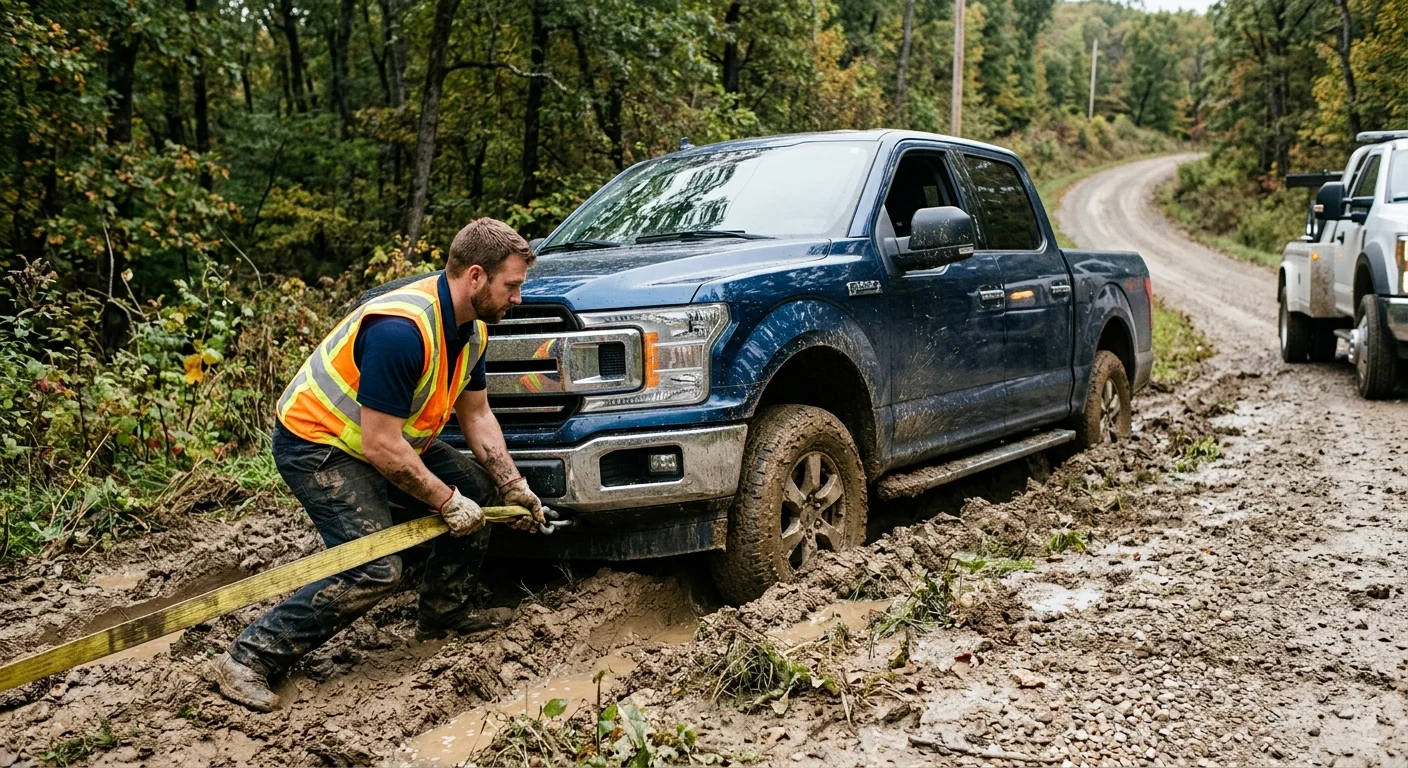
Mud over the tires near Springfield creates one immediate decision: recovery or transport. A winch out service pulls the vehicle onto stable ground. If it can safely drive afterward, it’s a winch-out. If it can’t, it also needs a tow.
What a winch-out is, in one paragraph
A winch-out is a controlled recovery from mud, a ditch, wet grass, or another surface where the tires can’t produce enough traction. An operator positions recovery equipment on stable ground, connects to an appropriate point, and pulls the vehicle back onto a usable surface. The goal isn’t to transport the vehicle somewhere else. The job ends when the vehicle is free and can safely leave under its own power. That distinction matters when you request a winch-out service. A car resting upright beside a gravel road may need only a short pull. A pickup buried to its wheel wells at a field edge may require more setup, a different pulling angle, or several controlled movements. Once an operator is on scene, a soft-shoulder winch can take 15 to 30 minutes. A deep recovery can take one to two hours. Those are work-duration ranges, not arrival estimates. Distance from firm ground, mud depth, vehicle position, and available access all affect the recovery. The wheels may also be turned against a rut or blocked by packed soil. That’s why “winch out” describes a type of work, not one identical procedure for every stuck vehicle.
The judgment call: can it drive away after?
The recovery-versus-transport decision comes down to the vehicle’s condition. Mud alone may stop a perfectly drivable car. Damage changes the answer.
Before anyone tries moving it, look at what happened. Did the vehicle simply slide from a soft shoulder? Did it strike a ditch bank, rock, stump, culvert, or road marker? Are any wheels sitting at an unusual angle? Is fluid visible beneath the vehicle? Report those details without trying to diagnose the problem yourself.
A vehicle may need towing after the extraction when:
- A tire is flat, separated from the rim, or buried against debris.
- A wheel or suspension part appears bent.
- Steering doesn’t feel normal.
- The vehicle won’t start after it reaches firm ground.
- Warning lights suggest a new mechanical problem.
- The underbody, bumper, exhaust, or drivetrain struck something.
- The recovery followed a collision rather than a simple slide.
The operator can reassess once the tires are visible and the vehicle is stable. If it can’t safely leave under its own power, the job changes from recovery to transport. That may call for accident recovery followed by emergency towing.
The same rule applies after an animal strike. A car may remain upright and still have hidden damage around the radiator, tires, or steering. Our guide on what to do after hitting a deer explains the first steps before moving it.
Don’t force the car to prove it can drive. Spinning tires digs deeper ruts. Repeated acceleration can also hide the original problem beneath a new one. Get it onto stable ground first, then decide whether it should move under its own power.
Soft shoulders, low-water crossings and field edges
Springfield’s road environment changes quickly beyond the city grid. A paved edge near Kansas Expressway isn’t the same as a gravel shoulder outside Republic. South along US-65, drivers pass through Nixa and Ozark toward the Branson corridor. Leave that main route, and narrow roads, field entrances, gravel, and low spots become more common.
Soft shoulders often look firm from the driving lane. After rain, the surface can support one side of a vehicle while the other sinks. The driver may accelerate, turn sharply, or reverse farther from the pavement. Each attempt can lower the vehicle or rotate it toward the ditch.
Stop spinning the tires once the vehicle stops making progress. Keep passengers away from moving traffic. If the vehicle is near an active I-44 or US-65 lane, report the direction of travel and the nearest exit or marker. Immediate danger belongs with 911.
Low-water crossings require a different decision. Mud recovery assumes the vehicle is resting on ground. Moving or rising water adds a hazard that a normal winch-out description doesn’t cover. Don’t ask a friend to drive another vehicle into the same crossing. Tell dispatch about the water, its movement, and whether it’s entering the vehicle.
Field edges create access problems. The nearest firm surface may be behind the stuck vehicle, across a narrow entrance, or on private land. Tell dispatch whether a gate, fence, crop row, steep bank, or drainage channel blocks access. Confirm that you have the property owner’s permission when access crosses someone else’s land.
Conditions on major routes can also affect where you wait. The MoDOT Traveler Information Map shows current incidents, cameras, and road conditions. MoDOT’s Motorist Assist and Emergency Response Program is a scheduled freeway patrol, not a call-out towing service. It doesn’t replace arranging an operator when your vehicle needs recovery or transport.
These details separate an ordinary shoulder pull from a deeper Ozarks recovery. “Stuck in mud” isn’t enough information by itself. The road, slope, water, access, and vehicle position shape the job.
Why a friend with a strap is the expensive option
A strap in a friend’s pickup can look like the fastest answer. It can also turn one stuck vehicle into two damaged vehicles.
The problem isn’t just pulling strength. Recovery depends on connection points, pulling direction, surface stability, and how the stuck vehicle will move once it breaks free. A strap attached to the wrong point can damage a frame, suspension part, bumper, or body panel. A sudden tug can also hurt people standing nearby.
Mud makes the movement harder to predict. One wheel may release before the others. The stuck vehicle can rotate, slide sideways, or move farther into the ditch. The assisting vehicle may lose traction while carrying the pulling load. Adding speed only adds force to that uncertainty.
Don’t crawl beneath a vehicle resting in soft mud. Don’t stand between the two vehicles. Keep everyone away from the strap’s path and the direction the stuck vehicle may travel. If the only proposed method requires a running start, stop and arrange professional recovery.
A friend can still help without making the pull. They can provide visibility from a safe location, share coordinates, photograph the vehicle’s position, or help describe the nearest firm access point. That information is valuable when you request a recovery operator.
The safest practical cutoff is simple. If the tires can’t regain traction through gentle movement, or the vehicle is sitting at an angle, stop trying. The costliest part of a strap attempt may not be the recovery. It may be the repair or tow needed after an avoidable second impact.
What to tell dispatch so the right truck comes
A useful recovery message describes the vehicle’s geometry, not just the mud. Start with your exact location. Share a map pin when possible. On I-44, include eastbound or westbound. On US-65, include northbound or southbound. Outside Springfield, name the nearest town, route, intersection, or recognizable entrance.
Then describe these points:
- Vehicle: Say whether it’s a car, SUV, pickup, van, or vehicle with a trailer. Include the drive type if you know it.
- Position: Explain whether all four wheels are on the ground. Mention any tilt, ditch angle, or wheel hanging over an edge.
- Depth: Say whether mud reaches the tire tread, wheel hubs, bumper, or wheel wells. A photo often communicates this better.
- Surface: Identify mud, wet grass, gravel, clay, standing water, or a mixed surface.
- Access: Describe the nearest firm place where recovery equipment could be positioned. Mention gates, trees, fences, culverts, or narrow shoulders.
- Condition: Report whether the engine runs and whether the wheels appear intact. Mention visible leaks or impact damage.
- Attempts: Explain what you already tried. Tire spinning or a failed strap pull may change the vehicle’s position.
- Safety: Report traffic exposure, rising water, smoke, fire, injuries, or other immediate hazards. Call 911 first when anyone is in danger.
Photos should show the whole vehicle, not only the buried tire. Take one from the front, one from the side, and one showing the approach from firm ground, when doing so is safe. Good images help an operator understand the pulling angle and available access.
Don’t describe the car as “just a little stuck” if the frame is resting on mud. Don’t call it a tow when it only needs extraction. Clear details help determine whether the job needs a simple winch-out, a deeper recovery, or recovery followed by transport.
The operator sets the price. You get that number before anyone is dispatched. If the vehicle shifts, water rises, or another recovery attempt changes the situation, update the information before an operator is sent.
When to call us
This stops being a do-it-yourself job when gentle traction fails, the vehicle sits at an angle, or damage may prevent it from driving. Our line takes calls 24 hours a day, and calls are recorded after a notice so we can line up an independent local operator. Call us at (417) 221-8911.