An AWD vehicle can be towed, but neutral alone doesn’t establish the right method. The current owner’s manual, wheel condition, and pickup location must guide the operator’s decision.
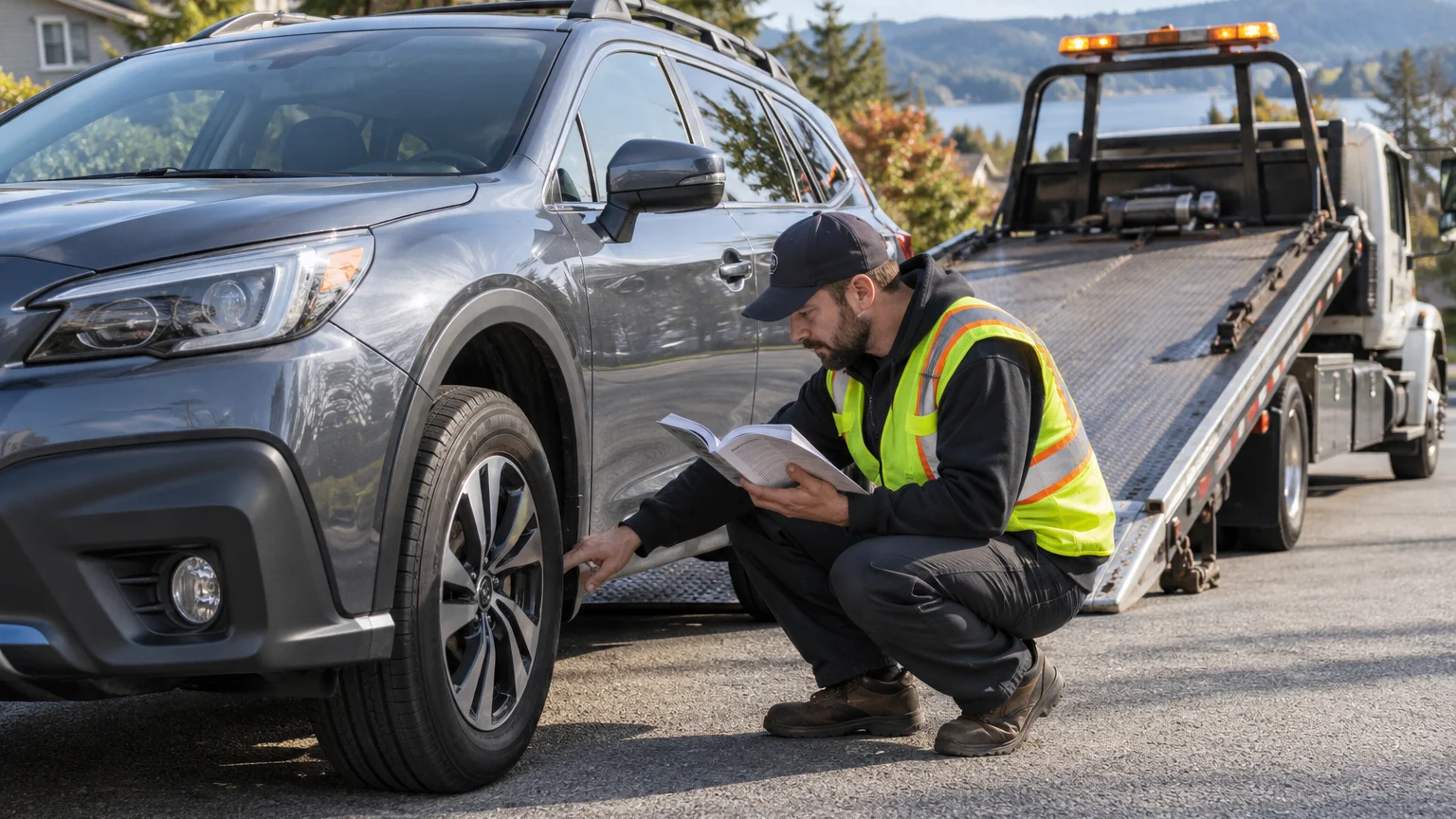
Neutral doesn’t disconnect every driven wheel
Moving the shifter into neutral changes the transmission state. It doesn’t prove that every part connected to the wheels can rotate as required during a tow.
That’s the key point behind the question, “Can you tow an all-wheel drive vehicle?” The answer isn’t based on the shifter position alone. AWD designs differ by model, model year, and drivetrain configuration. A method permitted for one vehicle might not be approved for another.
Don’t treat a freely rolling car as confirmation. Wheels can roll while connected drivetrain parts are still moving. Likewise, a dashboard showing neutral doesn’t tell an operator whether two wheels may remain on the pavement.
This situation differs from towing a front-wheel-drive or rear-wheel-drive vehicle. With AWD, both axles are part of the towing decision. The operator needs to know whether the manufacturer permits any wheels to roll during transport.
Neutral can still matter during loading. It may let the vehicle roll and steer as the operator positions it. That doesn’t automatically make a two-wheel lift appropriate for the trip.
The same distinction applies when discussing trailer towing. Questions about an AWD vehicle pulling a trailer, including the so-called 80% rule, concern load ratings and trailer capacity. They don’t answer how a disabled AWD vehicle should be moved. This page concerns the disabled vehicle itself.
The owner’s manual controls the approved method
The current owner’s manual is the starting point for AWD towing. Check the section labeled towing, emergency towing, recreational towing, or roadside assistance.
Use the manual for the exact model year. A manual from a similar-looking vehicle isn’t enough. Manufacturers can offer several drivetrains under one model name, and their instructions may differ.
Look for answers to these points:
- Whether the vehicle may travel with any wheels on the road
- Whether it requires a flatbed or another all-wheels-supported method
- Whether a tow mode or transport mode must be selected
- How the parking brake and steering should be handled
- What to do when the vehicle has no electrical power
- Whether the manual distinguishes emergency movement from transport
Don’t substitute an online forum post for those instructions. Advice based only on the AWD badge may overlook a model-specific procedure.
If the printed manual isn’t in the glove box, check the manufacturer’s official owner resources. Use the vehicle identification details to confirm that you’ve found the correct publication. If the instructions remain unclear, tell the operator instead of guessing.
Quick Tow Springfield connects callers with independent local operators. The operator chooses equipment after reviewing the vehicle, its condition, the manual’s instructions, and the scene. Our flatbed towing service page explains how to request that type of operator without assuming it fits every vehicle.
Wheel damage and locked steering change the request
A car being in neutral only answers one part of the problem. The operator also needs to know whether every wheel turns, rolls, and points normally.
A damaged tire, bent wheel, broken suspension part, or wheel pressed against a curb can change the loading plan. So can locked steering. If the car can’t power on, don’t assume that selecting neutral also released the steering or parking brake.
Tell the operator what you can observe without crawling under the vehicle. Useful details include a wheel sitting at an unusual angle, fluid beneath the car, collision damage, a flat tire, or a warning displayed on the dashboard.
Take clear photos when traffic and your surroundings allow it. Photograph the AWD badge, dashboard, wheel positions, and available space around the vehicle. These images can help describe the problem before dispatch, but they don’t replace an on-site inspection.
The separate guide to AWD towing when a wheel is damaged covers that problem in more detail. This article focuses on a car whose wheels appear able to roll, yet whose drivetrain still requires a vehicle-specific towing decision.
Springfield locations can create different access concerns. A vehicle near the Kansas Expressway and I-44 interchange presents a different scene from one inside a downtown parking structure. A driveway in Nixa, a shoulder near Ozark, and a gravel road outside Rogersville also offer different loading space. Describe the location precisely and check the MoDOT Traveler Information Map when traffic conditions affect your roadside position.
A flatbed and dollies solve different access problems
A flatbed carries the vehicle on its deck, keeping its tires off the roadway during transport. That makes AWD flatbed towing a common request when the owner’s manual calls for all wheels to be supported.
Still, “send a flatbed” isn’t the whole plan. The operator must reach and load the vehicle. Low clearance, a sharp driveway angle, limited overhead space, collision damage, or wheels that won’t roll can affect that process.
Dollies serve another purpose. An operator can use them to support wheels that would otherwise roll on the road or to help reposition a vehicle in limited space. Their suitability depends on the vehicle, the equipment, and the manufacturer’s instructions.
A wheel-lift towing operator may use added equipment when the manual permits that setup. A basic wheel-lift arrangement, with one axle raised and another rolling, shouldn’t be assumed appropriate merely because the transmission is in neutral.
Parking garages show why the distinction matters. A standard flatbed may face height or turning constraints before it can reach the car. An operator might need to move the vehicle to an accessible loading point using suitable equipment. That scene assessment isn’t a do-it-yourself procedure.
Our comparison of flatbed and wheel-lift towing explains how the equipment differs. The correct choice comes from the manual, the vehicle’s condition, and the pickup area, not a universal rule about every AWD badge.
What to tell the operator before dispatch
Good dispatch details help the independent operator evaluate the request before heading out. Start with the year, make, model, and drivetrain. Say AWD explicitly, even when the badge seems obvious.
Then describe the vehicle’s current state:
- Whether it starts and has electrical power
- Whether it shifts into neutral
- Whether the parking brake releases
- Whether the steering turns
- Whether all four wheels appear able to roll
- Whether any tire, wheel, axle, or suspension area is damaged
- Whether you have the key or key fob
- What the owner’s manual says about towing
- Where the vehicle sits and where it needs to go
Be specific about access. Say whether the car is on an I-44 shoulder, beside US-65, inside a garage, against a curb, or down a narrow Ozarks driveway. Mention gates, low ceilings, steep grades, soft ground, and traffic exposure.
Don’t try to settle the equipment choice by saying only, “It’s in neutral.” That leaves out the drivetrain instructions and the physical condition of the car.
Also avoid trying to create a homemade towing setup. Connecting a strap to another vehicle doesn’t resolve the AWD question, and the correct attachment and transport method haven’t been established. Once the vehicle needs lifting, controlled loading, dollies, or movement in traffic, an equipped operator should assess it.
The operator sets the price. Quick Tow doesn’t own trucks, employ drivers, or choose the towing method. We line up an independent operator after gathering the details needed for dispatch, and you receive the price before anyone is sent.
When to call us
Call when the AWD vehicle needs more than simple repositioning, or when the manual requires towing equipment you don’t have. The line takes calls 24 hours a day, and we can line up an independent local operator to assess the vehicle and select the method.
Call us at (417) 221-8911.