The slide is stuck out and you still need a tow. That does not automatically leave the RV sitting. An independent operator can often still move it if they know the rig type, how far the room sits, the coach’s condition, and whether they can get equipment around it.
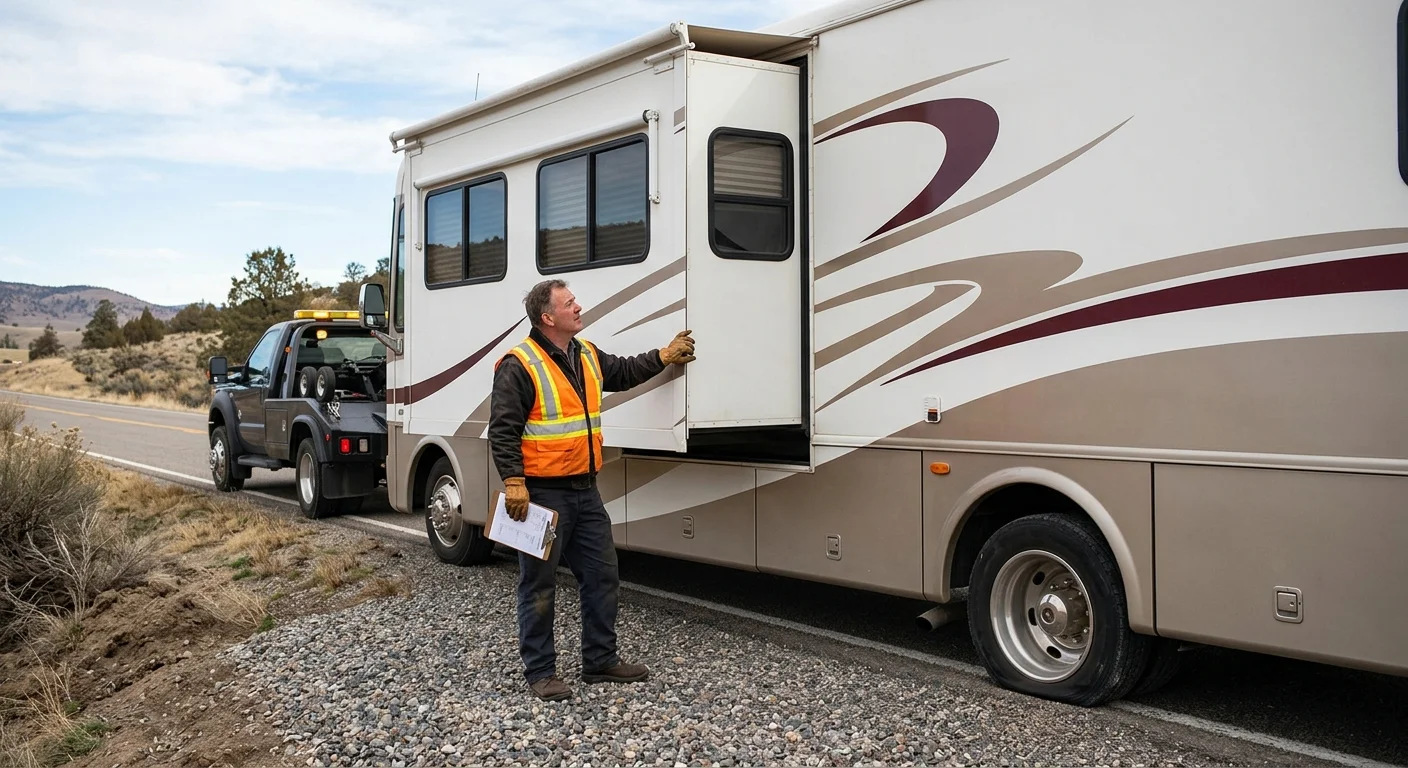
A stuck slide-out changes the transport request
A coach with the rooms in is a known shape. A coach with a room stuck out is a wider load. The operator is not just hooking a motorhome. They are moving extra width through real streets, pads, and shoulders.
Downtown Springfield is not Nixa. A Class A against a Campbell Avenue curb sits tighter than a fifth-wheel on a gravel pad west of Republic. Ozark’s US-65 ramps pinch differently than a Bass Pro lot off Kearney. The same stuck slide on a Table Rock campground pad is another job again. Road network and distance change with those places.
The extra width is the first fact. Which side is out is the second. An awning, steps, or a sewer hose hanging off the room changes the envelope again. So does a coach that will not roll. Leveling jacks still down belong in the first call.
Quick Tow Springfield is a referral service. We do not own wreckers, and we do not run a yard. We take those details and line up an independent local operator for RV and trailer towing. Some coaches and fifth-wheels need heavy-duty towing instead of a light hook. That choice belongs to the operator after they hear the year, make, length, and layout.
If you are sitting on I-44 through Springfield, freight is part of the scene. Prime Inc. has been headquartered here since 1980. About 23 percent of traffic on the Glenstone-to-Kansas Expressway segment is semi-trucks, per Ozarks Transportation Organization. An RV sitting wide on that shoulder is a visibility problem. MoDOT’s Motorist Assist / Emergency Response program is the state freeway courtesy patrol, based at the Transportation Management Center of the Ozarks. It does not tow. For live cameras, use the MoDOT Traveler Information Map.
South on US-65 toward Branson, the pressure is tourist traffic. That funnel carries Branson’s roughly 9-10 million visitors a year. A motorhome with a room out near Ozark or Hollister sits in a different stream than the same breakdown in Battlefield. Corridor steps live in RV breakdowns on US-65 near Branson. A stuck slide changes which truck the operator considers.
Do not force the room in. Do not bypass the mechanism. If the slide will not retract, treat the extra width as part of the tow request.
Motorhomes and towable RVs need different details
A Class A or Class C motorhome is a self-propelled coach. A travel trailer or fifth-wheel is a towed unit. The operator needs that split first. The stuck room is the same problem. The rolling plan is not.
For a motorhome, say whether it will roll and steer. Say whether you have the keys. Say whether leveling jacks are down. Say whether the coach sits on pavement, gravel, or a slope. A slide stuck on the street side of a Springfield curb is a different reach than a slide hanging over a ditch on a Christian County farm road. If the motorhome will not roll, the operator is looking at a drag or a lift, not a simple hook. That can push the job toward heavy-duty equipment. We cannot publish a capacity number for that. None is confirmed for this page. The operator decides after they see the coach.
For a towable, say whether the truck is still attached. Say the hitch type: bumper pull, gooseneck, or fifth-wheel pin. Say whether trailer brakes work, and whether the breakaway switch is intact. A travel trailer with a living-room slide out in a Nixa driveway is a different request than a fifth-wheel with a bedroom slide out on a Republic gravel pad. If the tow vehicle can still pull, width may still change the truck. If the trailer is unhitched, they also need a path to the tongue or pin box.
Toy haulers add a rear ramp to the picture. Class B vans can have a smaller slide, but the same rule holds. Name the body style. Name which room is out. Name whether more than one slide is extended. Dual slides between two cars at a Kearney-area lot leave almost no working room. Dual slides on an open Ozarks shoulder leave more space, and more highway width.
Keep people out of traffic while you gather that. On I-44 or US-65, stay off the travel lane. If the scene is already a crash, call 911 first. Towing is the second call.
The RV manual controls model-specific steps
Slide systems are not interchangeable. Some are hydraulic. Some are electric. Some use cables or a rack. The current owner’s manual for your year, make, and model is the authority for any in-coach step. Not a forum post. Not a video. Not a set of instructions from a towing referral line.
If the manual has a retract procedure that uses house power, generator power, or a 12-volt pump, follow only those printed steps. If you cannot find that page, stop. Guessing at a bypass is how rooms rack, floors tear, and seals rip. We will not walk you through forcing a room, pulling a motor, or overriding a control board. That work belongs to an RV tech with the right schematic. A tow operator’s job is transport, not slide repair.
Bring the year, make, model, and length when you call. If you have the VIN or a photo of the data plate, that helps the operator match equipment. If the coach has basement storage or a slide that sits low, say so. Ground clearance under an extended room matters on a crowned Ozarks road and on a campground pad with a concrete lip. The manual’s spec sheet is the right source for length and listed slide count. We will not invent a legal width cap or a listed room travel for your brand. Missouri’s own width rules were not confirmed in this vertical’s claims ledger for this page. Confirm any highway-width question with the operator and with the agency that actually sets it.
Cold weather can leave a slide stubborn. So can a dead house battery. So can a hydraulic leak you can see on the ground. Describe what you already tried from the manual. Do not keep cycling a motor that will not move. If the room moved partway and stopped, say how far it traveled and which side still sits out. A room that is mostly in is a different envelope than one sitting at full extension. Give the operator that picture in plain words.
Access around the rig affects the assessment
Width is only half the request. The path around the rig is the other half. An operator needs to know whether a truck can reach the coach, and whether the coach can leave without clipping a tree, a pole, or a parked car.
A downtown Springfield block near Park Central is tight. So is campus parking around Missouri State University, where the Springfield campus held 25,238 students in Fall 2025. A Walmart or Bass Pro lot off Kearney usually has more room, until Saturday traffic fills it. Nixa and Ozark neighborhood streets can be plenty wide for a pickup and still too tight for a Class A with a room out. Republic and the west-side farm roads often have space on paper and soft shoulders in practice. After rain, Ozarks clay does not hold a dualie well. A low-water crossing or a gravel campground loop can turn a simple pull into a recovery.
Overhead matters too. Campground trees around Table Rock hang low. City Utilities lines are a real limit on city streets. A covered fuel island, a hotel canopy, or a storage-lot roof can stop a tall coach even with the slide in. With the slide out, the operator also has to watch the sides, not just the roof.
Tell them what is on each side. Ditch, curb, fence, another RV, a retaining wall. Tell them whether the ground is paved, gravel, grass, or mud. Tell them whether the coach is nosed in, backed in, or parallel to traffic. A parallel motorhome on Glenstone is a different pull than a backed-in trailer on a Branson campground pad. If a wheel has already dropped off a pad, say that. That is recovery plus width, not a straight tow.
Once an operator is on scene, a soft-shoulder winch can take 15 to 30 minutes. A deep recovery can take 1 to 2 hours. Those figures describe the work itself. They are not an arrival window, and we do not publish one. The brand holds no trucks to measure travel time with.
Access also feeds cost. Extra width, extra equipment, and a tight pad all change what the operator quotes. Quick Tow does not set that number. You get it before anyone is dispatched. The variables on the Branson side of the metro are spelled out in what affects RV towing cost near Branson.
What photos and measurements to share
A clear photo set is the fastest way to describe a stuck slide. Shoot from the ground, not from traffic. If you are on a shoulder, stay behind the coach and out of the lane.
Take a full driver’s-side shot and a full passenger-side shot. Take the front and the rear. Take a close shot of the stuck room, including the seal line and anything hanging off it. Take the wheels, especially any tire that has left the pavement. Take the hitch or pin box if this is a trailer. Take a look at the path out: trees, poles, parked cars, the ditch. If leveling jacks are down, photograph them. If you are on I-44 or US-65, a mile marker or a ramp name in the background helps the operator place the scene.
Share measurements you can actually take. Coach length from the manual or the data plate. How far the room sits past the sidewall, measured with a tape if you can do it safely. Distance to the nearest obstacle on the slide side. Approximate overhead to the lowest branch or line if one hangs over the path. Do not guess a legal width limit. Do not guess what truck the operator must send. Those are their calls.
Add the facts that never show up in a photo. Keys or no keys. House batteries dead or alive. Generator running or not. Slide tried from the manual, then stopped. Anyone still in the coach. Pets. A toad or dinghy still hooked behind a motorhome. A boat or golf cart in a toy-hauler garage. Each of those changes the load the operator is agreeing to move.
If you cannot measure safely, skip the tape and send the photos. A message with year, make, body style, which slide is out, and the nearest town is enough to start the match. Name Springfield, Nixa, Ozark, Republic, Battlefield, Hollister, or Branson. Name the road. Metro Springfield is not one place, and the operator needs the real one.
When to call us
When the room will not come in from the manual’s own steps, stop. That is no longer a parking-lot project. Call us at (417) 221-8911. The line takes calls 24 hours a day, every day. Calls are recorded after a notice plays. We match you with an independent local operator, and you get their number before anyone is dispatched.