A missing ignition key doesn’t always stop junk car removal. The operator still needs to know whether the car can roll, steer, and leave the property safely. Ownership, authorization, access, and Missouri paperwork remain separate issues.
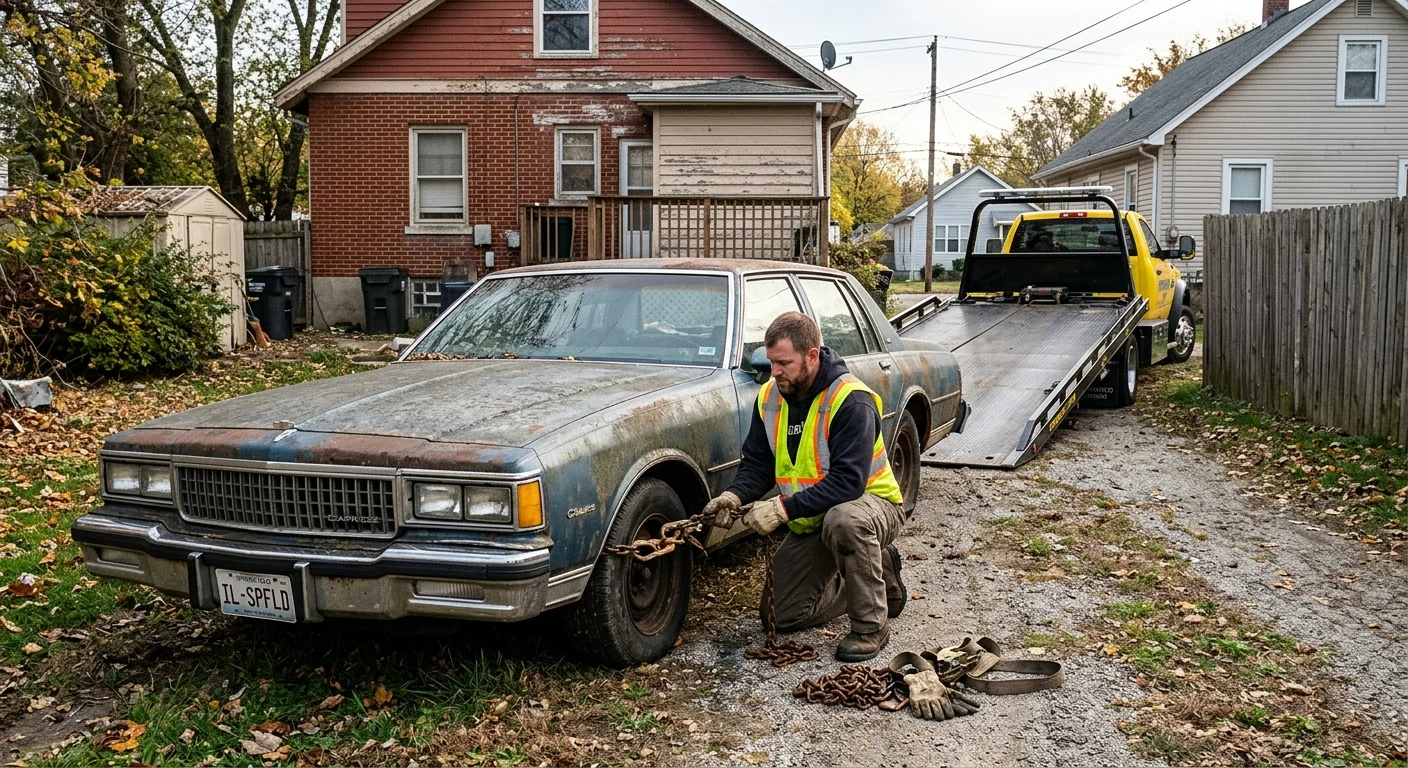
Missing keys don’t settle ownership or authorization
Keys show that someone can access a vehicle. They don’t prove that person owns it or may sell it. A title, salvage certificate, junking certificate, and property authorization each answer different questions.
Start by explaining your connection to the car. It might be your old vehicle, an inherited car, or one left behind by someone else. Don’t describe an abandoned vehicle as yours unless you own it.
If you own the car and want to sell it for junk, tell the receiving buyer that the keys are missing. The buyer must decide whether it can accept the vehicle and what ownership records it needs. Quick Tow Springfield doesn’t buy the car or decide whether a sale can proceed.
A vehicle belonging to someone else follows a different process. Missouri regulates towing from private property under RSMo 304.157. The applicable path can depend on the property, posted signs, notice, and how long the vehicle has remained there. A junk sale isn’t a shortcut around those rules.
Our guide to private property towing explains that distinction. If ownership or removal authority remains unclear, contact the Missouri Department of Revenue or the appropriate local agency before arranging pickup.
Tell the operator whether the owner has approved the move. Also identify any landlord, property manager, or neighbor involved. Sorting that out before dispatch helps prevent a loading plan from colliding with an ownership dispute.
Wheel position and the parking brake affect access
A car without keys may still be removable. The missing key changes what the operator must inspect before loading.
Report whether the front wheels are straight or turned. Say whether the steering wheel appears locked. If you know the parking brake is engaged, include that detail. Mention the transmission position when it can be seen without forcing anything.
Don’t crawl beneath an unstable vehicle or force its controls. The assigned operator can decide how to handle locked steering, a transmission that won’t shift, or wheels that won’t turn. Depending on the vehicle and its position, the operator may consider a flatbed, wheel-lift, dollies, skates, or winching equipment.
Tire condition matters too. Send photos showing flat tires, missing wheels, damaged suspension, or a car resting on blocks. Include anything touching the ground besides the tires. That information helps the operator judge whether the vehicle can roll toward the loading point.
Make, model, model year, and drive type are useful details. So is the car’s general condition. A complete vehicle on four tires presents a different loading problem than a stripped shell.
Our junk car and abandoned vehicle removal service connects property owners with independent local operators. The operator chooses the loading method after reviewing the vehicle and access. Missing keys alone don’t make that decision.
Tight driveways and blocked yards need photos
Access often matters more than the missing key. A clear driveway gives an operator more options than a car boxed behind another vehicle.
Take one wide photo from the car toward the street. Then photograph both sides, the front wheels, and the loading surface. Show gates, fences, parked vehicles, retaining walls, low branches, and sharp turns. If the route crosses grass, gravel, mud, or a drainage area, include that too.
Springfield Metro properties aren’t all alike. A narrow city driveway near central Springfield differs from an open lot outside Republic. Nixa and Ozark subdivisions can present gates or limited turning space. Rural Webster County properties may involve gravel lanes and soft ground. Steeper sites along the Branson corridor bring another access question.
Mention whether another vehicle can move before pickup. Tell us if the junk car sits behind a locked gate or inside a garage. Share whether the operator would need permission to cross neighboring property. Don’t assume a truck can fit simply because the car once did.
Photos should show the full route, not only the vehicle. A close image can document wheel position. A wider image tells the operator whether there’s room to approach and load.
Weather can change that route. Recent rain may affect a soft yard or gravel lane. Tell the operator what the surface looks like now. The operator can then review the actual conditions instead of planning around an old description.
Paperwork is separate from loading
Moving a car and transferring it for junk are different tasks. An operator may be able to load a car without keys, but that doesn’t settle the sale paperwork.
Missouri places several duties on the purchaser when a vehicle is sold for salvage, dismantling, or rebuilding. The purchaser must send the title or existing salvage certificate to the Missouri Director of Revenue within 10 days. That submission includes a completed application and an $8.50 fee.
A salvage title is required when the vehicle’s model year is six years old or newer at purchase. For a vehicle more than six years old, the purchaser may instead seek a junking certificate. A junking certificate permanently retires the vehicle from road use, subject to Missouri’s narrow 90-day rescission process for a vehicle not previously classified as junk.
Missouri also requires Form SHP-498B for junk, salvage, or rebuilding sales. The buyer completes that affidavit before a notary. The seller keeps the notarized form.
There is a narrow title exception. A scrap metal operator may buy an inoperable vehicle at least 10 years old without a title. Don’t apply that exception to newer vehicles or every junk buyer.
The exact everyday junking application form couldn’t be confirmed from a direct Missouri Department of Revenue statement. The purchaser should check the current requirement through the Missouri DOR motor vehicle section. Don’t guess at a form number.
The seller must remove Missouri plates before the buyer takes possession. Our Missouri junk-car paperwork guide covers these state steps in more detail.
What the operator and receiving buyer must confirm
The towing operator and junk-car buyer may have different roles. Confirm who will move the vehicle and who will receive it. Don’t assume the operator is also buying the car.
Before dispatch, give the operator a direct condition report. Include the missing keys, wheel position, parking brake status, tire condition, and loading surface. Describe every obstacle between the vehicle and the street. Send current photos when possible.
The receiving buyer needs to confirm whether it will accept the vehicle. It must also address the applicable title, salvage, junking, and affidavit steps. Ask the buyer what records it needs from you before pickup. If a title is missing, say that immediately.
Don’t treat a possible purchase amount as the removal price. Quick Tow Springfield doesn’t set either figure. We line up an independent local operator, and that operator sets the towing price. You get that number before anyone is dispatched.
Likewise, we can’t confirm that a buyer will pay for every no-key vehicle. The buyer may consider ownership records, age, condition, completeness, and its own acceptance policy. Our guide to cash for junk cars in Springfield explains why buying and towing should be discussed separately.
Before agreeing to pickup, confirm the destination and who will be present. Make sure gates can open and blocking vehicles can move. If authorization remains disputed, stop and resolve it before arranging removal.
When to call us
Call when missing keys come with locked wheels, blocked access, or a non-running vehicle you can’t move safely. We can line up an independent local operator, and the line takes calls 24 hours a day. Calls are recorded and transcribed after a notice. Call us at (417) 221-8911.