The car is on blocks in a south Springfield driveway. The wheels are gone, stolen or pulled, and it will not roll an inch. Junk car removal without wheels can still happen, but missing tires change access and loading, not whether you own the car.
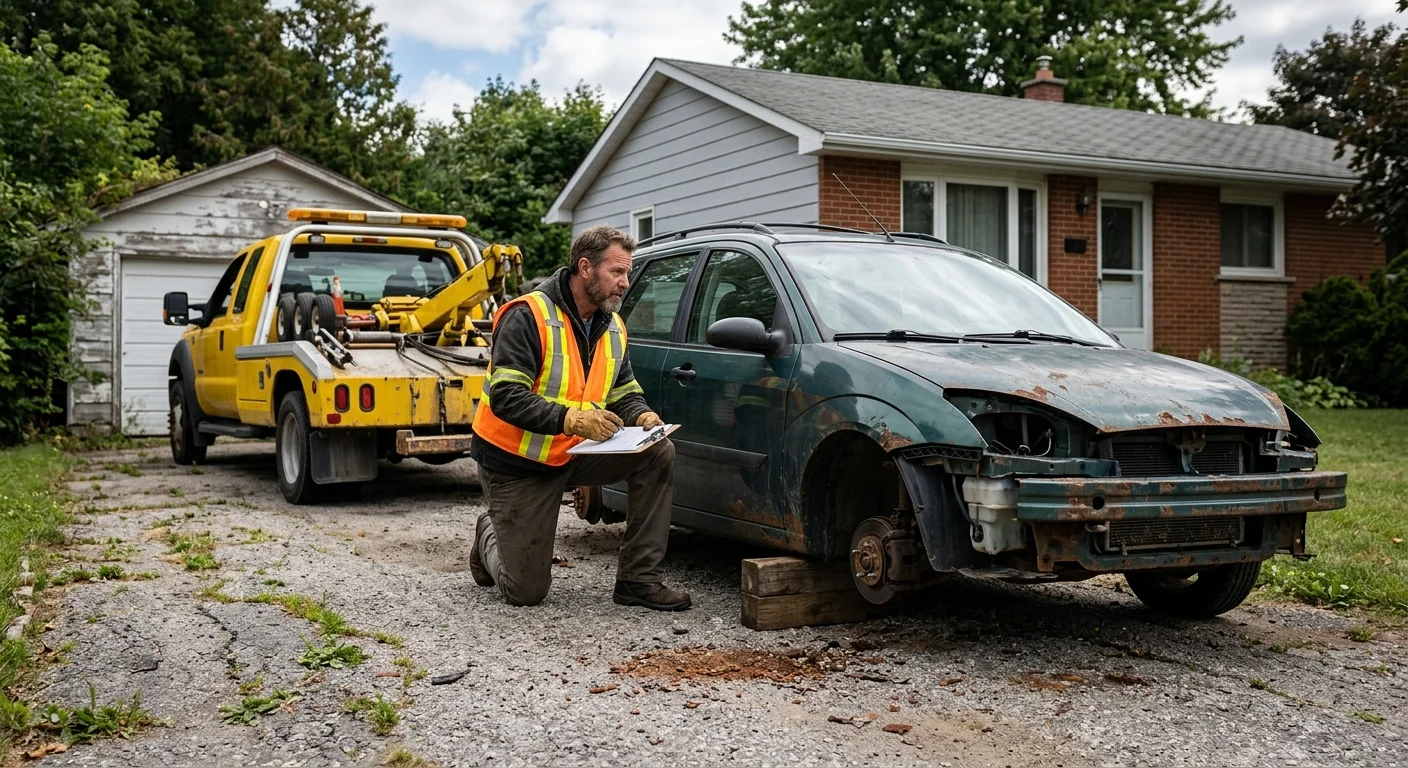
Missing wheels change access, not ownership
A car with no wheels is a non-rolling junk vehicle. It cannot be driven, and it cannot be rolled onto a bed the way a car with intact tires can. That is an access problem. It is not a change in title, and it is not proof the car is abandoned.
If the title is in your name, it stays in your name until a sale or junking is completed under Missouri rules. Sitting on jack stands in a Republic carport does not transfer ownership. Neither does a stolen set of wheels on a street near Glenstone. The operator we dispatch still needs a person who can authorize the pickup. Without that, the job stops before a truck is sent.
Do not treat this like a missing-key job. Keys control whether the steering and transmission can be released. Wheels control whether the car can roll at all. Those are different problems, and they stack if you have both. If the car also has no keys, start with removing a junk car without keys as its own question, then describe the missing tires on the same call.
A wheel-lift is built to pick a rolling car by the tires. With no tires, that method is usually the wrong tool. A flatbed, a winch, cribbing, or another setup may be what the operator brings. We do not own that equipment. The independent operator who takes the job does, and they decide what they can safely use on your ground.
Do not try to drag the body onto a trailer with a come-along, a garden tractor, or a borrowed engine hoist. Do not set the chassis on furniture dollies and push it down a slope toward Sunshine. A car body without wheels is heavy, sharp, and easy to drop through asphalt or gravel. The operators we dispatch handle non-rolling pickups as part of junk car and abandoned vehicle removal. Your job is to describe the car honestly before anyone is dispatched.
Tell them the wheels are gone on the first call. Say how many are missing. Say whether the car is on stands, on the rotors, or sitting on the frame. If you wait until the truck is in the driveway, the operator may not have the right gear. The price they quote is theirs, and it is quoted before dispatch. We do not set it, and we do not publish a surcharge for missing tires because no verified figure exists for that.
Stolen wheels are common enough along I-44 and in apartment lots near campus. MSU’s Springfield campus now holds 25,238 students, and street parking around it stays tight. A stripped car in a lot is still your car if the title says so. Report the theft if that is what happened, then treat the shell as a removal job, not a rolling tow.
Vehicle position affects the removal plan
Where the car sits matters as much as the missing wheels. A non-rolling shell in a wide driveway off Kansas Expressway is one job. The same shell behind a fence in Nixa, nose-in under a carport in Ozark, or on a slope off US-65 toward Branson is another.
Springfield core lots are often short and paved. The operator needs room to line up a bed, set straps, and work around the car without blocking a neighbor. Downtown and midtown driveways can be one-car wide with a sidewalk apron. If the car is already against a garage door, say so. If a second vehicle is boxed in behind it, say that too.
South of the city, Nixa and Ozark add grade and gravel. A car on a downhill concrete pad can slide once it is lifted off stands. A car on a gravel spur off a county road may sit where a wrecker cannot square up. Republic and the west side add long rural drives, low branches, and gates that will not open wide enough for a bed. Webster County and the Branson corridor add distance and tourist traffic on US-65. None of that makes removal impossible. All of it changes the plan.
Soft shoulders and Ozarks clay after a storm are their own problem. A car that has been sitting since a wet week can sink to the frame. That is recovery work once an operator is on scene, not a simple hook. A deep recovery can take 1 to 2 hours of work after they arrive. We do not publish an arrival window. The brand holds no trucks, so we have no measured ETA to give you.
If the car is on someone else’s land, stop and sort authority first. Private property towing in Missouri follows RSMo 304.157. A tow without a police order is allowed only in the cases that statute names: small owner-occupied residential property after notice and a wait, other private property after a longer wait, or posted lots with compliant signs. Springfield police will not tow from an apartment or rental lot at a landlord’s request unless there is a genuine hazard. Landlords are pointed to the private-tow process. Do not assume a stripped car in a rental lot can be hauled on a phone call alone.
If the car is yours, on your driveway, and you can prove it, the position question is practical. Can a truck reach it. Can the operator work around fences, AC units, basketball hoops, and overhead lines. Is there a second way out if the first approach is blocked. Answer those before anyone loads a winch.
A car on I-44 or another public road is a different lane. MoDOT’s Motorist Assist patrol can cover a live freeway scene. It does not haul junk cars off private property. For a driveway shell, stay on the private-property path.
Driveways and soft ground need clear photos
The fastest way to stall a no-wheel pickup is a vague description. “It’s in the yard” does not tell an operator whether they can get a bed within a few feet of the car. Photos do.
Shoot the car from all four sides. Then shoot the path from the street to the car. Include the driveway surface: concrete, asphalt, gravel, or dirt. Include the slope, if there is one. Include anything overhead, like service drops from City Utilities or low limbs. Include the gap on both sides. If the car is on stands, photograph the stands. If it is sitting on rotors in the dirt, photograph that.
Ozarks ground gets slick after rain. Clay in Greene and Christian counties holds water. A truck that would be fine on a dry Battlefield pad can rut a wet side yard in Fair Grove. The operator needs to see that before they quote the job. We cannot guess the soil from a phone message.
Measure what you can with your feet. Count the paces from the curb to the front bumper. Note a fence, a boat, a mower, or a pile of parts in the way. If you already pulled the wheels and left them stacked against the garage, say whether they are still there. Do not put them back on yourself if the hubs are damaged. That is not a DIY step we can bless.
Clear personal items from the cabin before pickup day. Missouri’s rules on belongings at a tow yard are not a free-for-all, and they are not the point of this job. You are arranging a consensual removal from your place. Take the plates, the garage door opener, the kids’ seats, and anything you still want. Plates do not transfer with the car in Missouri. Remove them before the buyer or the operator takes possession.
If the car is in a shared drive, warn the people who share it. A non-rolling load takes more setup than a rolling hook. Neighbors on a narrow street near Commercial Street do not need a surprise bed blocking the lane while the operator works. You do not need to direct the loading. You do need to keep people and pets out of the path.
Photos also stop a mismatch on equipment. A short wheelbase car on a wide pad is one picture. A crew-cab pickup with no tires, nose under a deck, is another. Send what you have when you call. The line takes the details. The operator who would run the job uses them to decide whether they can take it.
Paperwork remains a separate question
Missing wheels do not rewrite Missouri title law. The metal can sit on the dirt and the paperwork still has to be right.
When a vehicle is sold for salvage, dismantling, or rebuilding, the purchaser, not the seller, must forward the title or existing salvage certificate to the Missouri Director of Revenue within 10 days, with a completed application and an $8.50 fee. That is RSMo 301.227. A salvage title is mandatory if the model year is 6 years old or newer at purchase. It is optional, and the purchaser may go straight to a junking certificate, if the model year is more than 6 years old. A junking certificate is permanent. After one issues, no certificate of title or salvage title can be issued for that vehicle again.
The affidavit for a junk, salvage, or rebuild sale is Missouri State Highway Patrol Form SHP-498B. The buyer completes it before a notary. The notarized affidavit is kept by the seller. It is not filed with the state. Do not use the wrong form number you may have seen on other sites. The Patrol’s published form is 498B.
Scrap metal operators may buy an inoperable vehicle at least 10 years old, or parts from one, with no title at all. That exception is real and narrow. Do not treat it as a rule for a newer car on blocks in Springfield. If your car is newer than that, plan on a title path.
If the title is lost, Missouri’s duplicate-title process uses Form 108 marked “DUPLICATE,” notarized. The title fee is $8.50 plus $9.00 processing, $17.50 total. You can mail it to the Motor Vehicle Bureau in Jefferson City or file in person at a Missouri license office. The Missouri Department of Revenue motor vehicle page is the place to confirm current filing steps.
A vehicle sold under a salvage title or junking certificate is exempt from the normal Notice of Sale filing that a regular private sale requires. Junking is simpler on that one point. It is not a shortcut around ownership. If you cannot show you have the right to send the car, the operator should not take it.
We do not publish what a yard will pay for a car that does not run. No verified local payout sits in our claims file, and a national “up to” figure is not a Springfield price. Missing wheels may change the operator’s work. They may also change what a yard will give you. Those numbers come from the yard and the operator, not from this site. Confirm them before anyone is dispatched. For the full filing path, use how to junk a car in Missouri paperwork.
What the receiving operator must confirm
Quick Tow Springfield is a referral service. We answer the line and match you with an independent local operator. We own no trucks, run no yard, and set no prices. The operator who would take the car has to confirm five things before the job is real.
First, authorization. They need to know you can send the car. Title, bill of sale, or the narrow 10-year scrap exception are the lanes Missouri actually wrote. A neighbor’s shell in a Battlefield cul-de-sac is not yours to gift to a truck.
Second, access. Photos and a plain description of the driveway, the surface, and the room to work. If the car is in mud, on a slope, or boxed in, they need that before they load a bed.
Third, condition that affects loading. No wheels. Maybe no keys. Maybe a locked parking brake, a collapsed stand, or a frame already on the dirt. Each of those changes the method. None of them is a reason to invent a crane requirement from a blog. The operator says what they will bring.
Fourth, destination. Junk removal is not the same as a police-ordered tow to Henry’s lot under the city contract. This is a private pickup. The receiving yard or dismantler has to be willing to take a non-rolling car. That is their call.
Fifth, the number you will pay, or the number they will pay you, if a sale is part of the deal. Either way, you get that figure before anyone is dispatched. We do not quote a flat rate. We do not promise a payout. The operator who does the work sets the number.
If they cannot confirm those points, the honest result is that the job does not go today. That is better than a truck that cannot lift the car off a Nixa gravel pad. Be early and specific. Year, make, model, location in Greene, Christian, or Webster County or along the Branson corridor, and a clear statement that this is a tow of a junk car missing tires.
The operators in our network are licensed and insured. That is a claim about the network. It is not a claim that this brand holds a towing licence. Keep the two straight when you call.
When to call us
Once the car will not roll, the driveway is tight or soft, and you are past stacking boards under the rotors, this is no longer a do-it-yourself move. Call when you can authorize the pickup and can describe the missing wheels, the ground, and the path from the street. The line takes calls 24 hours a day, every day. Calls are recorded after a notice plays. An independent local operator is dispatched from there. Call us at (417) 221-8911.