Wheel lift towing in a low parking garage may be possible. Clearance alone doesn’t settle it, though. An independent operator must also evaluate the car, ramps, turns, wheels, and exit route.
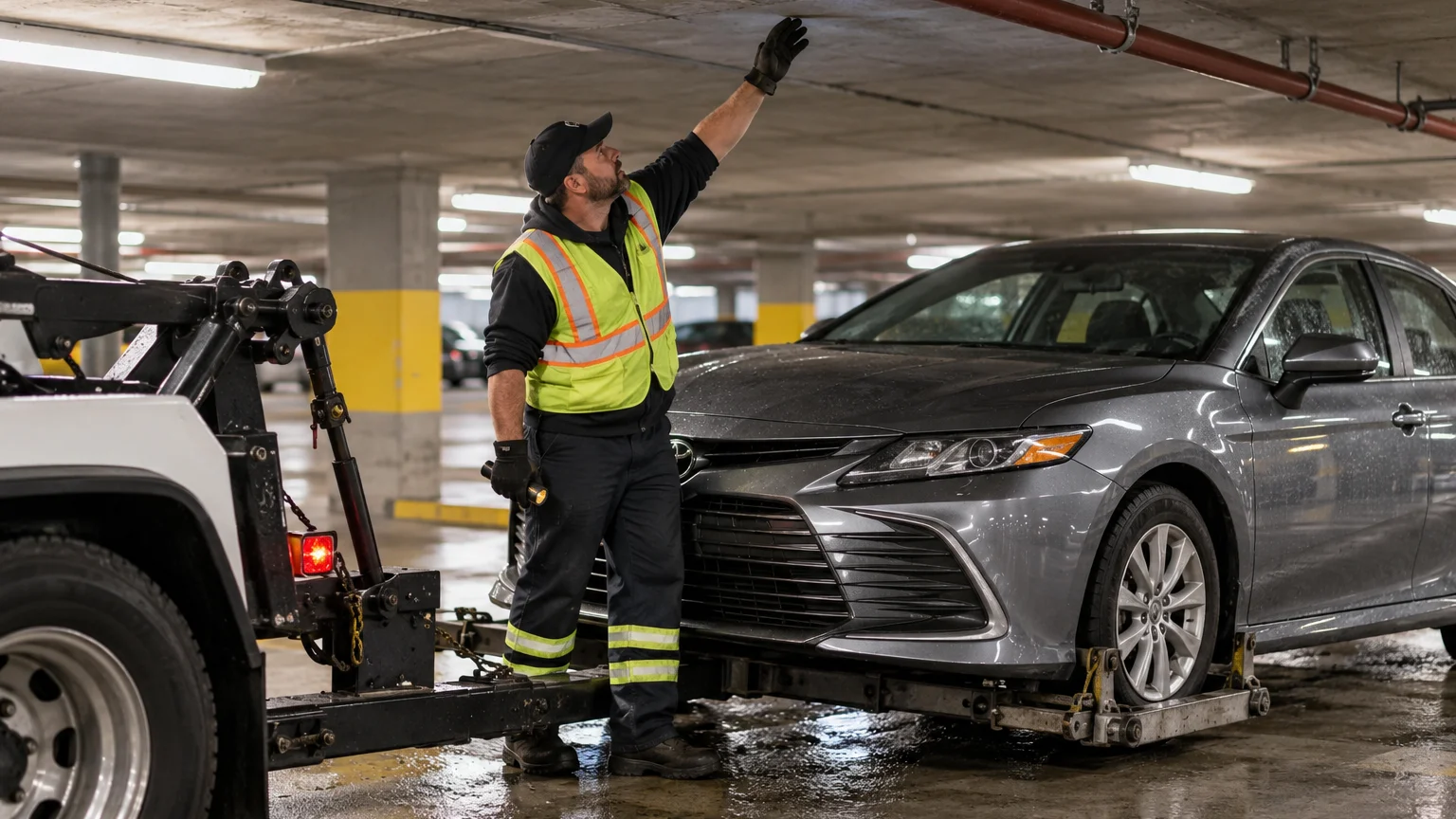
Garage clearance can rule out a standard approach
A flatbed may be the first towing method drivers picture. Inside a low garage, access may prevent that approach. The posted entrance clearance is only the beginning of the operator’s review.
Pipes, signs, beams, lights, and sloped sections can sit along the route. The lowest point may be far from the entrance. A ramp can also change the available space as equipment passes beneath an obstruction.
There isn’t one confirmed clearance figure that works for every garage or towing vehicle. We couldn’t verify a universal minimum for Springfield garages. Building management controls each property, while operators know the dimensions and limits of their equipment.
A wheel-lift towing operator may have an approach that fits where other equipment doesn’t. That still needs confirmation before dispatch. “Low clearance” doesn’t identify the actual height or the narrowest point.
Tell us whether the car sits underground, above street level, or near an exit. Mention every posted clearance sign you passed. Also report hanging pipes, gates, ticket booths, or sharp ramp transitions.
Downtown Springfield garages can present a different access problem than open lots near I-44 or US-65. The operator needs the garage details, not just a Springfield address. A street entrance may reveal little about the route inside.
Don’t try to gain space by changing the car or building fixtures yourself. The operator and property manager should evaluate any obstruction affecting access.
Drivetrain and wheel condition still control the method
A wheel lift fitting through the entrance doesn’t make it suitable automatically. The operator must determine which end, if any, can be lifted. The condition of the wheels that would remain down also matters.
Share the car’s year, make, model, and drivetrain if known. Don’t guess about the drivetrain. A dashboard label, owner’s manual, or manufacturer information may help the operator confirm it.
Explain what happened before the car stopped. A dead battery presents a different condition than collision damage or a wheel folded against the body. Tell the operator if the transmission won’t shift, the steering is locked, or the parking brake won’t release.
A flat tire, broken suspension part, or damaged wheel can change the plan. So can a car that won’t roll in either direction. The operator may need another method or supporting equipment. That choice belongs to the operator evaluating the vehicle.
Don’t release a parking brake, force the shifter, or drag the car toward the aisle. Those steps can change the vehicle’s position without solving the access problem. They can also leave it blocking a ramp or travel lane.
Our guide to a car that won’t shift into neutral explains why “just put it in neutral” isn’t always a workable instruction. For garage access, describe the symptoms and let the dispatched operator choose the method.
Photos of every wheel help. Include close views and wider shots showing the car’s position. The operator needs to see both the mechanical problem and the available working space.
Tight turns and ramps change the pickup plan
Garage access isn’t only vertical. The towing vehicle must reach the disabled car, position near it, and follow a workable route out. Columns, parked cars, walls, gates, and one-way lanes can narrow that route.
A car facing a wall may require a different approach than one facing the aisle. The same applies when vehicles occupy both neighboring spaces. Tell us whether the operator can approach from the front, rear, or one side.
Ramps add another layer. Photograph the bottom and top transitions, not only the slope. Include any sharp turn immediately before or after the ramp. An operator needs to evaluate the entire path with the disabled car connected.
This resembles a downtown curbside pickup in one respect: positioning controls the plan. Our guide to moving a parallel-parked car with a wheel lift covers that related access problem. A garage adds overhead limits and enclosed turns.
Property access matters too. Note whether the entrance uses a ticket, key card, call box, or movable gate. Ask garage management where a towing vehicle may enter and whether someone must open a service lane. Don’t claim permission based only on holding a parking ticket.
Give the operator the car’s level, section, row, and nearest landmark. “Third floor near the east elevator” is more useful than the garage’s street address alone. Mention whether traffic can pass while the car is being prepared.
Keep bystanders away from the working area. Follow directions from the operator and garage staff. They can coordinate vehicle movement and access without asking you to guide towing equipment.
A transfer outside may require a separate step
Getting the car out of the structure may not finish the tow. The method that works inside the garage might not be the operator’s choice for the full trip.
An operator may evaluate moving the car to an open area first. Once outside, the vehicle and access can be reviewed again. A separate flatbed towing step may be considered for the remaining trip.
That decision depends on the car’s condition, drivetrain, wheels, destination, and available equipment. It also depends on whether a legal, open transfer area exists. Don’t select a sidewalk, garage exit, traffic lane, or loading zone yourself.
Ask garage management whether there’s an approved place for the operator to reassess the car. Provide photos of that area before dispatch when possible. Include nearby curbs, overhead wires, gates, parked vehicles, and traffic flow.
A transfer can also affect how you describe the requested service. Tell us both destinations: the first open area and the final repair shop or other location. Don’t assume one connected movement covers both parts.
For unusual vehicles, access is only one part of the decision. Our article about an exotic car that won’t start in a Springfield garage addresses vehicle-specific concerns. This page focuses on an ordinary passenger car and the wheel-lift access question.
If the final route enters I-44 or US-65, the MoDOT Traveler Information Map shows current traffic, cameras, and reported incidents. Garage access still needs a separate operator assessment.
What to measure and photograph before dispatch
Start with the clearance sign at the exact entrance the operator would use. Photograph the whole entrance, then take a closer image where the text stays readable. If another entrance has a different sign, document that one too.
Don’t climb, stand in traffic, or measure overhead fixtures yourself. Ask garage management for documented clearance information. If management can’t confirm it, say that clearly. An unconfirmed measurement shouldn’t become a fact during dispatch.
Next, photograph the route from the entrance to the car. Capture these details:
- Entry gates, ticket machines, and raised curbs
- Low pipes, signs, beams, and hanging fixtures
- Ramp entrances, exits, and sharp transitions
- Tight corners with columns or parked vehicles
- The aisle directly in front of and behind the car
- All wheels, including any visible damage
- The front and rear distance from nearby obstacles
- The nearest practical route toward an open area
Take wide photos before close-ups. A close image of a pipe won’t show where it sits. A wide image helps the operator understand its position along the route.
Send the car’s year, make, model, parking level, and space number. State whether you have the keys. Also explain whether the car starts, steers, shifts, brakes, and rolls. Report only what you know.
Mention roof boxes, racks, antennas, or other additions on the disabled car. Don’t remove them unless the operator or property manager gives appropriate direction. The goal is to give the operator accurate information before equipment is selected.
Finally, confirm the intended destination and garage access process. If management must meet the operator, share that requirement. Clear details help us line up an independent operator who can assess the actual garage and vehicle.
When to call us
Once the car can’t leave its space normally, this stops being a do-it-yourself move. Our line takes calls 24 hours a day, and calls are recorded after a notice so we can gather details and line up an independent local operator. Call us at (417) 221-8911.