A stalled exotic inside a Springfield parking garage isn’t a routine curbside pickup. Exotic car towing from parking garage spaces starts with exact access, clearance, wheel, and model details. Keep the car parked, note what still works, and let the operator choose the recovery plan.
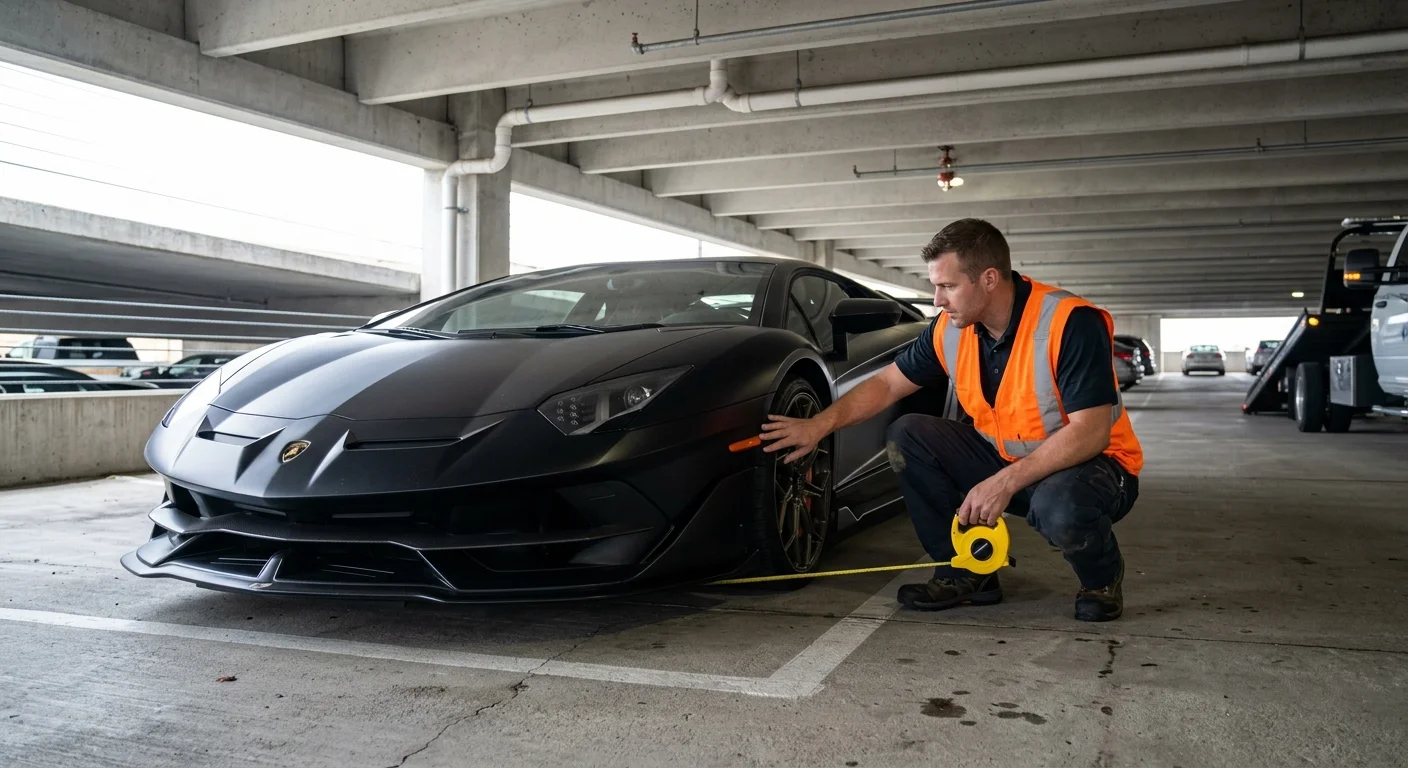
Share the garage level and entrance first
Start with the full garage location, not a nearby landmark. “Downtown Springfield” or “near Missouri State” leaves too much unresolved. Give the garage name, its street address, and the entrance you used.
A parking structure may connect to more than one street. The operator needs the entrance that actually reaches your car. Note any gate arm, ticket booth, keypad, permit check, or restricted entry. If an attendant controls access, ask what information that person needs from the operator.
Next, identify the car’s exact position. Include the floor, section, row, and nearest marked space. Say whether it’s beside a stairwell, elevator, ramp, wall, or support column. Don’t guess that two entrances reach the same level.
Your first description should cover these points:
- The entrance street and posted garage name
- The level, row, section, and nearest space number
- Whether the car faces a wall, aisle, or ramp
- The route from the entrance to the car
- Gates, ticket controls, or property access rules
- Any blocked aisle or unusually tight approach
Describe whether traffic inside the garage moves one way. Note if another parked vehicle limits access beside the exotic. An operator may need working room near the front, rear, or wheels.
When the operator contacts you, share clear photos if requested. Useful views include the entrance sign, ramps, car position, and space around it. Don’t photograph only the car. The surrounding structure often determines the recovery plan.
These details matter across Springfield’s metro. A downtown structure presents a different approach from a private garage near Battlefield Road. Give the operator the real entrance, even if another address looks closer on a map.
Height limits and tight turns shape the pickup
Read every posted clearance sign exactly as shown. Check the public entrance and any sign before an internal ramp. Don’t round the number or judge clearance by sight.
The entrance height isn’t the only constraint. A path may include low signs, overhead pipes, gate equipment, steep transitions, or tighter upper-level turns. Report what you can see without entering restricted areas or standing in traffic.
Also describe the route through the structure. Is the car one turn from the entrance or several levels above it? Are the ramps straight, curved, or sharply angled? Does the aisle allow vehicles to pass, or is it narrow with parked cars on both sides?
A carrier suitable for a curbside pickup may not suit the garage entrance. That doesn’t rule out professional recovery. It means the operator must decide whether equipment can reach the car or whether the move needs stages.
The independent operators we connect you with can provide flatbed towing service after access has been evaluated. That page doesn’t mean a full-size carrier can enter every garage. Posted height, turning room, ramps, and transfer space still control the plan.
Don’t ask an attendant to ignore a clearance sign. Don’t guide equipment through a space the operator hasn’t evaluated. Give the posted limit and let the operator compare it with the planned setup.
Photographs can resolve details that are hard to explain. Capture the clearance sign, gate, tightest turn, and ramp nearest the car. A short description should accompany each image. “Second ramp after the west entrance” is more useful than “tight corner.”
If no posted limit can be found, say that plainly. Ask garage management where the official clearance information is displayed. Never estimate a garage dimension from nearby vehicles.
Locked wheels and low clearance affect equipment
An exotic that won’t start may also refuse to roll or steer. Those are separate problems, and each changes the recovery plan. Tell the operator what the car does now, not what it normally does.
Report whether you have the key or key fob. Say whether the doors open and the dashboard powers on. If you already know, explain whether the transmission selects neutral, the steering unlocks, and the parking brake releases. Don’t experiment with unfamiliar controls just to complete the list.
Wheel position matters inside a narrow stall. Tell the operator if the front wheels are straight or turned. Mention a damaged tire, bent wheel, settled suspension, or visible fluid beneath the car. If something is unknown, call it unknown.
Low bodywork adds another constraint. Note front splitters, side skirts, rear diffusers, modified suspension, or removable aerodynamic pieces. Don’t remove parts unless the vehicle manufacturer’s instructions clearly assign that task to the owner.
The operator may consider wheel skates, dollies, a winch arrangement, or another method. Equipment choice belongs to that operator. The right option depends on the car, its position, the garage surface, and available working room.
Avoid improvised moving attempts. Don’t drag a locked wheel, push the car down a ramp, disconnect parts, or crawl underneath it. Those actions can make the operator’s access problem harder.
General collectible-car loading is covered in our classic car towing guide. A garage recovery adds separate limits. The structure may prevent the road-going carrier from reaching the vehicle at all.
When describing clearance, include the lowest visible body point. A nose parked close to a wall may leave no direct approach. A car centered in an open aisle creates a different problem. The operator needs that distinction before selecting equipment.
Give the exact model before dispatch
“Low sports car” isn’t enough. Give the exact year, make, model, and trim. Include any known drivetrain or suspension changes. Small differences within one model line can affect the manufacturer’s transport instructions.
Tell the operator whether the vehicle is rear-wheel drive, all-wheel drive, hybrid, or electric, if known. State whether it has factory air suspension, a nose-lift system, carbon bodywork, or aftermarket ride-height changes. Never guess. “I don’t know” is useful information.
Share the current failure symptoms in plain language. Examples include no electrical power, dashboard power without engine start, an immobilizer warning, or a damaged wheel. Don’t diagnose the cause unless it has already been confirmed.
The key situation also matters. Say whether the key is present, locked inside, missing, or not recognized by the car. Include any manufacturer app access that still works. The operator can then decide what additional information is needed.
Check the towing or roadside section of the owner’s manual. Some vehicles display model-specific transport instructions or warnings. Relay the wording accurately instead of translating it into your own loading plan.
Electric vehicles require the same model-level detail. Our guide to Tesla flatbed towing in Springfield explains why available controls and transport settings should be reported. Don’t assume those steps apply to another electric or exotic model.
Quick Tow Springfield is a referral service. We use the information you provide to line up an independent operator. Our exotic and classic vehicle towing service is built around that matching process.
The operator sets the price. Garage access, wheel condition, vehicle configuration, and any transfer step can affect the proposed work. You get the number before anyone is dispatched. A private garage recovery isn’t priced from Springfield’s police-ordered towing contract.
Plan where the car can be transferred safely
The final destination is only half the plan. The operator also needs to know where the exotic can leave the garage and meet road-going equipment, if a transfer is required.
Ask garage management where towing equipment may enter, wait, or stage. Confirm whether a loading area, service entrance, or other approved space exists. Don’t assume a sidewalk, fire lane, traffic lane, or neighboring lot is available.
The operator may propose moving the car from its stall to a suitable transfer point. That decision depends on access and equipment. The operator and property representative should agree on the location before movement begins.
Describe the exit route as carefully as the entry route. Note gate controls, sharp ramp transitions, one-way aisles, speed bumps, and the space beyond the exit. A clear garage aisle doesn’t help if the carrier has nowhere to position outside.
Then provide the delivery address. Confirm that the dealer, specialist, storage site, or private property can receive the car. If the destination is closed, ask that location about its key-drop and vehicle-receiving rules. Don’t leave an exotic at an unconfirmed entrance.
Springfield geography affects this step. A transfer in the downtown core differs from a trip toward Republic, Nixa, or Ozark. A destination near Branson generally directs the road portion toward US-65. A trip north or west may involve I-44 or another route.
Current traffic and incident conditions can also affect route selection. The MoDOT Traveler Information Map provides current Missouri traffic, camera, and incident information. Check it before departure, but let the operator select the final route.
Tell the operator if the destination has another gate, ramp, steep driveway, or low-clearance entrance. Solving the first garage problem shouldn’t create the same access problem at delivery.
A complete plan identifies three places: the car’s exact stall, a workable transfer area, and a confirmed destination. Each location needs enough room and access for the operator’s chosen method. Don’t move the vehicle toward an exit until that plan is settled.
When to call us
When the car won’t start, roll, steer, or clear the garage without special handling, stop treating it as a do-it-yourself move. We take calls 24/7, collect the garage and vehicle details, and line up an independent local operator. Calls are recorded and transcribed after a notice. Call us at (417) 221-8911.