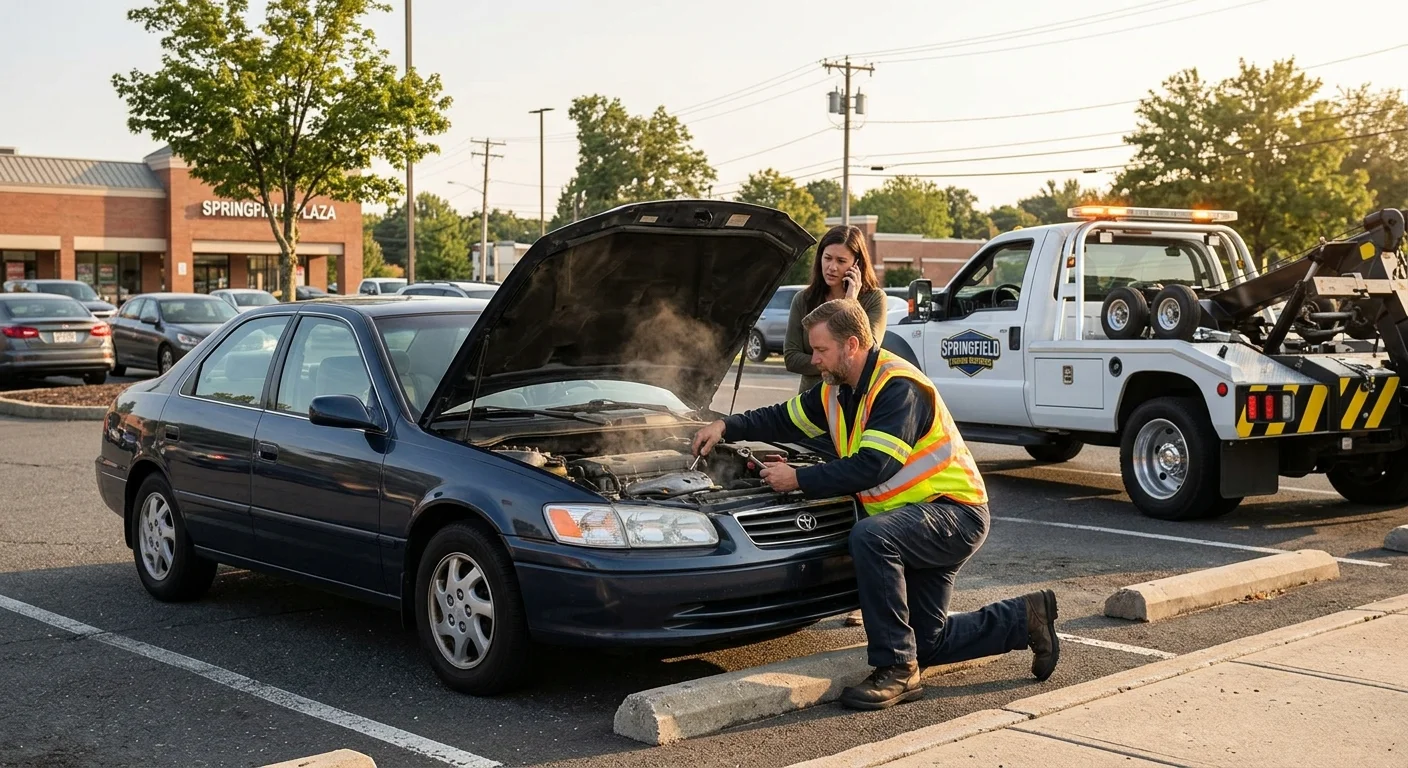
If you’re asking, “should I tow an overheating car,” stop the trip and check the current owner’s manual. Choose a tow when the manual says not to continue, the temperature warning remains, steam or fluid is visible, or you can’t assess the car safely. A repair professional, not a symptom list, should identify the cause.
Treat the warning as a stop-and-assess moment
An overheating warning changes the trip. Your next step isn’t deciding whether you can reach home. It’s finding a suitable stopping place and reading the instructions written for your vehicle.
Dash displays differ between makes, models, and years. Some use a gauge. Others show a symbol or written warning. Follow the exact guidance in your current owner’s manual. If the printed copy isn’t available, look for the correct manual through the manufacturer’s official source.
Note what happened before the warning appeared. Record the road, direction of travel, and nearby exit or business. Photograph the dashboard after you’re parked. Tell the operator whether the engine is running, whether it shut off, and whether you tried restarting it.
Don’t use a general symptom list to overrule the manual. A light that disappears doesn’t prove the underlying problem has been resolved. It only describes what the dashboard shows at that moment.
Choose emergency towing when the manual directs you not to continue or the warning remains. Towing also makes sense when you can’t complete the manual’s checks where the car sits.
The goal isn’t to diagnose the car beside the road. It’s to make a clear transport decision. An independent operator can move the vehicle to the repair shop you select. The repair professional can then inspect the cooling system and determine what happened.
Steam, warning lights, and coolant loss change the call
Steam, a temperature warning, and visible fluid are details to report. They aren’t a roadside diagnosis. Several problems can look similar from the driver’s seat, so avoid assigning a cause before a repair professional checks the vehicle.
Start with what you can observe without opening anything hot. Is vapor coming from under the hood? Is there fluid beneath the front of the car? Did a warning message appear, or did the gauge move from its normal position? Take photographs if you can do so from your parked location.
Don’t open a hot cooling system. Follow the cooling and inspection instructions in your vehicle’s current manual. If those instructions aren’t available, leave the system closed for the repair professional.
Color alone doesn’t confirm that a puddle is coolant. Air-conditioning condensation, rainwater, and vehicle fluids can appear beneath a parked car. Describe the liquid’s location and appearance without touching it. That gives the dispatcher and repair shop useful information without turning a guess into a diagnosis.
The tow-or-drive choice becomes clearer when several signs remain together. A continuing temperature warning, visible vapor, or unexplained fluid gives you less basis for another drive. If the manual says to stop operating the vehicle, arrange a tow.
Tell the operator exactly what you observed. That information can help determine how the vehicle should be loaded. It also helps the repair shop begin with a clear account of the breakdown.
A restart and a tow solve different problems
A restart confirms that the car started. It doesn’t establish why the warning appeared. It also doesn’t replace the inspection steps in the owner’s manual.
If the manual provides a restart procedure, follow it exactly. Watch the dashboard and note whether the same warning returns. Don’t repeatedly restart the car to test a theory. When the warning remains or the manual says not to continue, request a tow.
A tow answers the transportation question. It gets the disabled vehicle from its current location to a repair facility without treating the trip as a mechanical test. The repair shop answers the diagnosis question after inspecting the car.
Roadside assistance may fit when the manual identifies a permitted roadside step and the car is parked in a workable location. That doesn’t mean every overheating report can be handled beside the road. The roadside operator shouldn’t be treated as a substitute for a mechanical diagnosis.
Be precise when requesting help. Say whether the engine starts, but also explain the warning that led you to stop. Mention steam, suspected fluid loss, unusual sounds, or a recent repair only as observations. Don’t claim a failed part unless a repair professional has already identified it.
If you’re unsure which service fits, describe the condition instead of choosing equipment yourself. Quick Tow Springfield matches the request with an independent local operator. The operator decides what equipment is appropriate for the vehicle and pickup location.
Springfield streets and highway shoulders need different plans
A car parked near downtown Springfield presents a different problem from one stopped along I-44. In a parking area, you may have room to read the manual, photograph the dashboard, and choose a repair destination. On a highway shoulder, the vehicle’s location becomes part of the decision.
I-44 is Springfield’s freight spine. The segment between Glenstone Avenue and Kansas Expressway carries more than 65,000 vehicles daily, including over 15,000 semi-trucks. US-65 is also a freeway through Springfield and carries traffic toward Ozark and Branson.
Don’t describe your location as only “Springfield.” Give the route, travel direction, nearest exit, and a visible landmark. On I-44, say whether you’re eastbound or westbound. On US-65, include whether you’re northbound or southbound. A mile marker or exit number is more useful than a nearby neighborhood.
Check the MoDOT Traveler Information Map for current traffic, cameras, and reported incidents. If the car is in an active travel lane or there’s an immediate danger, call 911.
Our guide for a breakdown on I-44 covers that highway setting in more detail. It can help you organize the location information an operator needs.
Beyond Springfield, distances and road conditions change. Nixa and Ozark sit south of the city along the US-65 side of the metro. Republic is west of Springfield. Rural Greene, Christian, and Webster county roads may require a road name, crossroads, or dropped map pin.
Your mechanical decision still comes from the correct owner’s manual. Your location decision comes from the conditions around the stopped car. When either one rules out another drive, request transport instead of using the road as a test route.
What to tell the dispatcher about the car
A useful dispatch request starts with location and vehicle details. Give the road or parking-area name, travel direction, nearest intersection, and destination. Share a map pin if the street address isn’t clear.
Next, identify the vehicle. Include its year, make, model, and whether it’s carrying a trailer. Tell the dispatcher if it has been modified, sits unusually low, or has visible damage. Mention any loading concern you already know from the owner’s manual.
Describe the overheating report in plain language. Say which warning appeared and whether it remains visible. Report steam or fluid without guessing which part failed. Explain whether the car starts, shifts, steers, and rolls only if you can confirm those points from the driver’s seat or the manual’s approved checks.
Don’t leave out access details. A vehicle inside a downtown parking structure differs from one in an open lot near Glenstone Avenue. Mention height restrictions, a locked gate, narrow access, or a blocked wheel. On a shoulder, identify which side of the roadway holds the car.
Also name the repair destination before dispatch if you’ve selected one. Quick Tow Springfield doesn’t diagnose the cause or choose a repair shop for you. We pass the request to an independent local operator.
Before accepting service, ask who is being dispatched and what price the operator sets. You should get that number before anyone is dispatched. Our guide to choosing a Springfield towing company explains what else to confirm during that conversation.
Clear details prevent assumptions. They also help the operator understand the car, pickup setting, and requested destination before heading your way.
When to call us
Once the manual says not to continue, the warning remains, or you can’t assess the car safely, it has stopped being a do-it-yourself job. Our line takes calls 24 hours a day, and we can connect your request with an independent local operator. Call us at (417) 221-8911.