The title for that non-running sedan is not in the glovebox, and it is not in the kitchen drawer either. In Missouri, a missing title does not always stop a scrap sale. Scrap metal operators may buy an inoperable car that is at least 10 years old, or parts from one, with no title at all. Newer cars, running cars, and cars that still look like they belong on Kearney or Glenstone do not get that shortcut.
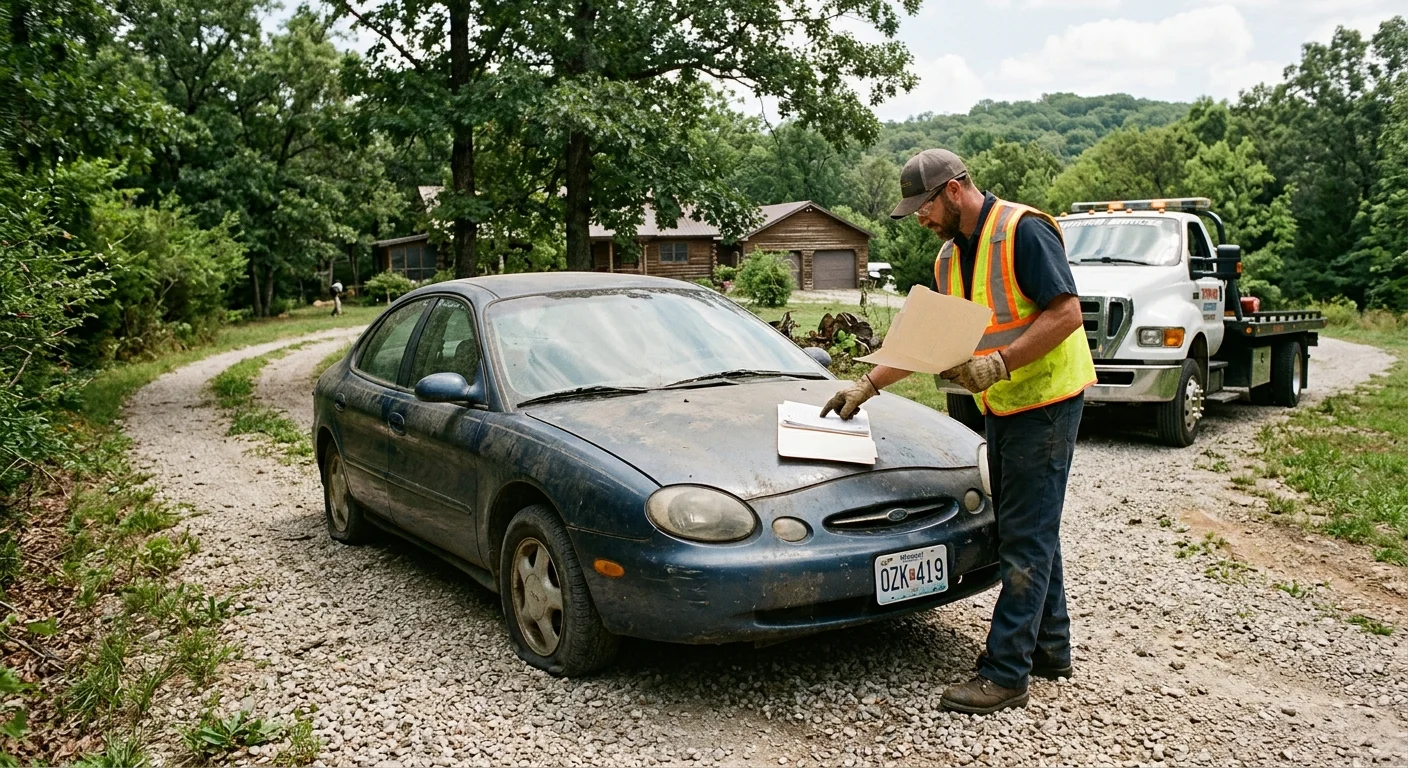
A missing title does not always block a scrap sale
Most Springfield-metro junk sales still start with a title in the seller’s name. Missouri treats that paper as the ownership record the purchaser then sends to the Missouri Director of Revenue. A lost title is a paperwork problem, not a dead end. You can replace it. The no-title scrap question is different. It asks whether the car can leave your driveway without that paper ever showing up.
The verified answer is yes only in a narrow case. Scrap metal operators may buy an inoperable vehicle that is at least 10 years old, or parts from one, with no title. That is the exception in RSMo 301.227. It is not a general Missouri rule for every junk car. It is not a rule for a driveable Honda behind a Nixa garage. It is not a rule for a two-year-old wreck on US-65.
If the car is newer than that 10-year line, or it still runs, plan on a title or a duplicate title before anyone hauls it for scrap. The duplicate path is Form 108 marked “DUPLICATE,” notarized, with an $8.50 title fee plus $9.00 processing, for $17.50. You can file at any Missouri license office, or mail it to the Motor Vehicle Bureau, 301 West High Street, Room 370, PO Box 100, Jefferson City, MO 65105-0100. Our lost-title walkthrough covers that filing. This page stays on the no-title decision.
National listicles talk about bills of sale, old insurance cards, and registration as stand-ins. Those papers can help a cautious buyer see who you are. They are not a verified Missouri substitute for the title on a newer car. If a buyer tells you a bill of sale is enough for a 2019 Camry, ask them to show the statute they are using. The exception we can publish is the inoperable, 10-year-old scrap-metal rule.
Some pages also mention a “$3,000 rule” for cars. No verified Missouri dollar cutoff for a no-title scrap sale turned up in the records this page uses. Missouri’s published exception is age and condition, not a cash figure. Confirm any dollar talk with the Missouri Department of Revenue before you treat it as law.
The narrow inoperable-vehicle exception, and who it applies to
The exception belongs to scrap metal operators. It belongs to an inoperable vehicle at least 10 years old, or to parts from one. Both pieces matter. Inoperable means it is not a running car you could still register and drive. Ten years old is a model-year floor, not a “looks old” test. A 2018 Fusion on blocks in Ozark does not meet it. A 2008 Taurus that has sat in a Republic backyard since the last time it moved might.
Quick Tow Springfield does not buy the car. We do not scrap it. We do not set a payout. We are a referral service. We line up an independent local operator for removal. The operator and the receiving purchaser handle the haul and the filings. If the receiving buyer is not a scrap metal operator, do not assume the no-title exception applies.
A car left on someone else’s lot is a different problem. That is abandoned-property territory under RSMo Chapter 304, not a scrap shortcut. An unattended vehicle removed or subject to removal from public or private property counts as abandoned property whether or not it runs. Landlords in Springfield cannot have SPD tow from an apartment lot just because a tenant left a dead car. They get pointed to the private-property tow process. A neighbor’s Civic rusting on your gravel drive in Strafford is not yours to scrap because the title is gone. Confirm ownership before anyone hooks it.
If the car is yours and it is old, dead, and heading to a scrap metal operator, ask that operator, in writing, whether they are using the no-title exception. Ask them to name the year, the VIN, and the fact that the car does not run. Keep that note with the rest of the file. The exception is real. It is also the kind of rule that gets stretched by people who want the car gone today.
Junking certificate, salvage title, and a regular title are different papers
A regular title says the car can still be a car. A salvage title says it was sold for salvage, dismantling, or rebuilding, and the state is tracking that. A junking certificate is the end of the road. Once a junking certificate issues, no certificate of title or salvage title can ever be issued for that vehicle again. It is retired.
Missouri draws a line at six years. If the vehicle’s model year is 6 years old or newer at purchase, a salvage title is mandatory. If the model year is more than 6 years old, a salvage title is optional. The purchaser may go straight to a junking certificate. That age line is not the same as the 10-year no-title scrap exception. Do not mix them.
If the vehicle had never previously been classified junk, the applicant may rescind the junking certificate within 90 days. They surrender it and apply for a salvage title instead. Once, and only inside that window. After that, the junking certificate stands.
People ask whether a salvage title can become a clean title. That rebuild path is a Missouri Department of Revenue question this page could not confirm as a publishable rule. Do not treat a junking certificate as a salvage title you can later wash. A junking certificate is permanent. For anything else, ask DOR directly on its motor vehicle pages.
Abandoned title Missouri searches land here for a reason. Missouri’s 30-day figure in the towing statutes is a title-transfer clock for an unclaimed vehicle, not a police hold. After 30 days with no redemption or challenge, a tow company can obtain title free of prior liens under RSMo 304.156. That is a custody and notice process. It is not a DIY scrap paper you print at home for a driveway car in Battlefield or Brookline.
What the buyer files, and what the seller should keep
Whenever a vehicle is sold for salvage, dismantling, or rebuilding, the purchaser, not the seller, must forward the title or existing salvage certificate to the Missouri Director of Revenue within 10 days. That filing needs a completed application and an $8.50 fee. Which application form the purchaser uses could not be confirmed from a single primary DOR sentence for this exact use, so this page does not name one. The purchaser applies to the Missouri Department of Revenue. That is the verified instruction.
The affidavit every junk, salvage, or rebuild sale requires is Missouri State Highway Patrol Form SHP-498B, the Junk, Salvage, or Rebuilding Affidavit. The buyer completes it before a notary. The notarized affidavit is kept by the seller. It is not filed with the state. It certifies the vehicle has no valid safety inspection and cannot be registered or driven in Missouri again until it passes one. The underlying regulation is 11 CSR 50-2.140. If a yard hands you a form labeled 498A, that is the wrong number. The Patrol’s own published PDF is stamped 498B.
Do not send a private owner to DOR Form 5825. That form is for a salvage pool or dismantler that took possession at an insurer’s request and sat unclaimed more than 45 days. It is not the everyday junking form for a car in your name.
One filing you skip on a junking sale: a vehicle sold under a salvage title or junking certificate is exempt from the Notice of Sale that a normal private sale requires. A normal private sale must be reported within 30 days. Missing that report is an infraction with a fine of up to $200, and more if the paperwork is fraudulent. Junking is simpler on that one point.
Plates never transfer with ownership in Missouri. Pull them before the buyer takes possession. Transfer them to another vehicle you own, surrender them at any license office, or mail them to DOR at ATTN: License Plate Surrender, 301 West High Street, Rm 370, Jefferson City, MO 65105-0100. There is no refund for unexpired registration.
The full paper stack, in order, lives on our Missouri junking paperwork page. Use that when you have a title and you are junking. Use this page when you do not.
How Ozarks driveway cars usually get stuck on paperwork
The typical stuck car here is not a downtown Springfield daily driver. It is a 12-year-old sedan on a gravel lane off a farm road west of town, or a pickup behind a shop in Battlefield that last moved years ago. Christian County driveways in Nixa and Ozark, Greene County lots in Republic and Strafford, and Webster County yards off US-60 all produce the same file: keys maybe, title no.
Distance and road type change the haul, not the statute. A car on a paved street near MSU’s Springfield campus is easier to reach than one down a low-water crossing after a wet week. A Republic backyard off US-60 is a short run compared with a Branson-corridor driveway that has to thread US-65 visitor traffic. The operator who shows up still needs a clear owner and a clear destination. A scrap metal operator using the 10-year inoperable exception is one destination. A rebuild shop that wants a salvage title is another. A family member who might fix it later is not a scrap sale.
Ownership fights stall more jobs than missing titles. The car is in a parent’s name. The sibling who lives in the house wants it gone. The title is in a lender’s file. Missouri’s lost-title process still needs the owner of record, or a path DOR will accept. A bill of sale from a seller who left town is not a verified substitute on this page.
If the car is on private property that is not yours, stop. Junk car removal is for an owner who can send the car. A vehicle abandoned on your land without consent is a property problem with its own clocks, notices, and, for towers, the RSMo 304.156 title path. Do not treat “it’s been here for months” as a title.
Photograph the VIN plate. Photograph the odometer if you can still read it. Photograph every paper you do have. That file helps the purchaser, and it helps you keep the SHP-498B with a matching VIN.
Who to confirm with before anyone hauls the car
Confirm three things before a wrecker backs down the drive. First, who is the owner of record. Second, whether the car is inoperable and at least 10 years old if you are using the no-title exception. Third, whether the buyer is a scrap metal operator who will actually file.
The Missouri Department of Revenue is the agency that titles, junks, and takes plates. Start at its motor vehicle section, not a Facebook group. The Missouri State Highway Patrol publishes SHP-498B. The seller keeps that notarized affidavit. If anyone tells you to mail 498B to Jefferson City, they have the custody rule backwards.
If the car was towed under a police order and is sitting in a city-contract lot, that is not a scrap-from-the-driveway problem. Springfield’s process for an impounded vehicle is on the city’s Obtain My Impounded Vehicle page. You get a release in person, then you deal with the lot. Do not try to scrap a car that is still in custody.
Ask the purchaser, out loud, who files with DOR within 10 days, and who keeps SHP-498B. The statute puts the title or salvage certificate on the purchaser. The affidavit stays with you. Get copies. If the numbers on the VIN plate, the affidavit, and the buyer’s receipt do not match, do not let the car leave.
Quick Tow Springfield does not hold a towing license, does not run a yard, and does not buy junk cars. When the paperwork is clear and the car needs to come off a driveway in Springfield, Nixa, Ozark, Republic, or the Branson corridor, we dispatch an independent operator. The operator’s price is theirs. You hear that number before anyone is dispatched.
When to call us
Call when the car is yours to send, it will not roll, and you need an independent local operator to take it off the property. The line takes calls 24 hours a day. Calls are recorded after a notice plays. We dispatch an operator. We do not buy the car and we do not file the junking papers. Call us at (417) 221-8911.