For bus towing in Branson, MO, useful dispatch starts with precise details. The operator needs the bus location, vehicle condition, passenger status, and available working space. That information helps the operator assess the request and select suitable equipment.
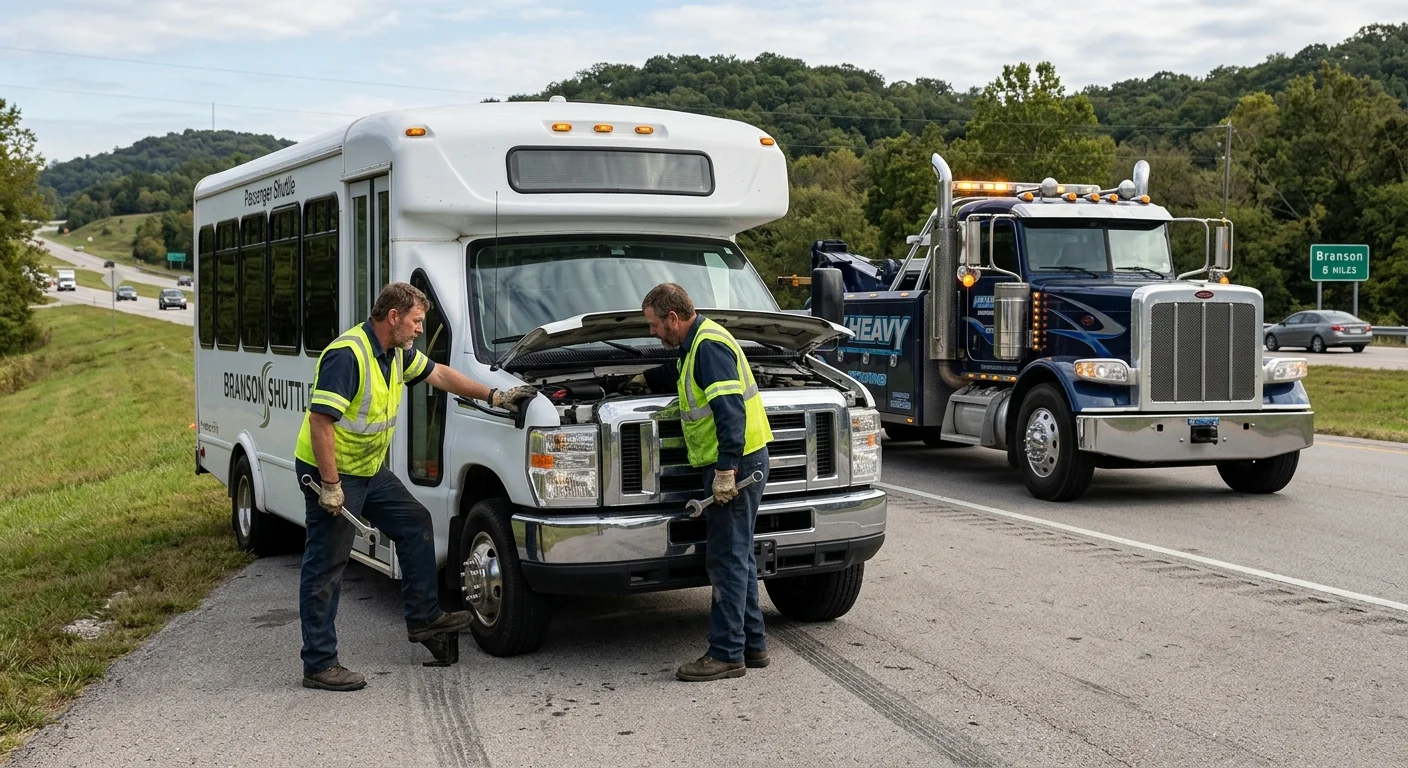
Passenger safety and the exact location come first
Start with any active emergency. Tell dispatch about injuries, smoke, leaking fluid, damaged power lines, or immediate traffic danger. Call 911 when emergency responders are needed before a towing referral can proceed.
Next, identify exactly where the bus stopped. “Near Branson” leaves too much ground to search. State whether it’s on US-65, inside Branson, near Hollister, or farther along the visitor corridor. Include the direction of travel when the bus is on a divided road.
Send a map pin when possible. Add the closest exit, mile marker, intersection, business, or recognizable entrance. If the bus is inside a large property, name the correct driveway and parking area. A hotel entrance, rear service lot, bus lane, and overflow lot may have different access.
Describe where the vehicle sits within that location. Dispatch needs to know whether it’s fully inside a parking space, blocking a travel lane, beside a curb, on a shoulder, or off the pavement. Mention slopes, soft ground, ditches, barriers, and tight turns without guessing their measurements.
Photos can explain what an address can’t. Send wide images showing the bus and surrounding space. Then send closer views of the wheels, damaged area, and road surface. Don’t stand in traffic to take them.
The MoDOT Traveler Information Map provides current Missouri traffic, camera, and incident information. It can help a fleet manager confirm which route reaches the scene without relying on an old navigation screenshot.
Bus size and running condition shape the request
“Bus” can describe several very different vehicles. Tell dispatch whether it’s a hotel shuttle, church bus, school-style bus, passenger van conversion, or full-size motorcoach. Don’t estimate its weight or towing requirements.
Send the manufacturer, model, model year, and vehicle identification number when available. A photo of the manufacturer plate or fleet specification sheet is better than a guess. Include the bus length, height, axle count, and listed weight information if those details are already documented.
Next, explain what still works. Does the engine start? Can the transmission shift into neutral? Does the steering move? Are the brakes released? Can the bus roll, or is a wheel locked? State whether the keys are present and whether the operator can enter the cab.
Report visible damage clearly. Note flat or separated tires, damaged wheels, low body panels, hanging parts, or contact with the pavement. Tell dispatch about any fluid seen beneath the bus without trying to identify it by color alone. Mention a trailer, wheelchair lift, exterior luggage compartment, or other attached equipment.
These details help an independent operator evaluate a heavy-duty towing request. The operator decides which equipment and loading method fit the actual vehicle. Quick Tow Springfield doesn’t own towing equipment or make that technical decision.
A no-start bus and a collision-damaged bus aren’t the same request. If the vehicle left the pavement, struck an object, or can’t roll freely, share that immediately. The operator may need to review the situation as accident recovery or a winch-out rather than a routine tow.
A loaded bus needs a separate passenger plan
Tell dispatch whether passengers are still aboard. Include the current passenger count, the driver, and any accompanying staff. Don’t rely on the bus’s seating capacity as a headcount.
The towing request covers the disabled vehicle. Your organization should make a separate plan for the passengers. That might involve another fleet vehicle, a contracted carrier, or coordination through the tour, hotel, church, or event organizer. Don’t assume the recovery vehicle will transport the group.
Share any passenger needs that affect scene coordination. These may include mobility equipment, children traveling with supervisors, luggage stored beneath the bus, or passengers waiting for medication. Dispatch also needs to know whether unloading has started and who controls that process.
Choose one fleet or group contact for the vehicle request. That person should have the bus details, keys, destination decision, and authority to speak with the operator. A second contact can manage passengers, luggage, and replacement transportation. Separating those roles reduces conflicting instructions.
Give both contacts the same location pin and property description. A replacement bus may use a main entrance while towing equipment needs another access point. If the group moves, tell dispatch whether the disabled bus remains occupied or has been cleared.
Weather, traffic, and nearby activity may change the passenger plan. Don’t ask the tow operator to decide where a tour group should wait. The fleet or tour organizer should coordinate that choice with the property manager or emergency personnel already controlling the scene.
For smaller vehicle problems that don’t require bus recovery, our guide to roadside assistance near Branson explains the details worth gathering before making a service request.
US-65 and Branson parking access affect recovery
US-65 funnels traffic south from Springfield through Nixa and Ozark toward Branson. A tour bus stopped on that route presents a different access problem than one parked at a hotel or attraction.
For a roadside stop, report the direction of travel and the bus’s position relative to traffic. Say whether it’s on pavement, on a paved shoulder, or beyond the pavement. Mention guardrails, slopes, nearby ramps, and visible space around the front and rear.
MoDOT’s Motorist Assist and Emergency Response Program is a scheduled freeway courtesy patrol. It provides roadside cover and visibility, but it isn’t a call-out towing service and doesn’t tow vehicles to a shop. A commercial bus still needs a separate recovery arrangement.
Parking areas bring other questions. Tell dispatch about gates, access codes, height bars, covered loading zones, parking structures, narrow loops, parked vehicles, and one-way traffic patterns. Send photos of the entrance and the approach to the bus. Include a property contact if access requires approval.
Branson receives roughly 9 to 10 million visitors annually. That visitor traffic can make a workable entrance look different across the day. Report the conditions you can see instead of predicting when a lot or roadway will clear.
The planned destination matters too. Tell dispatch whether the fleet wants a repair facility, its own lot, or another approved location. Confirm that destination can receive the bus before the operator is sent. Quick Tow Springfield can line up an operator, but it doesn’t operate a storage yard.
The intake questions overlap with those used for commercial vehicles elsewhere in the region. Our guide to box-truck and medium-duty towing on US-60 shows why vehicle dimensions, running condition, and access details matter across different commercial requests.
What the fleet or tour operator should send
A complete message saves repeated calls between the fleet, referral service, and towing operator. Gather the details from records and direct observation. Mark anything unknown instead of estimating it.
Send these items together:
- The bus’s map pin and written location.
- The direction of travel, when applicable.
- The nearest exit, intersection, entrance, or landmark.
- Clear photos of the bus and surrounding working space.
- The manufacturer, model, model year, and identification number.
- Documented dimensions and listed weight information, if available.
- The axle count and tire or wheel condition.
- Whether the engine starts and the bus can roll.
- Whether steering, brakes, and neutral selection are available.
- Any visible damage, leaking fluid, or contact with the ground.
- Details about attached trailers or exterior equipment.
- The passenger count and whether anyone remains aboard.
- The passenger transportation plan and its coordinator.
- The requested destination and the receiving contact.
- Gate instructions or a property-management contact.
- The fleet contact who can approve the operator’s price.
If a detail can’t be confirmed, say “unknown.” A clear gap is more useful than an incorrect weight, dimension, or mechanical diagnosis. The towing operator can then identify what must be checked before accepting the recovery.
Quick Tow Springfield answers the line and matches callers with independent local operators. We don’t own trucks, employ drivers, or select recovery equipment. The operator reviews the request, sets the price, and provides that number before anyone is dispatched.
Keep the fleet contact available after sending the information. Conditions may look different in the photos than they do from the operator’s approach. Updated information about passengers, access, or vehicle movement should go to the same contact chain.
When to call us
When the bus can’t move normally, passengers need a separate plan, or access complicates recovery, it’s time to request an operator. The line takes calls 24 hours a day, and calls are recorded and transcribed after a notice. Call us at (417) 221-8911.