A Springfield apartment manager on National, a church volunteer on Battlefield, and a shop owner off Glenstone all hit the same fork. A car does not belong on the lot, and someone is asking whether a standing towing contract is the missing piece. Missouri already sets the gate. A private property towing agreement in Springfield, MO is useful paperwork. It is not a city patrol permit, and it does not replace the written authorization the statute requires.
A one-off tow and an ongoing lot contract are different jobs
A one-off private-property tow is a single vehicle, on a named lot, with a person who can authorize that removal. You identify the car. You confirm it is on your property. You put the request in writing. An independent operator then does the work if the Missouri rules for that lot are already met.
A parking lot towing contract in Missouri is a different job. It is a standing relationship so the operator already has your contacts, your lot layout, and a copy of who may sign. It can speed the next request on a Glenstone retail pad or an HOA lot in Nixa. It does not let anyone cruise the property and pick cars at will.
Missouri law requires written authorization from the property owner before a company may start a private-property removal. A standing agreement can hold that authorization in a form the operator will actually accept. It is still authorization for a lawful tow, not a license to patrol.
Quick Tow Springfield is a referral service. We take the request and match you with an independent local operator. We own no trucks, run no yard, and do not patrol lots. The operators we dispatch handle the hookup. The city police-tow system is a third track entirely. Springfield uses a single city contractor for police-ordered tows, Henry’s Towing Service, LLC, under a term that runs through January 31, 2026. That contract’s published rates are for police-ordered work. They are not a private-lot price list, and they do not apply because you manage apartments on Sunshine or a storefront on South Campbell.
If you are calling because a tenant left a wreck that will never move, that may be junk car and abandoned vehicle removal rather than a parking-enforcement hookup. If you already have a specific unauthorized car and the paperwork to back the request, that is private property towing. Those are related jobs. They are not the same dispatch. If you are the driver asking whether a truck can reach a driveway, farm, or gated stall, that access question is can a tow truck come on private property.
A contract does not create a Springfield city permit number for private lots. None was confirmed for this use. The live rules sit in state law, mainly RSMo 304.157, plus the written-authorization and notice duties in 304.158. Get those right first. Then decide whether a standing file with one operator is worth the extra step for your property.
What Missouri already requires before a private-property tow
You can request a truck. The operator still has to stay inside RSMo Chapter 304. For private property, 304.157 is the section that decides whether a wait applies.
A tow without a police order is allowed only on one of three paths. First, owner-occupied residential property of four units or fewer, with law enforcement notified, and ten hours already passed. That is the small house or duplex path, common in older streets off Walnut, Commercial, and the east side near Glenstone. Second, any other private property, with law enforcement notified, and ninety-six hours already passed. That is the default for apartments, churches, strip centers, and HOA lots when the sign path is not in place. Third, compliant signs at all entrances. Then there is no wait.
Those clocks are state law. They are not a courtesy. Skipping them, or skipping the sign path, is how a removal turns into a class C misdemeanor under 304.157.
After the vehicle is gone, the operator still has filing work. An Abandoned Property Report, DOR Form 4669, goes to the Springfield Police Department within two hours when the lot is a signed lot, or within twenty-four hours otherwise. RSMo 304.158 also requires written notice to the vehicle owner within five working days. Storage lots must accept cash and make change. If the vehicle owner returns before the car is actually removed, the statute caps that hookup at half the regular charge.
Unauthorized removal is not a paperwork spat. 304.158 allows four times the damages, and a knowing violation is a class A misdemeanor. Towers are also liable for damage they cause in transit and storage.
Springfield Police will not tow from apartment or rental lots at a landlord’s request unless there is a genuine hazard. Landlords are pointed to the private-tow process. That is why an HOA towing authorization in Springfield, or a manager’s letter for a National Avenue complex, still has to stand on 304.157 and 304.158. It does not ride on a police rotation.
Missouri sets no statewide dollar cap on private-lot tow fees. Local governments may set maximums under 304.158. Springfield does that through the city contract for police-ordered tows. That schedule is not a private-property rate. Do not quote it to a tenant, a congregant, or a shopper as “what towing costs here.”
If the car has been sitting long enough that you are really asking what counts as abandoned, use the separate process for how to remove an abandoned vehicle from your property in Missouri. This page is about authorization and contracts. That page is about the abandoned-property track.
Signs, written authorization, and who can request the truck
Two documents do most of the work: the signs on the lot, and the written authorization the operator keeps.
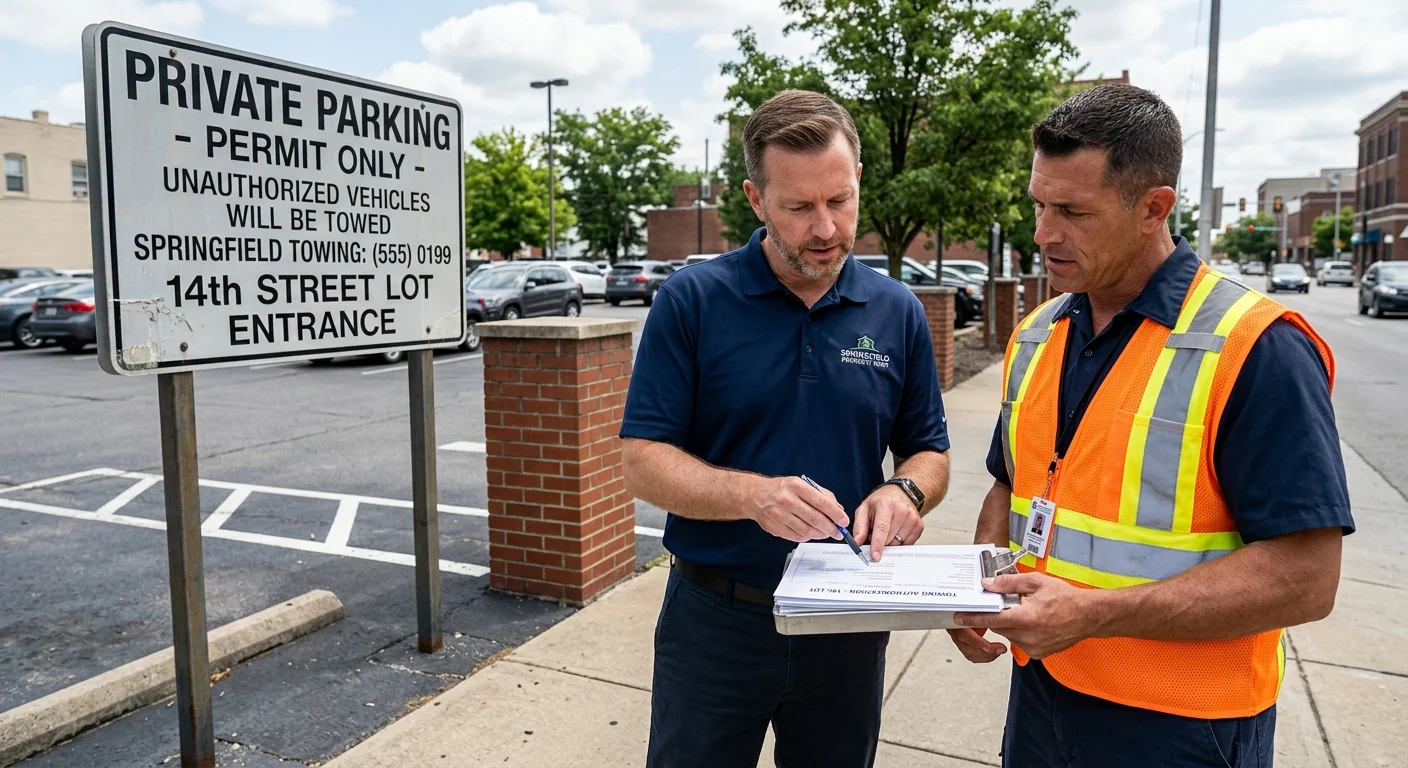
Signs are how you use the no-wait path in 304.157. They have to be at all entrances. The statute is specific about size, lettering, the statement that removal is at the owner’s expense, the maximum towing and storage fee, and a phone number for the vehicle’s location. The full checklist lives on our Missouri tow-away sign requirements page. Do not treat a faded board on one Glenstone curb cut as “signed” when the Kearney entrance has nothing. All entrances means all entrances.
Written authorization is the other gate. Under 304.158, the company may not start the removal without written authorization from the property owner. The operator keeps that paper. A handshake in the lot, a text from a weekend volunteer, or “we have always used the same truck” is not what the statute describes.
Who can request the truck is the owner of the real property, or someone who can actually bind that owner. For a Battlefield church, that is usually a trustee or an administrator named in the congregation’s records, not the person unlocking the building on Sunday. For an HOA in Republic or Ozark, that is the board or the manager with a written grant of authority, not a neighbor who is tired of a boat trailer. For a four-unit owner-occupied building near MSU’s Springfield campus of 25,238 students, it may be the owner who also lives on site. That last case is the only one that can use the ten-hour residential clock.
If you manage for someone else, have that authority in writing before you call. The operator is the one who has to show the authorization later. They will not guess.
Quick Tow does not sign a patrol contract that lets an affiliate remove cars at its own discretion. We refer authorized requests. The operator who rolls still needs the owner’s writing, and the lot still needs either the wait or the signs. That is the Missouri shape. It is not Illinois, Colorado, or Oregon procedure, and those states’ contract forms do not travel here.
Apartment, church, and retail lots in Springfield are not the same
Downtown Springfield, Nixa, Ozark, and Republic share RSMo Chapter 304. They do not share the same lot, the same caller, or the same police practice.
Apartment and rental lots inside the city are the place managers get stuck most often. SPD will not take a landlord’s word and send the city contractor unless there is a genuine hazard. A car in a reserved stall on National, a guest hogging the dumpster pad off Grand, or a tenant who stopped paying and left a sedan, is a private-property problem. You need the signs or the ninety-six-hour clock, plus written authorization. An HOA towing authorization in Springfield should name the property, the people who may sign, and the kinds of vehicles the board actually wants moved. Keep it aligned with what the signs say. A rule that exists only in a lease packet, with no entrance signs, puts you on the wait.
Churches along Battlefield, in Republic, and south toward Nixa often have the opposite gap. The lot is empty six days and packed on Sunday. Overflow spills onto a side drive. Signs were never ordered, or they died in the sun. Without compliant signs at every entrance, the church is on the ninety-six-hour path after law enforcement is notified. A standing file with an operator still helps, because the volunteer who calls at noon will not be the same person next month. The file does not erase the clock.
Retail lots are a third pattern. Glenstone between the Kearney corridor and Battlefield, the Kansas Expressway approaches to I-44, and the pads near Bass Pro Shops at 2500 E. Kearney take through traffic that never meant to shop. Those lots live or die on entrance signs. A private-property tow from a signed retail lot can proceed without the wait. A lot with one sign facing the street and a second unmarked cut from the alley is not finished. Christian County lots in Nixa and Ozark follow the same state statute. They are simply outside Springfield’s police-tow contract, so there is even less reason to mix Henry’s city rates into a private request.
US-65 south toward Branson adds visitor parking pressure on weekends, with roughly 9 to 10 million people a year moving through that corridor. A church or strip center on that funnel sees more one-off cars, not a different statute. Write the authorization for the lot you actually manage. Do not borrow a downtown apartment template and tape it to a gravel overflow field.
What to have ready before you ask an operator to quote
Have the lot file in one stack before you pick up the phone. The operator sets the price. You get that number before anyone is dispatched. You do not get a useful number if the caller cannot prove the request is lawful.
Bring proof that you can authorize the tow: deed, management agreement, HOA resolution, or a letter from the owner that names you. Bring the street address and a plain description of the stall, the building, and which entrance the truck should use. A “the lot behind the shop on Glenstone” call wastes the first conversation.
Photograph the vehicle: plate, VIN if you can see it, how it sits, and what it blocks. Photograph every entrance sign, or photograph the absence of signs if you are on a wait. If you used the ten-hour or ninety-six-hour path, be ready to say that law enforcement was notified and when. If the car is a long-dead hulk, say that up front so the operator can treat it as removal, not a parking hookup.
Do not ask for the city contract schedule. Do not ask this brand to patrol. Do not ask for a Springfield private-lot permit number. None was confirmed. Confirm instead that the operator meets RSMo 304.154: a visible business address, secure lighted storage, published rates, and at least $500,000 in liability coverage. That is the company’s statutory floor, not a claim about Quick Tow.
We serve Springfield and the rest of the metro across Greene, Christian, and Webster counties, plus the Branson corridor. The request still has to be tied to one property. Name that property. Then ask for the quote on that job.
When to call us
Call when you have a specific vehicle, a property you can speak for, and written authorization ready, and you need an independent operator lined up rather than another round of notes on the windshield. Quick Tow Springfield refers that request. We do not patrol, and we do not set the operator’s price. The line takes calls 24 hours a day at (417) 221-8911. Calls are recorded after a notice plays, and an independent local operator is dispatched from there.