The dual-rear-wheel pickup is on the I-44 shoulder, and it is not limping to a shop. A sedan-style hook is the wrong request. A semi wrecker may be too. What the operator needs first is your exact place on the interstate, how the truck is built, and whether a trailer is still on the hitch.
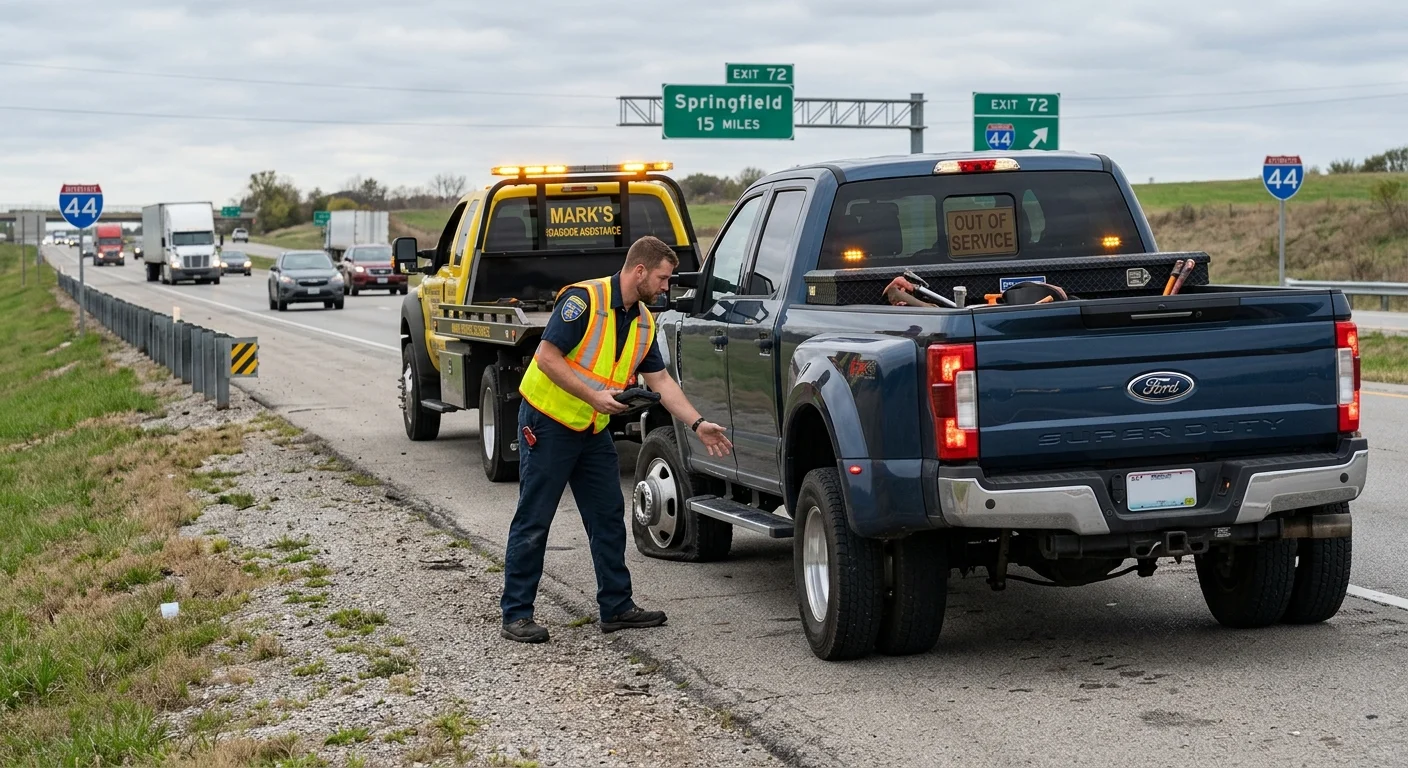
Start with the pickup’s exact I-44 location
You are not “somewhere near Springfield.” I-44 cuts across several different jobs in a few miles.
Name the direction first. Eastbound toward St. Louis is not westbound toward Joplin. Then name the interchange you can actually see. Glenstone. Kansas Expressway. Chestnut Expressway. US-65. Or the Brookline and Farm Road 115 side west of town. If you already passed Strafford and have not reached Glenstone, say Strafford. If you are west of Kansas Expressway heading toward Republic, say Republic.
Springfield city, Nixa, Ozark, and Republic do not share the same ramps. They do not share the same lighting either. A downtown shoulder with wall and gore is one staging problem. A dark rural pull with a long walk from the nearest exit is another.
A mile marker beats a landmark you half remember. If the truck has a nav screen, read the mile. If it does not, use the last exit sign. Then say which side you are on: right shoulder, left shoulder, ramp, or median.
Check MoDOT’s Traveler Information Map or Missouri 511 from the cab if you can. That map shows cameras and incidents. It does not send a wrecker.
Hazards on. Stay out of the travel lanes. If you can stay in the cab with the seat belt on, do that. If the pickup is in a live lane or someone is hurt, call 911 first. A police-ordered tow inside Springfield city limits is a city-contract job, not this referral. If you later need a vehicle the city had moved, the City of Springfield explains that on its Obtain My Impounded Vehicle page. Do not mix that path with an owner-requested breakdown tow.
MoDOT’s Motorist Assist / Emergency Response works from the Transportation Management Center of the Ozarks. The state freeway courtesy patrol has run since 1993. Springfield-based staff handled 3,260 incidents across 21 counties in 2022. They put cover on a shoulder. They do not tow a disabled pickup to a shop. Do not hold the truck for them if you already know it cannot roll.
I-44 is 293 miles in Missouri, the longest interstate in the state. Through the Glenstone-to-Kansas Expressway segment it carries 65,000-plus vehicles a day. About 23 percent of those are semi-trucks. Prime Inc. has been headquartered in Springfield since 1980, so this stretch is used to freight. A dual-rear-wheel pickup on that shoulder is easy to miss between trailers. Exact location is how an independent operator finds you at all.
Truck configuration shapes the equipment request
A dually is a pickup with two wheels on each side of the rear axle. That is the fact that matters on the call. It is not automatically a semi. It is not a sedan either.
Do not tell dispatch “just a truck.” Say dual rear wheels. Say the make, model, and color. If the door badge reads 2500 or 3500, read it off. If you do not know the class, say you are not sure. Guessing a weight class does not help. We do not publish a pound limit for this job, and we will not invent one.
Lifted trucks, long beds, crew cabs, and aftermarket fender flares change how an operator approaches the rear. A lift kit is not a reason to skip a tow. It is a reason to say the truck sits high. The operator can then plan ramps, straps, or a bed that can take that stance. The operator who takes the job decides what their equipment can handle.
Four-wheel drive, locked hubs, and a transfer case that will not go to neutral all change the move. If the driveline is locked, say so. If you have keys, say so. If the truck is in park and will not shift, say that too.
This sits in the gap between a light car hook and a box truck on US-60. Some dualies can roll onto a flatbed. Some sit too wide, too tall, or too loaded. Heavy-duty towing is the service path when the operator needs a bigger wrecker. That is an equipment call. It is not a nickname for every dual-rear-wheel pickup.
Quick Tow Springfield is a referral line. We match you with an independent local operator. We do not own wreckers. We do not set the price. You hear the operator’s number before anyone is dispatched.
A dually on I-44 is also not a disabled semi. A tractor with a 53-foot box is a different request. If you are in a pickup, say pickup. If you have commercial plates or a company name on the door, mention that. The operator then knows it may be a work truck with extra gear in the bed.
A trailer or load must be described separately
A lot of dualies on this corridor are not empty. Fifth-wheels heading toward Branson. Gooseneck stock trailers. Equipment trailers. A loaded bed. Each one changes the job.
Describe the truck and the trailer as two pieces. Is the trailer still coupled. Ball hitch, fifth-wheel, or gooseneck. How many axles on the trailer. Can it roll. Is it loaded, empty, or you cannot tell. Animals, fuel, or equipment in it: say the type. Do not guess a pound count.
If the trailer can be unhooked and left safe, say that. If it cannot, say you need both moved. Do not assume one wrecker handles both. The operator decides whether that is one trip, two trips, or a different truck.
Bed load matters even without a trailer. A welder, a pallet, or a camper shell changes the rear weight and the tie-down plan. You do not need a certified scale. You need a plain description: empty bed, tools, or a visible load.
Missouri does not require a towing rider on auto insurance. Coverage is an optional add-on set by your policy. If you have roadside through an insurer, say so after you describe the truck. The policy still may not cover a trailer. Check the paper in the glove box rather than assuming.
Branson sees roughly 9 to 10 million visitors a year. Weekend fifth-wheel traffic on I-44, then south on US-65, is real. A dually-plus-trailer on the shoulder near the US-65 interchange is a wider, longer footprint than a lone pickup east of Strafford. Say the combination out loud. The operator should not be surprised on scene.
Wheel condition and access affect movement
Dual rear wheels mean four tires in back. A blowout on the inner dual is easy to miss from the cab. Walk around only if it is safe. Count which tires are down. Say if a wheel is bent, missing, or if the truck is sitting on a rotor.
A truck that will not roll needs a different approach than one that will. If the rear is jammed against the guardrail, say so. If you dropped a dual off the paved shoulder into gravel or a ditch, that is a recovery question, not only a tow. Accident recovery and winch-outs is the path when the pickup is off the pavement, against a cable barrier, or tied to a crash. A soft-shoulder winch can take 15 to 30 minutes once an operator is on scene. A deep recovery can take 1 to 2 hours. Those are job times, not a promise of when someone arrives.
Do not stand in the travel lane to take photos. Take them from behind the barrier. Or from inside the cab if that is all you have.
Access on I-44 is not the same at every ramp. The Kansas Expressway diverging diamond opened in 2009 as North America’s first. It is a tight, multi-stage interchange. A wide dually on a narrow gore point is a different staging problem than a long straight shoulder west of town toward Brookline. Downtown near Chestnut Expressway you may have wall, ramp gore, or a short shoulder. Out toward Strafford you may have more room and less light.
If you are on an entrance ramp, say ramp. If you are in the median, say median. If only the right shoulder is open, say that. Night, rain, and ice all cut visibility. The January 2007 ice storm put about 1.5 inches of ice on the Springfield NWS reading and left about 200,000 without power in the region. You do not need that history on the call. You do need to say wet pavement, ice, or fog.
A spare and a jack do not make this a DIY tire swap on a freight interstate. Inner duals, a loaded bed, and 65,000-plus vehicles a day on the Glenstone-to-Kansas Expressway stretch are a bad mix for a shoulder repair. If you already tried and the truck still will not move, say what you tried. The operator should not be working around a half-jacked axle.
What the driver should send before dispatch
Keep the message tight. This line takes calls 24 hours a day. A greeting and a recording notice play first. Calls are recorded and transcribed. Missouri is a one-party consent state. There is no live person on this line.
Leave this, in order:
Your name and a callback number that will ring on the shoulder. Eastbound or westbound I-44, nearest interchange, and the mile marker if you have it. Dual-rear-wheel pickup, make, model, color, and plate state. Trailer or no trailer, hitch type, and whether it is still attached. What failed: no start, overheat, flat, wreck, or off the shoulder. Whether the truck will roll, and which wheels are down. Keys, four-wheel drive, lift kit, and loaded bed. Destination if you have one: a shop, home, or you need the operator’s suggestion.
Photos help if you can send them after the call. Rear duals. The hitch. The full passenger side. The shoulder width. Do not walk into traffic for a better shot.
If this started as a crash, say so. A breakdown and a collision are different requests. If police are already on scene, say that. Inside Springfield, a police-ordered tow is not this referral. If you are the owner asking for a consensual tow after the scene is clear, say you are requesting the move yourself.
Do not guess a GVWR. Do not guess a wrecker class. Do not ask for a promised arrival window. None of those figures are something this brand can stand behind. The operator who accepts the job quotes the price before they roll. That number is theirs, not a site rate.
If you were heading north toward Fair Grove, south toward Nixa and Ozark, or west toward Republic, name the town you wanted. The metro is Greene, Christian, and Webster counties plus the Branson corridor. A dually that died on I-44 but needs a drop in Ozark is not the same trip as a drop at a shop off Kearney, near Bass Pro Shops at 2500 E. Kearney.
When to call us
Once the dually will not move under its own power, this is not a shoulder DIY. Call when you have the location, the dual-rear-wheel setup, and whether a trailer is still on the hitch. The line takes calls 24 hours a day. Call us at (417) 221-8911. After the notice, leave the details above so we can dispatch an independent local operator.