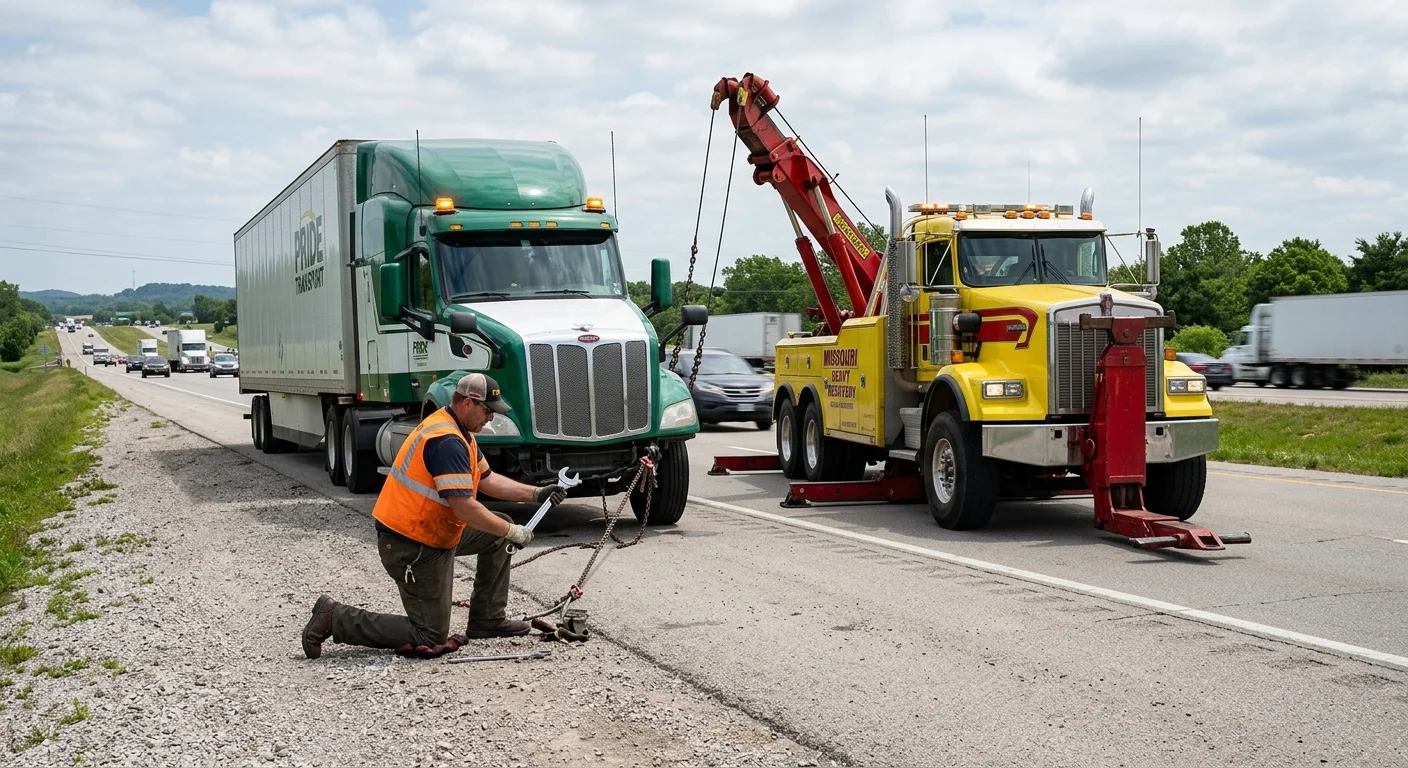
A disabled tractor-trailer on I-44 needs a precise, equipment-aware call. For semi-truck towing on I-44 in Springfield, Missouri, first pinpoint your interchange, identify which unit failed, and report the load. Those details help an independent operator choose equipment and set the price.
Identify the exact I-44 location
Start with the direction of travel. Say eastbound or westbound before giving any other location detail. Then read the nearest mile marker, exit sign, overpass name, or interchange sign.
Springfield has several I-44 reference points that sound similar during a rushed call. Glenstone Avenue sits east of the Kansas Expressway interchange. US-65 is farther east. A driver saying only “north Springfield” leaves too much uncertainty.
Include where the truck stopped relative to the interchange. It might be before an exit, beyond an entrance ramp, or inside the interchange area. Say whether the unit is on the right shoulder, left shoulder, ramp, median, or beyond the pavement. Report if any part of the tractor or trailer remains in a travel lane.
The Glenstone-to-Kansas Expressway segment carries more than 65,000 vehicles daily. More than 15,000 are semi-trucks. That makes precise positioning especially important along this Tier 1 freight corridor.
Check the MoDOT Traveler Information Map for current incidents, cameras, and traffic conditions. A map pin can help, but don’t rely on it alone. Phone location data may identify the road without showing the correct direction.
Report visible landmarks without walking into traffic. An overhead sign, nearby business, bridge, or ramp number can narrow the location. If there’s a crash, fire, spill, injury, or immediate traffic hazard, call 911 first.
For more driver-focused shoulder guidance, read our guide for anyone who has broken down on I-44 in Springfield.
Tractor, trailer, or loaded combination changes the call
Tell the referral service exactly what needs to move. A tractor-only call isn’t the same as a trailer-only recovery. A connected and loaded combination presents another set of access and equipment questions.
For a tractor, report whether it has a trailer attached. Describe the steering, tires, suspension, axles, and driveline as accurately as possible. Say whether the engine runs and whether the air system builds pressure. Don’t diagnose damage you can’t see.
For a trailer-only call, identify the trailer type. A dry van, refrigerated trailer, flatbed, tanker, and specialized trailer can’t be treated as interchangeable. Report visible damage around the landing gear, kingpin area, axles, tires, and rear frame.
For a connected combination, send the full configuration. Tell the operator whether the trailer is loaded, empty, or partly loaded. Include the cargo type and the weight shown on available shipping documents. If the cargo shifted, leaked, or broke through its packaging, say so clearly.
Hazardous materials need exact information from the placard and shipping papers. Don’t guess at a substance or hazard class. Give emergency responders the documented information if the scene involves a spill or exposure.
A mechanical failure can also change the recovery plan. Locked wheels, damaged steering, a separated driveline, or a trailer sitting off pavement may require different equipment. The independent operator makes that decision after reviewing the details.
Our heavy-duty towing service explains how we connect commercial drivers and fleet managers with local operators. Quick Tow Springfield doesn’t own recovery trucks or employ tow drivers. We take the call and line up an independent operator for the situation reported.
When roadside repair is not enough
Some breakdowns may be repairable where the truck stopped. Others need towing or recovery before mechanical work can continue. The key is recognizing when a roadside attempt could create more damage or expose people to traffic.
Give the mechanic or operator the symptoms, not a confident diagnosis. Say what happened immediately before the truck stopped. Describe warning lights, unusual sounds, fluid on the ground, smoke, loss of air pressure, or steering changes.
A truck that still starts isn’t necessarily ready to move. Damaged steering, brakes, wheels, suspension, or coupling components need a qualified assessment. Don’t move a combination simply because the engine runs.
Roadside repair may make sense when the problem is accessible and the unit sits in workable space. A recovery call becomes more likely when the truck can’t roll, steer, or remain stable. The same applies when a trailer is damaged, disconnected in a bad position, or sitting beyond the paved shoulder.
A collision adds another layer. Report the position of every unit, the direction each one faces, and any visible cargo movement. Mention barriers, signs, guardrails, ditches, or other vehicles near the truck. Photos taken from a safe location can help an operator understand the scene.
For a wrecked or off-pavement commercial vehicle, review our accident recovery and winch-out service. The independent operator determines what recovery equipment is appropriate. That decision depends on the truck’s position, damage, load, and available working space.
If police or MoDOT personnel are managing the scene, follow their directions. Tell the referral service which agency is present and whether traffic control has begun. Don’t promise a lane-clearance time to a customer, carrier, broker, or receiver.
Recovery space near a Springfield interchange
An I-44 interchange can offer landmarks while making recovery access harder. Ramps, bridge supports, traffic islands, guardrails, and merging lanes can limit where equipment approaches the truck.
The Kansas Expressway interchange uses a diverging diamond design. It became North America’s first diverging diamond interchange in 2009. A truck stopped near its ramps needs more detail than “I-44 and Kansas.” State whether the unit is on I-44, Kansas Expressway, an entrance ramp, or an exit ramp.
Glenstone Avenue has its own traffic pattern and nearby commercial access. Identify which side of Glenstone you’re near and whether you passed the interchange. On the busiest part of the corridor, one missed directional detail can send an operator to the opposite side.
At US-65, say which highway you’re actually on. US-65 is the north-south freeway through Springfield and continues toward the Branson corridor. A truck transitioning between US-65 and I-44 may be on a connector ramp rather than either main roadway.
Describe the recovery space in plain terms. Note the shoulder width, ground slope, ditch, guardrail, bridge edge, soft soil, or blocked ramp. Mention whether the tractor and trailer remain aligned. If one unit is angled or off pavement, explain which direction it moved.
Weather and visibility also belong in the call. Heavy rain, ice, darkness, fog, or standing water can affect access. Report what you can observe without leaving a protected position.
MoDOT’s Motorist Assist and Emergency Response Program is a freeway courtesy patrol based in Springfield. It runs scheduled patrols and isn’t a call-out towing service. Don’t wait for that program when the combination clearly needs commercial towing or recovery.
What fleet managers should send before dispatch
A fleet manager can shorten the fact-finding process by sending one complete incident summary. Gather confirmed details from the driver, electronic records, shipping documents, and safe photos.
Send these basics:
- I-44 travel direction and nearest mile marker or exit
- Nearest Springfield interchange or cross street
- Shoulder, lane, ramp, median, or off-pavement position
- Tractor make, model, and unit number
- Trailer type and identifying number
- Tractor-only, trailer-only, or connected combination
- Loaded, empty, or partly loaded status
- Documented cargo type and weight
- Hazardous-material placard details, when applicable
- Visible damage and wheels that won’t roll
- Current condition of steering, brakes, air, and driveline
- Police, fire, or MoDOT presence
- Safe photos of the truck, trailer, and surrounding space
- Requested repair facility, terminal, or other destination
Confirm who can authorize the work. The driver, carrier, owner-operator, leasing company, or cargo customer may have different roles. Share the correct billing contact without delaying emergency communication.
Tell us if the tractor and trailer need different destinations. A damaged tractor may go to a repair facility while a usable trailer goes to a terminal. If the destination is outside the Springfield area, our guide to long-distance towing from Springfield explains which trip details matter.
Don’t ask a referral service to select equipment from a partial description. We pass the reported facts to the independent operator. That operator determines the recovery setup and price. Get the price before anyone is dispatched.
Keep the driver’s phone available after sending the details. Conditions can change while traffic backs up or cargo shifts. Report any new leak, smoke, tire failure, vehicle movement, or traffic exposure to emergency personnel and the operator.
When to call us
This stops being a do-it-yourself job when the truck can’t roll, steer, or remain safely positioned. Our line takes calls 24 hours a day, calls are recorded after a notice, and we can line up an independent local operator. Call us at (417) 221-8911.