A breakdown on US-60 near Aurora starts with one practical choice: roadside help or a tow. Your direction, roadside position, vehicle condition, and destination shape that request. Share those facts before an operator is matched.
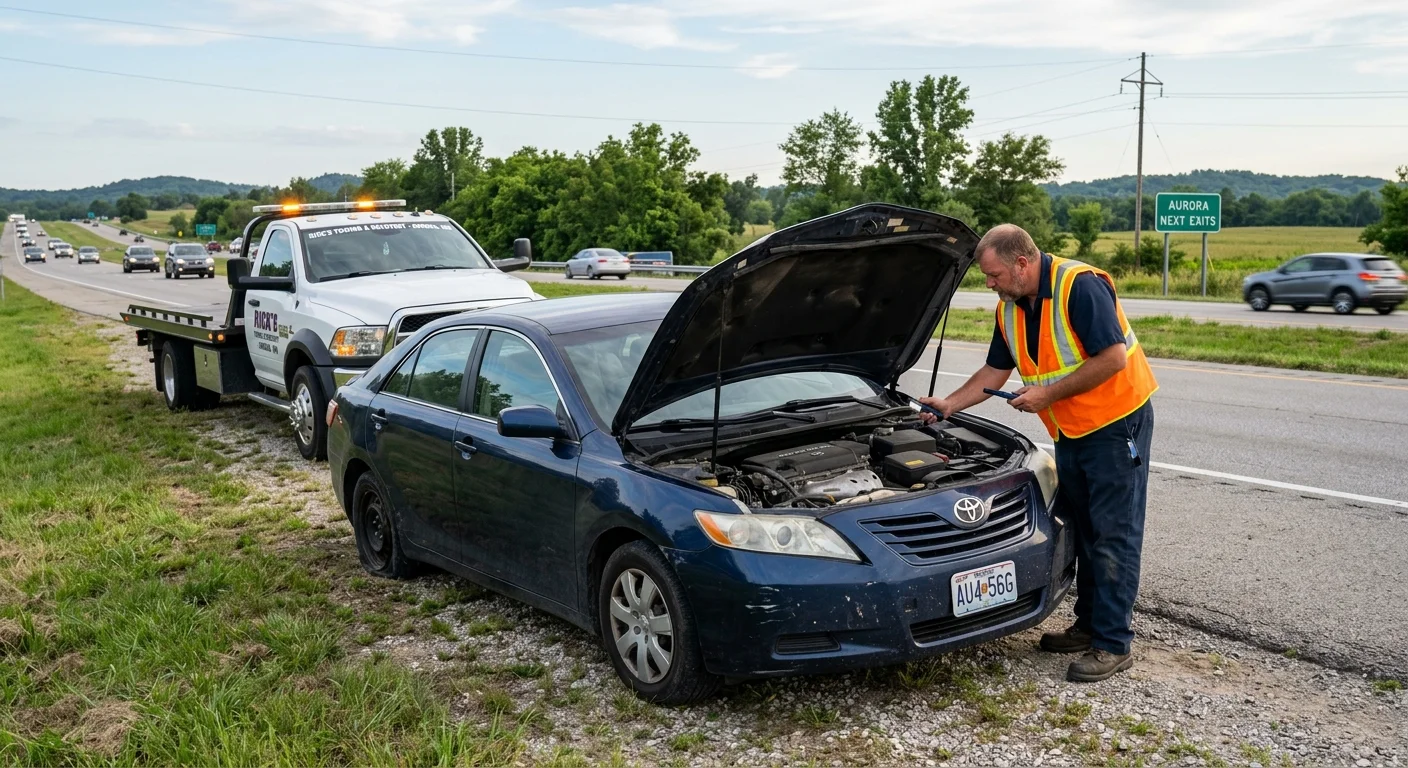
Start with the exact US-60 location
“Near Aurora” covers too much ground for a useful dispatch request. Start with your direction of travel and your position relative to Aurora. US-60 runs east from Aurora toward Springfield and west toward Monett. Saying eastbound or westbound immediately narrows the search.
Next, look for a nearby intersection, route marker, business, or recognizable sign. Your phone’s map can also provide a dropped pin. Read the location carefully instead of relying only on the blue dot. If possible, share both the pin and a nearby landmark.
Your stopping place matters as much as your location. Tell us whether the car is:
- On a paved shoulder
- On gravel beside the roadway
- Close to a traffic lane
- In a parking lot
- In a driveway or private entrance
- Off the pavement or down an embankment
A parking lot provides a different working area than a highway shoulder. An operator needs that distinction before heading toward you. Also mention barriers, gates, mud, steep ground, or limited space around the car.
Follow your vehicle’s current owner’s manual for warning lights and roadside safety steps. Don’t attempt a repair beside moving traffic. If anyone is injured, or the vehicle creates an immediate danger, call 911.
You can check the MoDOT Traveler Information Map for current traffic and incident information. That can help you describe closures or congestion near your location. It doesn’t replace giving the operator your exact position.
Roadside help and towing solve different problems
Roadside assistance may solve a limited problem where the car sits. Common requests include fuel delivery, a jump-start, or help with a flat tire. A tow moves the vehicle when roadside work isn’t suitable or the car shouldn’t be driven.
Start by describing what happened, not by guessing the cause. “The engine stopped while driving” is more useful than naming an unconfirmed mechanical failure. Mention what you saw, heard, or felt. Include any dashboard message exactly as displayed.
If the fuel level is the concern, explain where the vehicle stopped and whether it starts. Our guide to fuel delivery or towing after running out of gas explains the choice without assuming fuel is the only problem.
For a tire issue, report whether the tire is flat, missing, or visibly damaged. Mention any damage you can see around the wheel. Also say whether you have a spare. Don’t loosen parts or lift the vehicle unless its manual permits that work in the current location. The flat-tire roadside or tow guide offers more detail.
MoDOT’s Motorist Assist and Emergency Response Program is a scheduled freeway courtesy patrol, not a requested towing service. It doesn’t tow vehicles to repair shops. Don’t depend on seeing a patrol vehicle near Aurora. Request the specific help your vehicle needs.
Vehicle condition decides what help to request
The operator needs a clear picture of the vehicle before dispatch. That doesn’t require you to diagnose it. Report its present condition and follow any warning found in the owner’s manual.
Useful details include:
- Whether the engine starts
- Whether the vehicle can shift into neutral
- Whether the steering wheel turns
- Whether all four wheels appear attached
- Whether a tire or wheel looks damaged
- Whether the car left the pavement
- Whether there was a collision
- Whether you have the keys
Tell us the vehicle’s year, make, model, and general size. Mention all-wheel drive, four-wheel drive, electric power, low ground clearance, or vehicle modifications when applicable. The operator uses those details when deciding how the car can be loaded and transported.
Don’t crawl beneath the car to inspect it. Don’t try moving it when its owner’s manual says to stop driving. If you can read a warning from inside the vehicle, share its exact wording. A photo taken from a safe position may also help explain visible damage.
A car resting in a ditch needs a different request than one sitting level in a parking lot. Say whether the wheels remain on firm ground. Mention mud, water, loose gravel, a fence, or another obstacle. Those facts help distinguish a basic tow from a recovery request.
If you aren’t sure whether roadside help will work, say that plainly. Quick Tow Springfield can line up an independent operator based on the facts you provide. The operator makes the final transport decision after reviewing the vehicle and location.
Aurora and Springfield destinations change the trip
Choosing the destination before dispatch prevents confusion after the operator arrives. A driver near Aurora may want a local destination or a longer trip east to Springfield. Those are different requests, even when they begin at the same spot on US-60.
An Aurora destination can keep the vehicle near where it stopped. That may suit a home, repair facility, dealership, or another private location. Provide the full street address and any entrance instructions. Confirm that the property allows the vehicle to be left there.
A Springfield destination means continuing east along the US-60 corridor. US-60 becomes James River Freeway through south Springfield. Give the operator a complete address, not only a business name or neighborhood. Springfield locations can have several entrances, service lanes, or after-hours access points.
No current shop availability in Aurora or Springfield could be confirmed from the material supporting this page. Contact the destination directly. Ask whether it can accept the vehicle, where the operator should leave it, and how keys should be handled. Don’t assume a shop is open because its parking lot is accessible.
Quick Tow Springfield doesn’t set the total price. The independent operator doing the work sets it. You’ll receive that price before anyone is dispatched. Share the destination first because it affects the request.
If the car must travel to Springfield, ask for emergency towing help and state that destination immediately. Don’t describe the request as a local Aurora drop if you already know the vehicle needs to go farther east.
What to share before an operator is matched
A complete first message helps us match the request accurately. It also reduces avoidable back-and-forth while you’re stopped near US-60.
Include these details:
- Your eastbound or westbound direction
- Your location relative to Aurora
- A map pin or nearby landmark
- Shoulder, parking-lot, driveway, or off-road position
- Vehicle year, make, model, and color
- The vehicle’s current condition
- Visible tire, wheel, or collision damage
- Whether you have the keys
- Your requested destination
- Any passengers who need separate transportation
Mention trailers, attached cargo, oversized loads, or vehicle modifications. Don’t leave those details until the operator reaches the scene. They may change which independent operator can handle the request.
Photos can help when taken without entering traffic or unstable ground. A wide photo can show the vehicle’s position. A closer photo can show visible wheel or body damage. Don’t take pictures if doing so would place you near moving traffic.
There’s no verified arrival window for an operator near Aurora. We don’t publish estimated response times. Your exact location and accurate vehicle details are still the best way to prevent a mismatched request.
Quick Tow Springfield is a referral service. We take the details and match drivers with independent local tow operators. We don’t own trucks, employ drivers, or operate a storage yard. The operator sets the price and handles the towing work.
When to call us
Call when the owner’s manual says not to drive, roadside help can’t solve the problem, or the vehicle needs transport from US-60. The line takes calls 24 hours a day, and calls are recorded and transcribed after a notice so we can match your message with an independent operator. Call us at (417) 221-8911.