A nighttime breakdown calls for two quick decisions. Get away from moving traffic if you can, then decide whether you need roadside help or a tow. If anyone faces immediate danger, call 911 first.
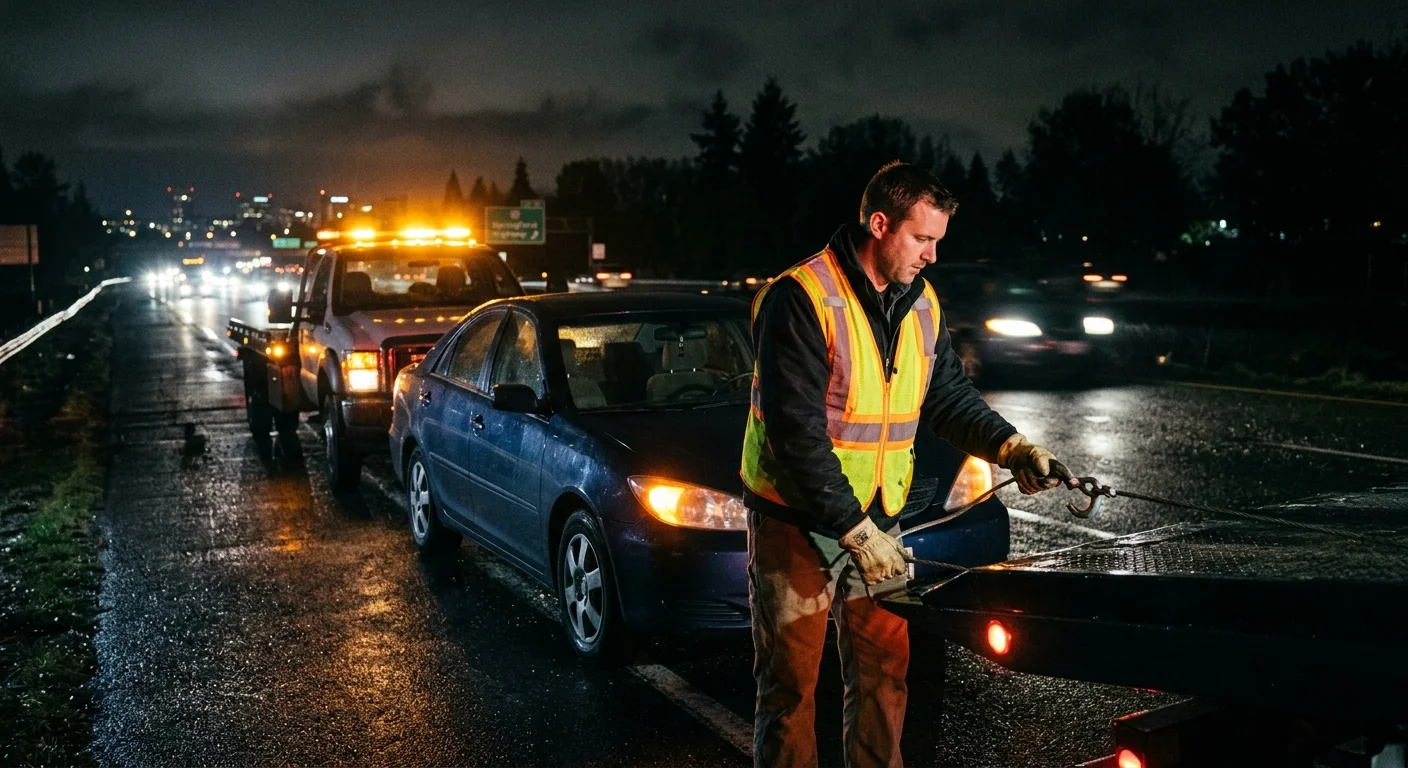
Get the car and yourself out of the travel lane
Turn on your hazard lights as soon as the car loses power. If it still rolls and responds normally, move toward a shoulder, parking lot, or nearby exit. Don’t cross several lanes just to reach a preferred side.
Springfield roads create very different breakdown settings. A stopped car near the downtown grid may have a lighted lot nearby. I-44 and US-65 offer fewer protected places once you’re between exits. The Kansas Expressway diverging diamond also requires drivers to watch traffic coming from unfamiliar angles.
Stop as far from moving vehicles as conditions safely allow. Leave enough room for an operator to reach the car. Don’t push the vehicle along an active road or stand behind it while traffic approaches.
A car stranded in a travel lane needs immediate traffic protection. Keep the hazards running, stay belted if leaving would put you in traffic, and call 911. Give the road name, direction of travel, nearest exit, and lane position. Say whether the car has been struck or is blocking traffic.
Smoke, flames, or a strong fuel smell change the situation. Leave the vehicle if you can do so without entering traffic. Move away from the road and call 911.
Once the car is clear, pause before trying a repair. Darkness makes an ordinary tire change or jump start harder to judge. Our emergency towing service can connect you with an independent operator when the car can’t be handled safely where it stopped.
Being seen: lights, triangles, and where to stand
Hazard lights are your first visibility tool. Keep them on while the vehicle is stopped, unless an emergency official directs otherwise. At night, don’t assume approaching drivers understand why your car isn’t moving.
The Springfield section of I-44 between Glenstone and Kansas Expressway carries more than 65,000 vehicles daily. More than 15,000 are semi-trucks. That volume leaves little room for confusion around a dark shoulder.
Use reflective triangles only when you can place them without walking into traffic. Follow their manufacturer’s directions. Don’t step behind the car on a narrow shoulder to arrange equipment while vehicles pass beside you. A warning device isn’t useful if placing it exposes you to greater danger.
Your waiting spot depends on the road. A guardrail may offer separation if you can reach the protected side safely. On another shoulder, leaving the car may put you closer to moving vehicles. Choose the position with the most distance and strongest barrier from traffic. Don’t stand directly ahead of or behind the disabled vehicle.
Keep children and pets contained. Don’t let passengers gather near the road while checking the engine or unloading bags. If you move away from the car, take your phone and essential medication.
Send your location to someone you trust. A map pin can also help the operator find the correct side of I-44, US-65, or Kansas Expressway. Street names alone can be misleading when divided roads and interchanges separate opposing traffic.
Weather can make visibility worse. Rain reflects headlights, while fog and winter precipitation can hide lane edges. If conditions make your location unsafe, tell 911 that the disabled vehicle is creating a roadway hazard.
Who to call, and what MoDOT’s patrol does and doesn’t do
Call 911 when someone is injured, the car is blocking traffic, or the scene presents an immediate danger. For a disabled car that’s safely off the road, the next call depends on whether it needs a roadside service or transport.
If you’re searching for “24 hour roadside assistance Springfield MO,” identify the problem before requesting dispatch. A depleted battery, lockout, empty tank, or damaged tire may fit roadside assistance. Steering damage, collision damage, overheating, or a car that won’t run may call for a tow. Don’t keep driving to test a problem that could worsen.
MoDOT’s Motorist Assist and Emergency Response program is the state freeway courtesy patrol. It’s based at the Transportation Management Center of the Ozarks in Springfield. It operates as a scheduled patrol, not an on-demand towing service, and it doesn’t tow cars to repair shops.
Springfield also has a separate volunteer Motorist Assist Program through the city. Its role is roadside cover and visibility, not towing. Don’t confuse the city program with MoDOT’s freeway patrol.
Check the MoDOT Traveler Information Map before choosing another route or asking someone to meet you. It displays current Missouri traffic, cameras, and incident information. Missouri 511 also provides current road conditions.
A breakdown on I-44 has its own traffic and location concerns. Our guide to breaking down on I-44 in Springfield explains how exits, freight traffic, and direction of travel affect the call.
Quick Tow Springfield’s line takes calls 24 hours a day. We match drivers with independent local operators, but we don’t own trucks or set prices. The operator’s price should be provided before anyone is dispatched. No unverified arrival estimate should replace clear information about your location and vehicle.
What to have ready before the truck is dispatched
Good location details prevent confusion after dark. Start with the road, direction, nearest intersection, and visible landmark. On an interstate, include the nearest exit or mile marker. In a shopping area, name the business and the side of the building where you’re parked.
Then describe the vehicle and problem clearly:
-
Give the year, make, model, and color.
-
Explain whether the engine starts, cranks, or remains silent.
-
Say whether a tire is flat, a wheel is damaged, or fluids are leaking.
-
Describe the car’s position, including a shoulder, ditch, garage, or gravel road.
-
Mention collision damage, locked steering, or wheels that won’t roll.
-
Share whether the vehicle is electric, all-wheel drive, heavily loaded, or towing a trailer.
-
State how many passengers are waiting and whether anyone has mobility needs.
If you need a tow, have a destination in mind. It may be your home, a repair shop, or another safe location. Confirm that the destination can receive the vehicle, especially after normal business hours. A closed shop may have specific rules for leaving cars outside.
Don’t guess about equipment. Accurate details help the referral service find an operator prepared for the position and vehicle. A car parked normally needs a different approach from one resting in mud or against a curb.
The operator sets the price. Ask for that number before dispatch and explain anything that could change the job, including a ditch, missing wheel, trailer, or difficult access. Quick Tow Springfield doesn’t set or promise the final charge.
Keep your phone available after leaving the message. If the car is hard to see, describe nearby signs, entrances, or lighting. Don’t crawl under the vehicle, attempt a roadside recovery, or stand in traffic while waiting.
If you’re outside the city on a two-lane road
A breakdown outside Springfield changes the location problem. Roads near Nixa, Ozark, Republic, Strafford, and Rogersville can shift quickly from busy corridors to darker rural stretches. Webster County and the Branson corridor add hills, curves, gravel approaches, and longer distances between clear landmarks.
Don’t use “outside Springfield” as the full location. Give the town you last passed, your direction, the road name or county road number, and the nearest intersecting road. A mailbox number, bridge marker, business sign, or map pin may provide a better reference than a distant city name.
Pull completely away from the travel lane when the ground is firm and the move is safe. Soft shoulders can trap a vehicle or make it lean. Don’t drive deeper onto an unfamiliar shoulder just to create more space. Tell the operator if one side has dropped into mud, loose gravel, or a ditch.
Low-water crossings need special care after rain. Don’t stop within a crossing or try to drive through water covering the road. If rising water threatens the car, move to higher ground when you can do so safely and call 911.
Wildlife is another nighttime concern across the Ozarks. Missouri’s statewide deer crash totals peak during October and November, with evening among the busiest periods. If your breakdown followed a collision, use our guide on what to do after hitting a deer before a tow. Don’t approach an injured animal or remain exposed in the road.
Keep the vehicle visible and conserve your phone’s battery. Share the location pin before service weakens. If you must leave the vehicle because the position is dangerous, tell the referral line where you’ll wait.
Distance alone doesn’t determine what happens next. Road surface, vehicle position, nearby traffic, and access all matter. Clear details help us match you with an independent operator serving Greene, Christian, or Webster County and the Branson corridor.
When to call us
When the car can’t be moved safely or a roadside fix won’t solve it, it’s time to line up an independent local operator. Our line takes calls 24 hours a day, and the greeting lets you leave your location, vehicle, and problem so we can match you with an operator. Call us at (417) 221-8911.