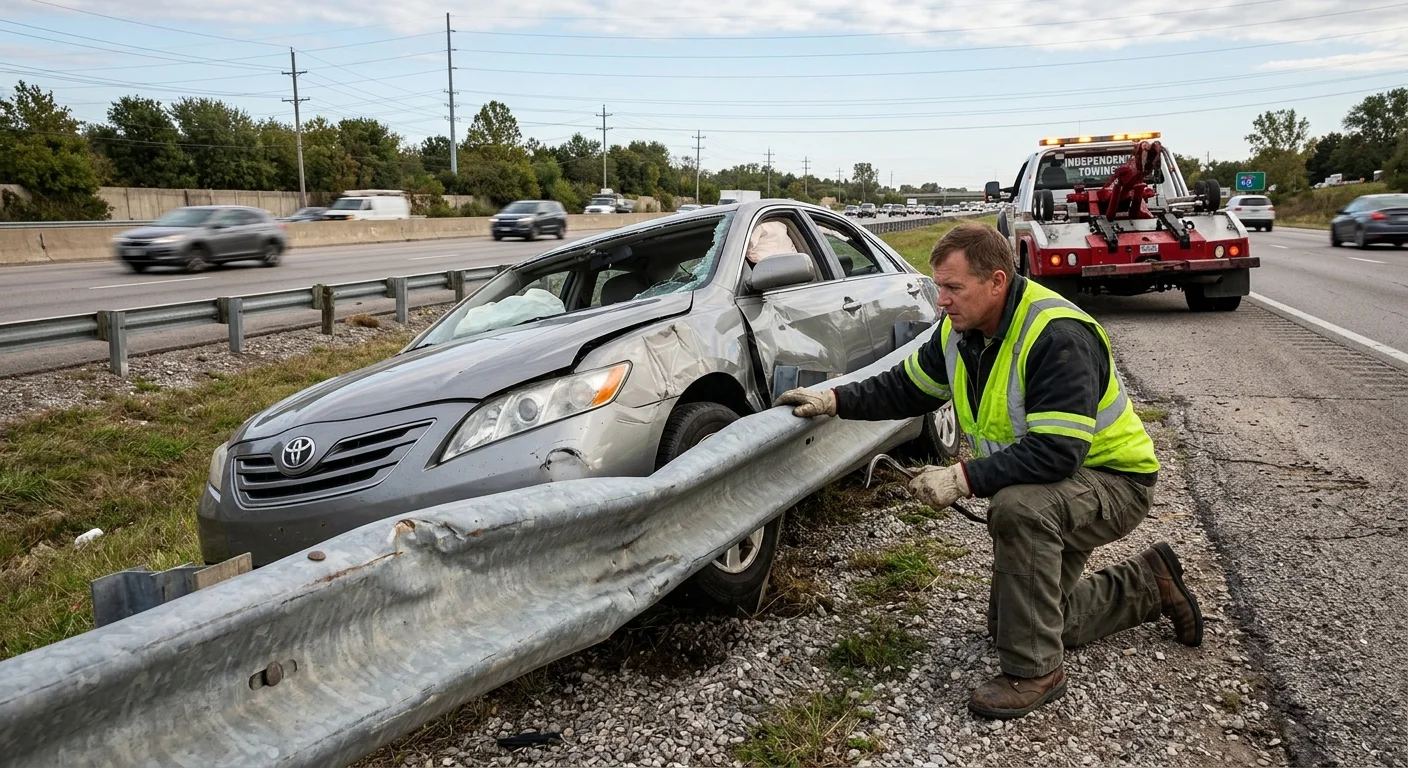
The car is hung on the rail, with traffic still moving on I-44 through Springfield, out toward Strafford, or west toward Republic. You need to know whether this is a recovery first, then a tow, or a load that can happen once the scene is safe. Stay out of the travel lanes, and do not try to pull the car off the steel yourself.
Separate scene safety from vehicle movement
Those are two different problems. One is keeping people out of the path of traffic. The other is getting the car off the rail and off the interstate.
If someone is hurt, call 911. Springfield has two Level I trauma centers, Cox South and Mercy Hospital Springfield. Mercy also runs the only burn center in southwest Missouri. You are not choosing a hospital from the shoulder. Crews on scene do that.
I-44 is Missouri’s longest interstate, 293 miles in the state. Through the Glenstone-to-Kansas Expressway segment it carries 65,000-plus vehicles a day. About 23 percent of that, more than 15,000, is semi-trucks. This is a Tier 1 freight corridor. Prime Inc. has been headquartered in Springfield since 1980. A person standing on the pavement here is easy to miss.
MoDOT’s Southwest District headquarters sits at 3025 E. Kearney Street. MoDOT and the city jointly operate the Transportation Management Center of the Ozarks. MoDOT’s Motorist Assist / Emergency Response program is the state freeway courtesy patrol, based there since 1993. That patrol is a scheduled freeway service. It is not a call-out wrecker, and it does not tow a car to a shop. The City of Springfield also runs a volunteer Motorist Assist Program through SPD’s volunteer unit, in place since April 2014. That program is roadside cover and visibility. It does not tow either. Do not treat either program as the recovery. The MoDOT Motorist Assist page spells out what that patrol does.
Do not walk a live lane to look at a bumper. Do not climb the rail to yank sheet metal. Do not wave traffic around the car. If police or MoDOT already own the scene, follow the people in uniform. If this is a private call after the crash is cleared, that is when a referral for accident recovery belongs. Check the MoDOT traveler map only from a safe place. It shows cameras and incidents. It does not move the car.
Body contact and wheel position shape the recovery
The fork is mechanical, not cosmetic. A scrape on the door is not the same job as a wheel stuffed into a post.
You can see three things without stepping into traffic: where the body touches the rail, where the tires sit, and whether the car is still on its wheels. If all four tires are on pavement and the rail is only against a panel, an operator may treat the next step closer to a standard load. If a control arm is on the steel, a wheel is in the air, or the rail is through the fender, that is a recovery. Dragging it off is how you fold a knuckle or tear a rail cap. No page can give you the odds. The operator on scene has to see the contact.
This is the same split as a car in a ditch. The stuck part and the transport part are not always one motion. A ditch job hangs on slope and soil. A guardrail job hangs on how the car is married to the beam and the posts. Ozark and Nixa sit south of town on different roads. Their ditches and low shoulders are not this interstate rail. Republic and Brookline sit closer to the west I-44 ramps. The method has to match the scene.
If this started as a deer strike, say so. Missouri recorded 2,952 deer-collision crashes in 2024. There is no Greene County figure. Statewide only. A deer hit can leave a radiator open, a wheel tucked, and then a slide into the rail. That stack is not a simple hookup. Read what to do after hitting a deer before you assume the car should roll.
A hanging wheel on an AWD car is a driveline problem, not just a body problem. Describe it. The independent operator on scene chooses the method. Quick Tow Springfield does not. We match you with a local operator. We do not own wreckers, and we do not run the recovery.
Recovery and transport may be separate jobs
People say tow when they mean get it off the rail, then get it to a shop. Those can be two steps even when they happen in one visit.
Recovery is the work that frees the car. That can mean winching, lifting, or unhooking the body from the beam. It ends when the car can roll or be loaded. Transport is the load onto a truck and the trip to a shop, a driveway, or a lot. An operator may do both. They may also tell you the car has to come off the rail before it can be loaded. That is normal. It is not a stall.
Once an operator is on scene, a soft-shoulder winch often runs 15-30 minutes. A deep recovery can take 1-2 hours. Those are job times for the work itself. They are not a promise of when a truck shows up. This brand does not publish arrival windows. We have no fleet to measure them with.
If law enforcement orders the tow inside Springfield, that is a different track. The city runs a single-contractor contract, not a rotation. Henry’s Towing Service, LLC, holds the current term from February 1, 2025 through January 31, 2026. Under that contract, winching is listed at $200 for police-ordered tows. Those are the city’s contract rates, not a quote from us, and they need a re-check after January 31, 2026. A private call through our line is not that contract. The operator who takes the job sets the number. You get that number before anyone is dispatched. We do not set it.
Missouri law on accident-scene towing lives in RSMo Chapter 304. RSMo 304.153 says the owner’s choice of company is honored unless an exception applies. That section does not apply in third- and fourth-class counties. Which agency has your exact mile of I-44 is not something this page can confirm. Follow the officers on scene.
Missouri does not mandate towing coverage on an auto policy. Towing is an optional add-on set by your insurer. Ask them. Do not assume the recovery is included.
I-44 access changes the operator’s assessment
A car against the rail at Kansas Expressway is not the same job as one east of Glenstone. Neither is a car on the US-65 interchange. Kansas Expressway and I-44 was North America’s first diverging diamond interchange, in 2009. That geometry changes how a wrecker approaches and where it can stage. Glenstone between Evergreen and Kearney logged 26 crashes in the 2025 city set. That count is city surface, not an I-44 total. Citywide Springfield had 5,222 crashes and 21 fatal crashes in 2025. Use those as citywide numbers. Do not treat them as a corridor score.
Westbound toward Republic and Brookline, ramp length and the next safe pull-off matter. Eastbound toward Strafford, the freight mix stays heavy. South of town, Nixa and Ozark are not on this rail. They sit on US-160 and the US-65 funnel. US-65 through Springfield was the first six-lane freeway in Southwest Missouri. Branson traffic, roughly 9-10 million visitors a year, feeds US-65, not this I-44 steel. If you slid off a two-lane in Christian County, say that. Do not tell the operator you are on I-44 if you are not.
Median contact is a different access problem than the right-hand rail. Crossing live lanes to reach a car in the median is not something you do yourself. The operator has to plan the approach. Construction on MoDOT’s Forward 44 program, a $471 million corridor project, can also change which shoulder is open. We cannot confirm today’s lane pattern from this page.
Give the operator the direction of travel, the nearest named exit, and which side of the rail you are on. Saying you are on 44 in Springfield is not enough. Westbound I-44, past Kansas Expressway, right-side rail, passenger wheels still on pavement is enough to start the assessment.
What photos and location details to share
Photos help only if you take them from a place that is already safe. Do not step into a lane for a better angle. Do not walk the rail. A shot from behind the barrier, from inside the car, or from a ramp you already occupy is the point.
Send what the operator cannot guess. Direction, westbound or eastbound. Nearest exit or cross street: Glenstone, Kansas Expressway, US-65, Kearney, or the Republic or Strafford side. Mile marker if you can read it from where you sit. Which side of the guardrail the car is on, traffic side or field side. Which panels touch the steel. Which tires are on pavement, in the air, or against a post. Fluids under the car, yes or no. Airbags, yes or no. Whether you have the keys, and whether the car still shifts or rolls. If it is AWD, lowered, or wearing a hitch that changes the load.
A short video that pans from the rail contact to the wheels beats ten close-ups of a scratch. Say if this followed a deer, ice, or a lane change. I-44 in this district does ice. The January 2007 storm put 1.5 inches of ice on the NWS Springfield reading from January 12-14. Do not stand on glazed pavement to photograph a bumper.
If the scene is still an active crash, wait for 911 traffic to finish before you call for a private recovery. If the car is already yours to move, that is emergency towing plus recovery, not a jump-start. We refer both. We do not send “our truck.”
When to call us
Once people are safe and the car is still on the rail, this is not a self-pull. Call us at (417) 221-8911. The line takes calls 24 hours a day, calls are recorded after a notice plays, and we match you with an independent local operator for the recovery and the tow.