Your traction battery just hit empty on a Springfield street, and the car will not move under its own power. The next step is not a random wrecker. Charging access, the owner’s manual, and where you sit on this metro’s roads decide whether an independent operator loads you on a flatbed or tries roadside help first.
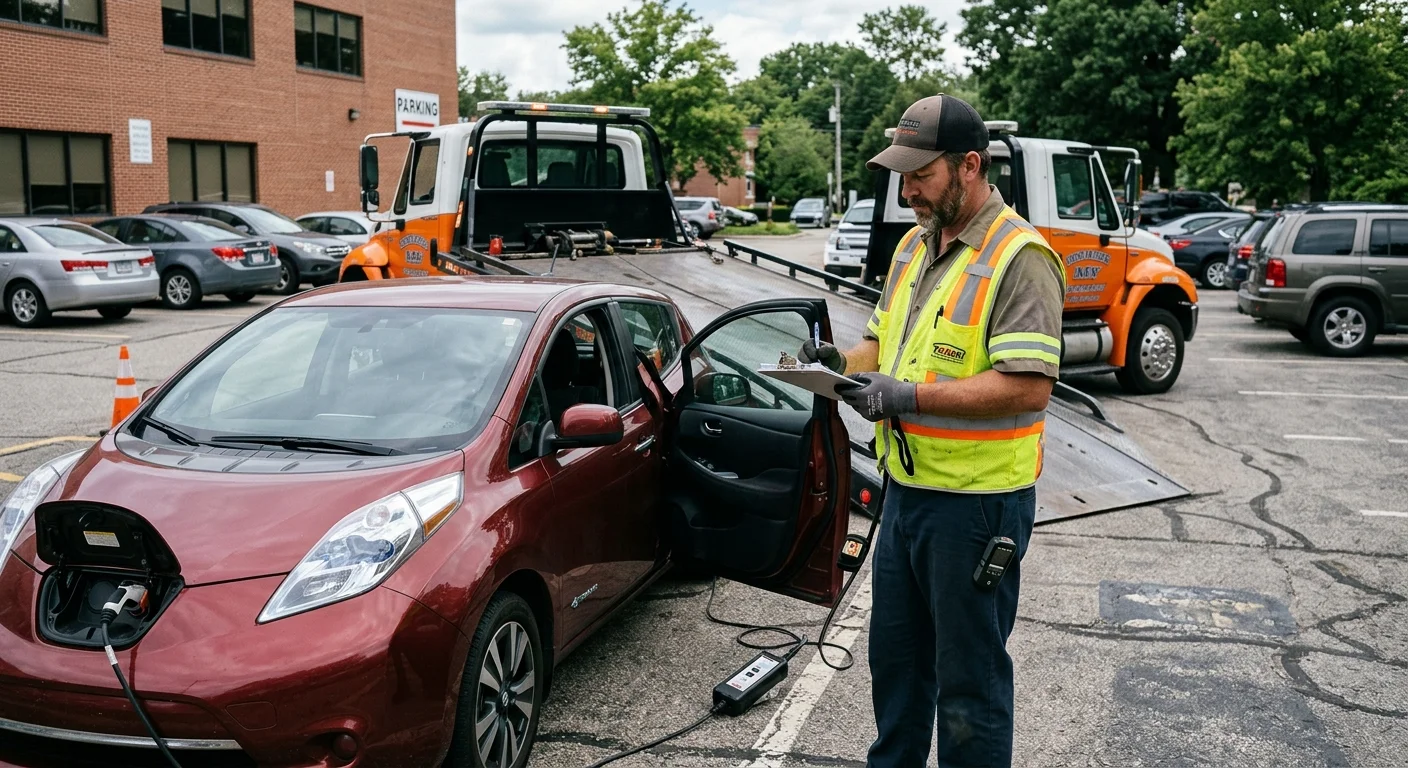
Confirm which battery system is involved
Most electric cars run two battery systems. The traction pack is the large one that turns the motors. A smaller low-voltage battery, often 12 volts, runs the computers, locks, lights, and screens. They fail in different ways. Mixing them up sends the wrong kind of help.
If the dash still wakes and the car reports zero percent or zero miles, you are probably looking at a depleted traction pack. The car may still unlock. Hazards may still flash. It will not drive. That is the electric-car-out-of-charge moment this page is for.
If the car is dark and will not unlock, you may be looking at the low-voltage side. A dead 12-volt battery can hide a healthy traction pack. It can also keep a depleted pack from talking to you at all. We will not diagnose either system on the call. An operator on scene should not guess either. Your job is to describe what you see.
“The screen says 0% and it will not move” is a clear report. “Nothing lights, the app will not connect, and the doors stay locked” is a different report. Do not tell anyone it is just out of charge if you have never seen a charge reading.
A jump does not refill a traction pack. Some manuals allow a 12-volt jump for the small battery. Some forbid it. Follow the book for that vehicle. Fuel delivery does not apply. There is no can of electricity to pour in at the curb.
If the car sat for two weeks in a Nixa driveway or an MSU garage, do not assume the traction pack is empty. Cars that sit often drain the small battery first. That is a wake-up problem, not a range problem. Keep those two stories separate when you call. We cannot confirm how far any model will still roll after the display hits 0%. Manufacturers differ, and invented reserve-mile figures do not help the operator.
Charging access and vehicle condition shape the call
Roadside help only works if you can add charge where you sit, or drive a short, safe distance after a small top-off. We could not confirm a dedicated mobile-charging truck that serves Springfield, Nixa, Ozark, Republic, or the Branson corridor. Do not wait on a charging van that may not exist here. If your insurer or club offers one, they will say so on that call. If they cannot send it, plan on a tow to a charger, a dealer, or home.
A lot near Battlefield and Glenstone is a different job from the I-44 shoulder. In a lot, you may already sit near a public charger. In a downtown garage, the stall may be too tight for a flatbed. On a gravel drive in Christian County, the approach angle changes. On the Kansas Expressway diverging diamond, ramps and sight lines change how an operator stages.
Vehicle condition matters as much as the battery reading. Does the car roll. Are the tires on dry pavement, wet leaves, or grass. Is it nose-in against a curb at an MSU lot. Is Park engaged and the parking brake on. Do you have the key card or fob. Can the screens still open the transport or tow mode the manual names.
Where it goes matters. Towing an EV to a charging station only helps if that station is open, compatible, and reachable after unload. A closed charger at night on the US-65 funnel toward Branson wastes a trip. Home charging in Nixa or Republic can be the cleaner drop if the operator can get there and the car can use that equipment. A dealer or EV-capable shop is the better drop if something besides charge is wrong.
Do not count on pushing the car across a lot. Many EVs are heavy. Many manuals warn against rolling driven wheels on the pavement. If it will not roll freely, say so before an operator is matched.
The owner’s manual controls the loading method
The loading method is not a Springfield ordinance. It is the manufacturer’s instruction for that vehicle. An operator who ignores the manual can damage the motor and inverter. Wheels tied to motors can generate current if they spin on the road.
For a lot of EVs, that means all four wheels off the ground. That is why flatbed towing is the usual request after a depleted traction pack. A wheel-lift that leaves two tires on the pavement is the wrong default unless the manual clearly allows it for that drivetrain.
Tesla owners have extra steps. Transport mode, or the tow settings in the service menu, keep the parking brake from fighting the winch. We already walk through those screens in how to put a Tesla in transport mode and in Tesla flatbed towing in Springfield. Have the fob, a charged phone, and enough low-voltage life to wake the screen if you can.
Other brands use different names: tow mode, transport, service, or a dolly note. Open the tow or recovery chapter. Screenshot it. The operator needs that page more than a generic “it’s electric” warning.
A depleted pack does not make the car easier to load. Some cars still hold Park. Some lose power steering. Some will not release the parking brake without the small battery. Tell the operator what still works.
Missouri’s towing statutes in RSMo Chapter 304 cover removal, notices, and storage. They do not spell out an EV loading method. The mechanical rule still comes from the owner’s manual. The same private-property and highway rules apply as they do for a gas car. We cannot confirm what a full depletion does to a warranty. Ask the dealer or the manufacturer for that.
Parking areas and highway shoulders need different plans
A quiet stall behind a Republic grocery is a loading problem. A live lane on I-44 is a traffic problem first.
On the interstate, start with visibility and position. Hazards on. If you can leave the car, occupants go to the safe side, away from traffic. I-44 through Springfield is a Tier 1 freight corridor. Ozarks Transportation Organization counts 65,000-plus vehicles a day on the Glenstone-to-Kansas Expressway segment, and about 23 percent of that is semi-trucks. A dark EV on that shoulder is easy to miss. Emergency towing is the right request when you sit in a travel lane or on a narrow shoulder, not when you are hunting a charger in a lot.
MoDOT and the city jointly run the Transportation Management Center of the Ozarks. MoDOT’s Motorist Assist / Emergency Response is the state freeway courtesy patrol based there. It has run since 1993. In 2022, Springfield-based staff handled 3,260 incidents across 21 counties. That patrol is not a tow company. It does not haul you to a charger. The City of Springfield’s volunteer Motorist Assist Program is a separate roadside-cover program, and it also does not tow. Read MoDOT’s Motorist Assist page for what the patrol actually does. Use the MoDOT Traveler Information Map or Missouri 511 for cameras and incidents while you wait.
US-65 south toward Ozark, Nixa, and Branson is a different geometry. Branson sees roughly 9-10 million visitors a year. Weekend traffic stacks on that funnel. A depleted EV in a lot off Kearney near Bass Pro is a short staging job. The same car on a two-lane Ozarks shoulder after dark is a longer recovery conversation. Downtown around Park Central, or a tight garage on the MSU campus of 25,238 students, may need a wait for a stall to clear.
If police order a custody tow inside city limits, that is Henry’s Towing under the current city contract, not this referral line. That is a different process and a different lot.
What to share before an operator is matched
Quick Tow Springfield is a referral service. We take the call and match you with an independent local operator. We own no trucks and we set no prices. The operator who does the work sets the number, and you hear it before anyone is dispatched. The line takes calls 24 hours a day. Calls are recorded after a notice plays.
Share this, in order. Exact place: name the city first, Springfield, Nixa, Ozark, Republic, Battlefield, Strafford, or Branson, then a pin, exit, mile marker, lot name, or cross street. “Near Glenstone and Kearney” beats “on the highway.” What the car is: year, make, model, color. A Tesla, Rivian, Bolt, and ID.4 do not load the same way.
Which battery story you have: traction at 0% with a live screen, or a dark car that will not wake. Describe. Do not diagnose. Whether it rolls, and whether you can put it in the transport or tow mode the manual names. Where you want it to go: a named charger, home, or dealer, and whether you know that charger is working. Occupants, kids, pets, weather, and whether you sit in a travel lane.
Missouri does not mandate towing coverage. State law requires liability only and says nothing about towing. Towing coverage is an optional add-on set by your policy. Check your own roadside rider before you assume an insurer will pay.
If you ran out of power while driving, the car stops moving under its own power. That is the fact. Models warn in different ways. We will not invent a reserve-mile figure or a reduced-speed mode. Use whatever motion you still have to reach a safe, legal place, then stop. An EV that has broken down can be towed. The operator follows the manual, usually on a flatbed, to a charger or shop you name.
When to call us
Call when the car will not add charge where it sits, when you cannot reach a working charger under your own power, or when you are on a shoulder, ramp, or tight lot that needs a professional load. Call us at (417) 221-8911. The line takes calls any hour, a notice plays, the call is recorded, and we match you with an independent local operator.