If your car broke down near Strafford, MO, start with your exact position. Your direction, nearest exit, shoulder location, vehicle condition, and intended destination help us match the right independent operator.
Don’t describe the location as simply “outside Springfield.” Strafford sits east of Springfield along I-44, so that wording can send the search toward the wrong part of the corridor.
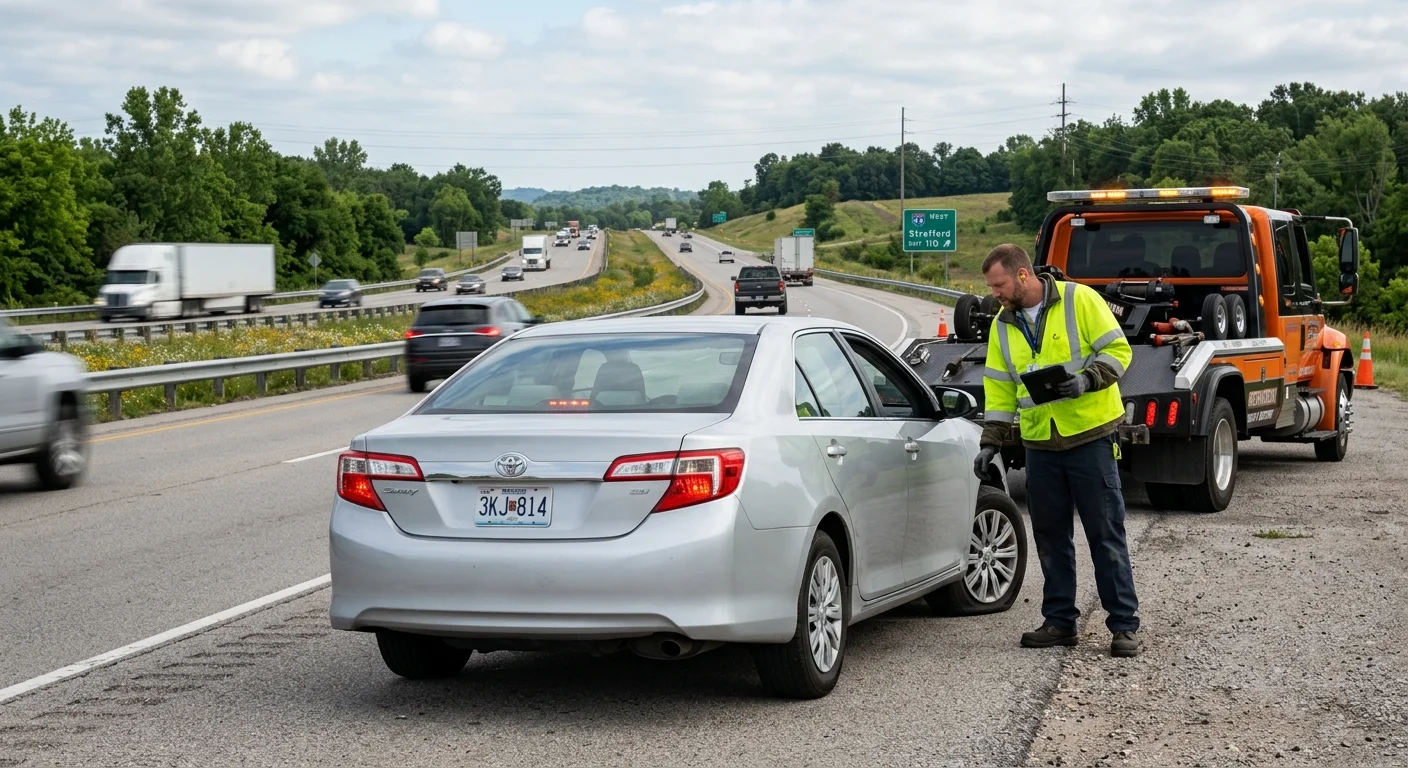
Why the exact Strafford location comes first
The word “Strafford” narrows the area, but it doesn’t locate your vehicle. An operator still needs to know which side of I-44 you’re on. Your travel direction matters because the interstate separates opposing traffic.
Share the direction you were traveling before the car stopped. Then give the nearest exit information or mile marker you can confirm. A map pin can help, but read the location shown on your phone too. That gives the operator something clear to compare against dispatch information.
Explain whether you’re on the outer shoulder, beside a ramp, or near a travel lane. If the car left the pavement, say that immediately. Don’t call a ditch, slope, or soft edge a normal shoulder. Those conditions can change the type of request.
Mention anything visible without guessing. A readable road sign is useful. An uncertain landmark isn’t. If two people are in the car, one can check the map while the other makes the call. Nobody should walk along I-44 just to find a better sign.
If the vehicle is blocking moving traffic or anyone faces immediate danger, call 911. For current traffic, cameras, and reported incidents, check the MoDOT Traveler Information Map. That information can also explain why access from one direction may be harder.
Our guide for a breakdown on I-44 in Springfield covers the city portion. Near Strafford, be clear that you’re east of Springfield so the request stays tied to your actual position.
Roadside help and towing solve different problems
A breakdown doesn’t always mean the car must be transported. It does mean the problem needs to be described before an operator is selected.
A dead battery, empty fuel tank, lockout, or manageable tire problem may fit a roadside assistance request. Describe what happened instead of diagnosing it yourself. “The engine clicks but doesn’t start” is more useful than “the starter is bad” when you haven’t confirmed the cause.
Towing becomes the better request when the vehicle can’t be made movable at the roadside. It may also be needed after a collision, overheating problem, steering issue, or visible wheel damage. Tell the operator what you observed. Don’t restart or move a vehicle when doing so could cause more damage.
MoDOT’s Motorist Assist and Emergency Response Program is a free freeway courtesy patrol based in Springfield. It operates as a scheduled patrol, not an on-demand tow service. It can provide roadside cover and assistance, but it doesn’t tow a disabled car to a repair shop.
That distinction matters near Strafford. Seeing a courtesy vehicle doesn’t replace arranging transportation for a car that still won’t move. When roadside help won’t solve the problem, our emergency towing service can connect you with an independent local operator.
Share the symptoms first. The operator can then decide whether roadside service is practical or whether the car needs towing.
I-44 shoulder access changes the pickup plan
An I-44 pickup isn’t the same as collecting a car from a Strafford parking lot. Moving traffic, divided lanes, ramps, shoulder width, and the vehicle’s position all shape access.
Tell dispatch which side of the car faces traffic. Explain whether every wheel remains on pavement. If the car is angled, partly in a lane, against a barrier, or below the road surface, use those exact words. These details help distinguish a routine tow from a recovery request.
Your travel direction also affects how an operator approaches. A vehicle on the opposite carriageway may look close on a map while requiring a different route. Don’t leave out direction because the map pin appears accurate.
Weather and visibility matter too, but stick to what you can see. Report rain, ice, standing water, darkness, or limited visibility without predicting road conditions elsewhere. The January 2007 ice storm showed how heavily ice can affect the I-44 region, but a past storm doesn’t describe today’s pavement. The MoDOT map is the better source for current conditions.
Don’t assume there’s enough room for a standard pickup. Say whether the passenger doors can open away from traffic and whether a trailer, cargo carrier, or attached load is present. If you’re towing something, provide its type and condition as part of the request.
Drivers continuing farther east or returning toward Springfield may need different destination planning. If you were actually traveling another regional corridor, our guide for a breakdown near Aurora on US-60 explains why that location creates a different dispatch decision.
Vehicle condition determines the operator request
The operator needs to know more than the car’s year and model. The way it failed affects how it can be loaded, moved, and transported.
Start with whether the vehicle rolls, steers, and shifts into neutral. Mention locked wheels, damaged suspension, leaking fluid, deployed airbags, missing keys, or an electronic parking brake that won’t release. Don’t test these systems beside moving traffic. Share only what you already know or can observe safely.
Drive type also matters. Tell dispatch if the car is front-wheel drive, rear-wheel drive, all-wheel drive, or four-wheel drive when you know. If you don’t know, say so. The operator can review the make, model, and visible condition before choosing equipment.
Describe any collision damage plainly. A bent wheel, loose bumper, broken axle area, or vehicle resting off pavement isn’t a standard no-start. Likewise, a car that overheated and stopped on the shoulder may roll normally but still shouldn’t be driven.
Size changes the request. Give the full vehicle type, including whether it’s a sedan, pickup, van, motorcycle, RV, or commercial vehicle. Report anything attached to it. A trailer creates a separate handling question, even when the tow vehicle itself looks undamaged.
Quick Tow Springfield is a referral service. We don’t own trucks or employ drivers. We use these details to line up an independent operator for the stated vehicle and situation. The operator decides what equipment the job requires after reviewing the information provided.
Accurate details prevent a simple mechanical breakdown from being described as a collision recovery, or a recovery from being treated like an ordinary roadside stop.
What to share before help is matched
A short, orderly description makes the call easier. Begin with the location, then cover the car, the problem, and the destination.
Have these details ready:
- Your direction of travel on I-44
- The nearest confirmed exit or mile marker
- Whether you’re on an outer shoulder, ramp, lane, slope, or ditch
- The vehicle’s year, make, model, and general size
- Whether it rolls, steers, and shifts into neutral
- Any collision damage, locked wheels, leaking fluid, or attached trailer
- The number of people traveling with the vehicle
- The destination you want the operator to consider
The destination shouldn’t be an afterthought. Decide whether you want a repair facility, home address, dealership, or another lawful drop-off point. Confirm that the destination can receive the vehicle. We can’t verify a shop’s hours or acceptance policy unless that shop confirms them directly.
The independent operator sets the price. Get the number before anyone is dispatched. Make sure the operator knows the confirmed pickup point, vehicle condition, and intended destination when pricing the job. Don’t rely on an estimate built around a different exit or a car that was described as fully movable.
If the breakdown involves a rental, company vehicle, roadside plan, or insurance policy, check that provider’s instructions. Missouri doesn’t require towing or roadside-assistance coverage. Whether your tow is covered depends on your own policy or optional roadside terms.
Keep your phone available after leaving the message. If the location changes, the vehicle moves, or police direct traffic elsewhere, provide the updated facts. Don’t assume a map pin automatically updates the operator.
When to call us
Call when roadside help won’t restore movement, the car can’t be driven, or its position requires an operator. Our line takes calls 24 hours a day, and calls are recorded after a notice so we can match the request with an independent local operator. Call us at (417) 221-8911.