The engine cut out on US-65 in Ozark, hazards on, and traffic did not stop. You are either pointed north toward Springfield or south toward Highlandville and the Branson corridor. If your car broke down in Ozark MO, the next useful move is a roadside fix or a tow, and those are not the same job.
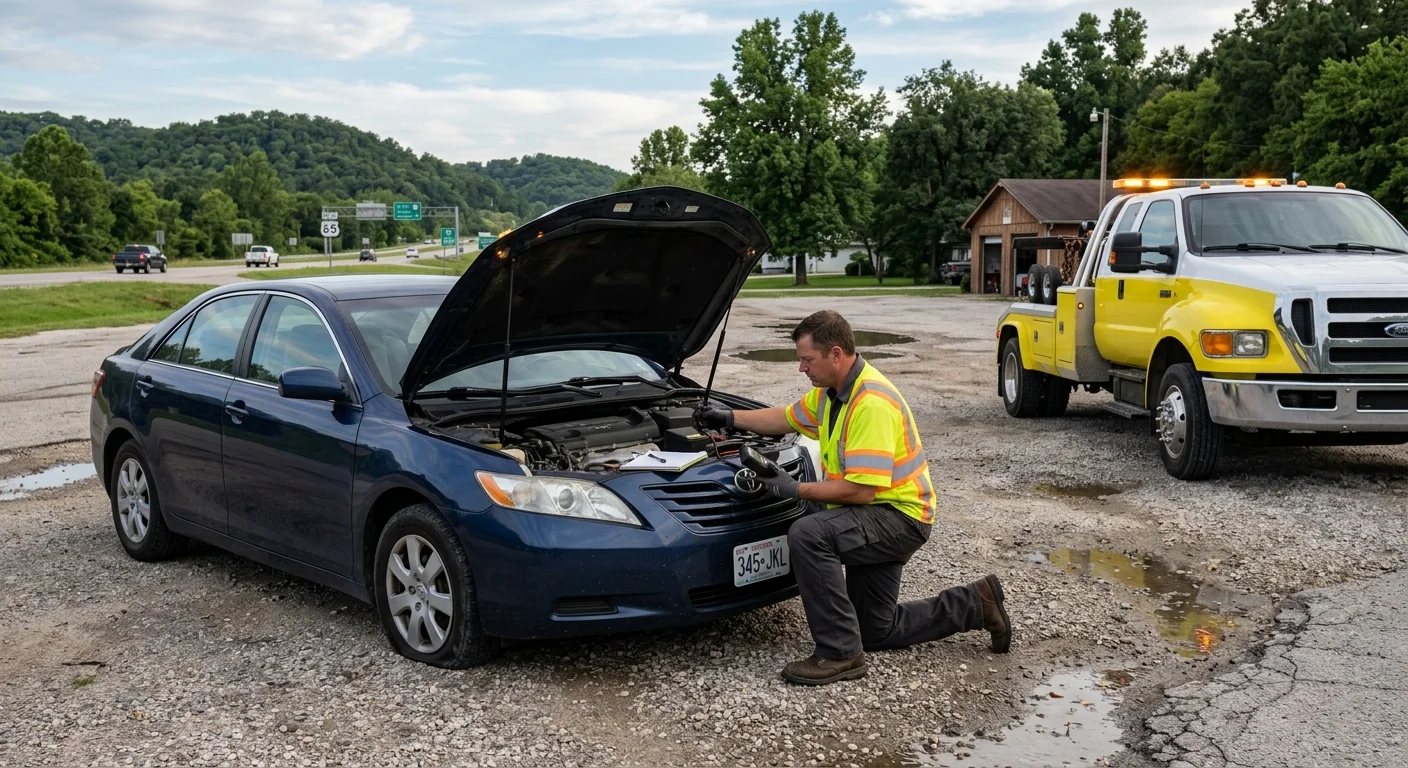
Start with the exact Ozark location and direction
Name the road first. Then the direction. Then the nearest exit or cross street. “I’m in Ozark” is a start. It is not a pin.
US-65 is the north-south spine through town. Northbound traffic is climbing toward Springfield in Greene County. Southbound traffic is dropping toward Highlandville and the Branson visitor stream. That highway feeds a corridor with roughly 9-10 million visitors a year. A disabled car on that shoulder is a different problem than a dead battery in a lot off 3rd Street.
If you are on US-65, say northbound or southbound. Add the last exit you passed. The Route 14 interchange, the US-160 ramps, and the business exits along the commercial strip are the usual markers. If you already rolled onto a frontage road or into a lot, say that. An operator can work a parking stall. A live lane is a different setup.
Off the freeway, Ozark still has a real street grid. US-160, Jackson Street through much of town, crosses the highway and runs west toward Nixa. South 3rd Street and the older streets west of 65 lead toward the square and the Finley River. Those streets are slower. They also have tighter turns, parked cars, and lot aisles a wrecker has to thread.
Stay out of the travel lane. If you cannot move the car, keep the hazards on. On a high-speed shoulder, staying in the vehicle with your seatbelt on is often safer than standing beside the fender. In a lot, stay with the car so the operator can find the right row.
If you can look at a phone without stepping into traffic, open the MoDOT Traveler Information Map. It shows incidents, cameras, and conditions on Missouri highways. It will not send a truck. MoDOT’s Motorist Assist / Emergency Response program is a freeway courtesy patrol based at the Transportation Management Center of the Ozarks in Springfield. In 2022, Springfield-based staff handled 3,260 incidents across 21 counties. That patrol can cover a stopped vehicle and help with visibility. It does not tow a vehicle to a shop. It is a scheduled patrol, not a private call-out you summon. Do not treat it as your only plan.
If someone is hurt, call 911. A dead car is a recovery problem. An injury is not.
Roadside help and towing solve different problems
Roadside help is for a car that can leave under its own power after a short fix. Towing is for a car that should not be driven, or cannot be.
A jump, a spare-tire swap, a lockout, or a fuel can may be enough in a quiet lot. That is roadside assistance. The operator still has to reach you, work on the shoulder or in the aisle, and confirm the car can move. If the tire is shredded, the wheel will not roll, the transmission will not go into gear, or the engine is overheating, stop treating it as a five-minute fix. Heat, a locked drivetrain, or a rim on the pavement is a tow.
Emergency towing is the right ask when you need the vehicle moved to a shop, a driveway, or off the highway. The operators we dispatch bring the truck the job needs. Quick Tow Springfield does not own wreckers and does not run a yard. We match you with an independent local operator. That operator sets the price. You get the number before anyone is dispatched.
Missouri does not require towing or roadside coverage on an auto policy. State law requires liability. Towing is an optional add-on, and it follows your own policy language. Check the app or the card in your glove box if you have time. Do not sit on US-65 waiting on an insurer path that may not cover this stop.
A membership club can send its own vendor. That is fine when it actually covers Ozark at this hour. If it does not, you still need a local operator.
After the car moves, the repair is a shop problem. Ozark has independent garages. Springfield has more of them. We do not pick the mechanic for you. Tell the operator where you want the car to go, or say you need a moment to choose.
Common no-start calls still split this way. A battery that takes a jump and holds a charge can leave the lot. An alternator that dies again at the first light needs a tow. A car that overheats on the 65 grade should not be nursed toward a Springfield exit. Let it cool in place and move it on a truck.
US-65, US-160, and local lots need different pickup plans
A pickup on US-65 is a highway recovery. Speed, limited shoulder, and the north-south grade all matter. The operator needs a safe approach, room to line up, and a clear word on whether you are in the right shoulder, a gore, or already on an exit ramp. Do not walk the shoulder looking for a better bar of cell service. Stay with the vehicle unless you are in immediate danger.
US-160 is a different road. It is the east-west cut through Ozark, with business access, signals, and slower traffic than 65. A stall in a turn lane or on Jackson near the highway is visible. It is also easy for other drivers to clip. Say whether you are blocking a through lane or already in a lot.
Shopping lots along the US-65 frontage look simple. They are not always. Aisle width, cart corrals, lighting, and a car nosed against a curb all change how a truck hooks up. Private lots are private property. If a manager is asking you to move, say so when you call. Missouri’s private-property rules in RSMo 304.157 cover tows without the owner’s consent. That is not this job. You are requesting the work. The lot layout is still part of the pickup plan.
If you slid into grass or a ditch near the Finley, that may be a recovery, not a simple hook. Say if all four tires are on pavement. Say if the car is against a curb, a sign, or a landscaping island.
The same kind of breakdown on I-44 in Springfield is a different corridor. Freight, interchanges, and the Glenstone-to-Kansas Expressway stretch do not apply here. If that is actually where you sit, use the guide for a car that broke down on I-44 in Springfield. West of the metro on US-60, the problem looks more like a breakdown near Aurora. Ozark’s problem is US-65, US-160, and the lots in between.
Night on 65 adds glare and less room to be seen. Hazards first. Then the location. Then whether the car will roll.
Ozark is not Nixa and it is not downtown Springfield
Ozark is in Christian County. Nixa is the next city west. Downtown Springfield is north in Greene County. Treating them as one parking lot is how people give the wrong location.
A disabled car on the 65 commercial strip in Ozark is not the same recovery as a stall on CC in Nixa. The road network is different. The distance to a Springfield shop is different. The operator’s run is different. If you live in Nixa and broke down on 65 in Ozark, say both: where the car sits now, and where you want it taken. A stall that is actually in Nixa belongs on the Nixa breakdown page. US-65 north of Springfield, toward Polk County, is the Bolivar breakdown, not this Christian County stretch.
Springfield’s city towing system does not run Ozark. Springfield uses a single-contractor city contract for police-ordered tows. Henry’s Towing Service is the current contractor through January 31, 2026. That contract, the city-contract rate sheet, and the SPD release process at headquarters on E. Chestnut Expressway belong to Springfield. They do not set a private Ozark pickup. Do not drive to a Springfield police lobby looking for a car that never left Christian County.
Springfield also added an ordinance power to tow for expired plates or tabs that are more than 30 days expired. That is Municipal Code 106-101 after Ordinance 6913, with enforcement from March 26, 2025. Missouri state law does not authorize a tow solely for expired registration. Outside Springfield city limits, no matching rule was confirmed. A Christian County stop for tags is a citation question, not a Springfield impound story.
The highway itself changes too. US-65 through Springfield was the first six-lane freeway in southwest Missouri. South of the city line the same route is still the Branson funnel, but the interchanges, the lot pattern, and the backup shops are Ozark’s. A page that swapped the city name and kept the rest would be wrong on this road.
We serve Ozark with the rest of the metro: Greene, Christian, and Webster counties, plus the Branson corridor. The operator who shows up is local and independent. The job still starts with the pin, not the county name on a map.
What to share before an operator is matched
Before we match an operator, give the facts that change the truck.
Where you are. Highway or street. Northbound or southbound. Last exit or cross street. Lot name if you have one, or the store and the aisle if you do not.
What failed. No-start, flat, overheat, steam, grinding, will not shift, accident, or in a ditch. If a warning light is on, say which one you can see.
Whether the car will roll. Neutral, parking brake, curb, or a wheel that will not turn.
Where the car should go. An Ozark shop, a Nixa driveway, a Springfield dealer, or stay in the lot until morning. We do not choose the shop.
Who is with the vehicle. Kids, pets, or a driver who needs another ride. Ask the operator on scene about riding in the truck. Do not assume it is allowed.
Keys, fobs, and wheel locks. AWD or a low body kit. Those details change equipment.
If this is an insurance or club dispatch, say so. If you already called 911, say so.
Quick Tow Springfield is a referral service. We take the call, then line up an independent local operator. We own no trucks and run no yard. The line takes calls 24 hours a day, every day. After a notice, calls are recorded and transcribed. Missouri is a one-party consent state. There is no arrival-time promise, because we do not sit on a clock we cannot control.
Have the destination ready if you already know it. A tow that stays in Ozark is a different run than a tow that climbs 65 into Springfield. Say which one you want before the truck is matched.
When to call us
If the car will not move, the engine is hot, you are on the US-65 shoulder, or a lot manager wants it gone now, this is no longer a parking-lot fix. Call us at (417) 221-8911. The line takes calls 24 hours a day. After a notice, the call is recorded, and we dispatch an independent local operator to you.