Your car is dead on the shoulder, and the first instinct is to stay in the cabin. Once an operator is ready to load it, that seat is the wrong one. In Springfield, whether anyone may ride in a vehicle being towed is the independent operator’s call. A statewide yes or no could not be confirmed in Missouri’s published towing statutes.
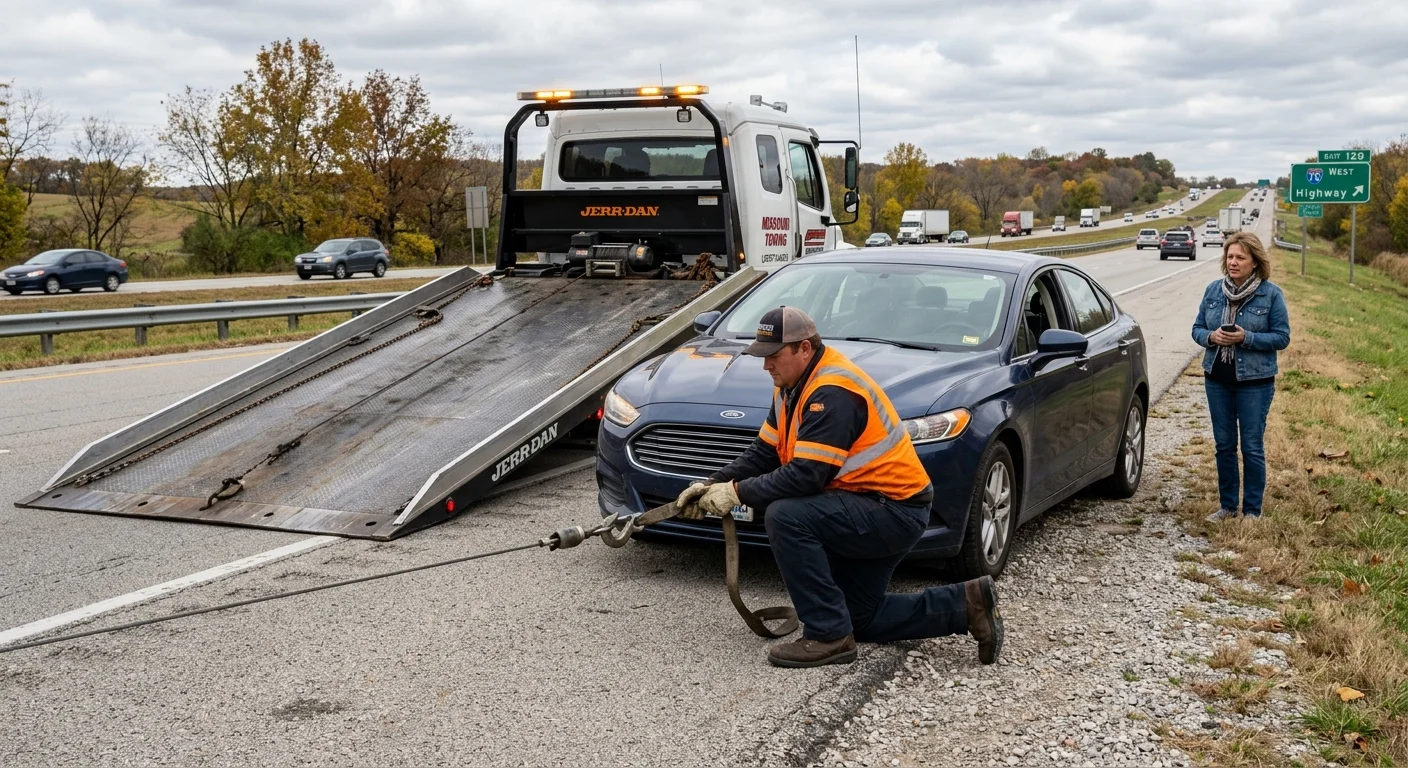
Riding in the towed car is a different question from riding in the cab
People mix two seats. One is your loaded car. The other is the wrecker’s cab. They are different rides, and they get decided separately.
The cab question already has its own page: can you ride in a tow truck. This one is about staying in the car while it is hooked, winched, or sitting on a bed. If you asked “can you ride in the car while it is towed,” you are on the right page.
Missouri’s towing rules live in RSMo Chapter 304. Those sections cover accident-scene choice of company, storage access, abandoned-vehicle clocks, and private-property tows. A specific statewide rule that says a person may sit in a car being towed, or must get out, could not be confirmed in those published sections. Treat a blog written for Texas, Arizona, or another country as that place’s advice. It is not Missouri law.
What does control the job is the operator we match you with. Quick Tow Springfield is a referral service. We take the call and line up an independent local operator. That operator owns the truck, picks the load method, and decides who may sit where.
A flatbed puts the whole car on a steel deck. A wheel-lift picks a pair of wheels and leaves the other end on the pavement. In both cases, the cabin of the loaded car is cargo space for the trip. Ask the operator on scene, before the straps go on. A friend who once rode along on US-65 does not set this truck’s policy.
Downtown Springfield, Nixa, Ozark, and Republic are different waits and different road speeds. The passenger rule still comes from the operator standing next to your bumper, not from the city name on the sign.
Why operators usually keep people out of the loaded vehicle
Most operators want the loaded car empty. That is how they run the job.
A car on a bed still moves. The deck tilts. Straps cinch. A wheel-lift can bounce on a pavement joint on Glenstone or Kearney. Anyone still in the cabin has no steering and no part in the load. If you hoped to stay in the car during a tow, this is why that plan usually dies on scene.
The operator also has to see the vehicle. A person in the driver’s seat blocks door checks, under-car looks, and the path of a winch line. On a night job after an MSU home game, with 25,238 students on the Springfield campus, that sight line matters more than it does in a quiet Republic driveway.
Company policy and insurance sit on the operator’s side of the clipboard. We do not publish those policies, because they belong to each independent company. We do not set them. If the operator says the car has to be empty, that is the arrangement for that truck.
None of this is a claim that Missouri bans the practice in a numbered statute we can point to. It is the usual way a local operator will run an emergency towing job so the load stays stable from the shoulder to the shop.
If you need to go the same direction as the car, that is a cab question, a friend, or a separate ride. It is a poor reason to stay buckled in a Honda that is about to leave the ground. Cox South and Mercy Hospital Springfield are both Level I trauma centers in this city. The operators we dispatch would rather you wait on the safe side of the guardrail than test what a loaded cabin does in a sudden stop.
Passengers, kids, and pets still need a plan before dispatch
Tell the line who is with you before anyone is dispatched. A solo driver on Campbell is a different scene than a family of five plus a dog on the US-65 ramp into Ozark.
We cannot invent a child-restraint rule, a pet policy, or an extra passenger fee for this page. Those details are not in our approved claims, and they are not a statewide figure we can quote. The operator’s truck and current policy control who may ride in the cab, if anyone may. Pets need their own plan too. Do not assume a crate in the wrecker. Do not assume a lap in the loaded car.
Have the ride lined up before the truck is committed. Call a person in Nixa, Battlefield, or on the MSU campus. If nobody can come, say so when you call us. The operator can still take the car. You still need a way off the pavement.
For a longer haul, the same split holds. Long-distance towing from Springfield toward Branson, or out of Greene County, is a vehicle move. It is not a family shuttle. Branson sees roughly 9-10 million visitors a year. A rental that dies on the US-65 funnel still leaves people standing on the shoulder. Plan their ride as its own problem.
If the car is going to a shop on Kearney and you live in Republic, decide that split before the load. Do not wait until the bed is up and then ask to sit in the cabin.
Personal property is a separate issue from a seat. On a city-ordered tow, personal property inside the vehicle stays with it. For Springfield police-ordered tows, the city’s Obtain My Impounded Vehicle page walks the release steps. Grab what you need from the cabin before the operator asks you out. Watching a purse through the windshield is not a reason to stay in a car being towed.
Kids standing on an I-44 shoulder need a grown-up with them, clear of traffic. The Kansas Expressway / I-44 interchange is a diverging diamond, and sight lines there are already busy. Get the children to a safe waiting spot first. Sort the cab-versus-car question second.
Highway shoulders and parking lots change the waiting plan
Where you wait is its own decision. It is not the same as where you sit for the tow.
On I-44 through Springfield, the Glenstone-to-Kansas Expressway stretch carries 65,000-plus vehicles a day, about 23 percent of them semi-trucks. That corridor is a Tier 1 freight route, and Prime Inc. has been headquartered here since 1980. A disabled car on that shoulder sits in a working freight lane. Get out on the side away from traffic when you can do it safely. Wait well clear of the car. Sitting in it hoping the next truck will see you is a poor plan.
Our guide on what to do when you broke down on I-44 in Springfield walks that shoulder sequence. MoDOT’s Motorist Assist / Emergency Response program is a freeway courtesy patrol based at the Transportation Management Center of the Ozarks. It is a scheduled patrol, and it does not tow. The city’s volunteer Motorist Assist Program, run through SPD’s volunteer unit since 2014, gives roadside cover and visibility. It also does not tow. Neither one is a seat in your loaded car. For live cameras and incidents, use the MoDOT Traveler Information Map or Missouri 511.
A lot behind a Battlefield shop is calmer. You can wait inside a store, on a sidewalk, or with a friend who already pulled in. Still get out before the load. The operator still needs the cabin empty.
If you are thinking of leaving the car and catching a ride first, know the abandoned-vehicle layer. Springfield’s city rule on public right-of-way is a 48-hour sticker-and-tire-mark process. An operable, validly licensed vehicle parked in view of its owner’s own residence is not treated as abandoned. That city rule is faster than the state interstate clocks in RSMo 304.155. It does not answer the passenger question. It only tells you that leaving a car on a public street starts a clock of its own.
Nixa, Ozark, and Republic are not downtown Springfield. A two-lane Ozarks shoulder, a gravel pull-off, or a dark lot on US-60 is a different wait than a lit garage on South Campbell. Stay visible. Stay out of the loaded car. Tell the operator exactly where you will stand while the bed comes down.
October and November add deer traffic statewide. Peak hours run 6-7 a.m. and 6-9 p.m. A dark wait on a Greene County two-lane is a worse place to sit inside a disabled car than a busy lot on Glenstone. Get out, stay off the travel lane, and keep the kids with you.
What to confirm with the operator before the car is loaded
Ask these things out loud before a strap hits a tire.
Who is riding, and where. The loaded car is almost always empty. The cab is a separate yes or no. Get the answer for this truck, this night.
Where the car is going. Shop, home, or another lot. If you will not be in either vehicle, confirm the drop address and who has the keys.
What has to come out of the cabin. Medications, bags, a child seat you still need, a pet. On a city impound, personal property stays with the vehicle. On a job you called in, take what you need now. Missouri’s prescribed-medication floor in RSMo 304.155.9 is for abandoned-vehicle removals from public property, where medication prescribed by a physician must be released on request even if charges are unpaid. It is not a reason to stay in the car.
How the car will be moved. Flatbed or wheel-lift changes how you stand around the truck. Stay where the operator points.
Who pays, and what number you were given before dispatch. Quick Tow does not set the operator’s total. You get the number before anyone is dispatched. We do not publish a passenger surcharge here, because we do not have a confirmed extra-charge figure for riding along.
If the operator says no one rides in the car, that is the plan. If someone will not get out, the load waits. Call us back if the job has to change.
Keep the conversation short. The operator is working next to live traffic. You already know the answer you came here for. You stay out of the car being towed unless that operator, on that job, says you may. In this metro, plan on standing outside.
When to call us
Call when the car cannot move under its own power and people still need a way off I-44, US-65, or a dark lot in Christian County. That wait is past a do-it-yourself job. Call us at (417) 221-8911. The line takes calls 24 hours a day, every day. Calls are recorded after a notice plays. We match you with an independent local operator for the tow. Have your passenger plan ready before the truck is on the way.