A dead battery on Saturday evening creates two problems. Your car won’t start, and the shop or parts counter you planned to visit may already be closed. Weekend jump start service in Springfield can get the engine running, but you still need to decide whether the car should be driven.
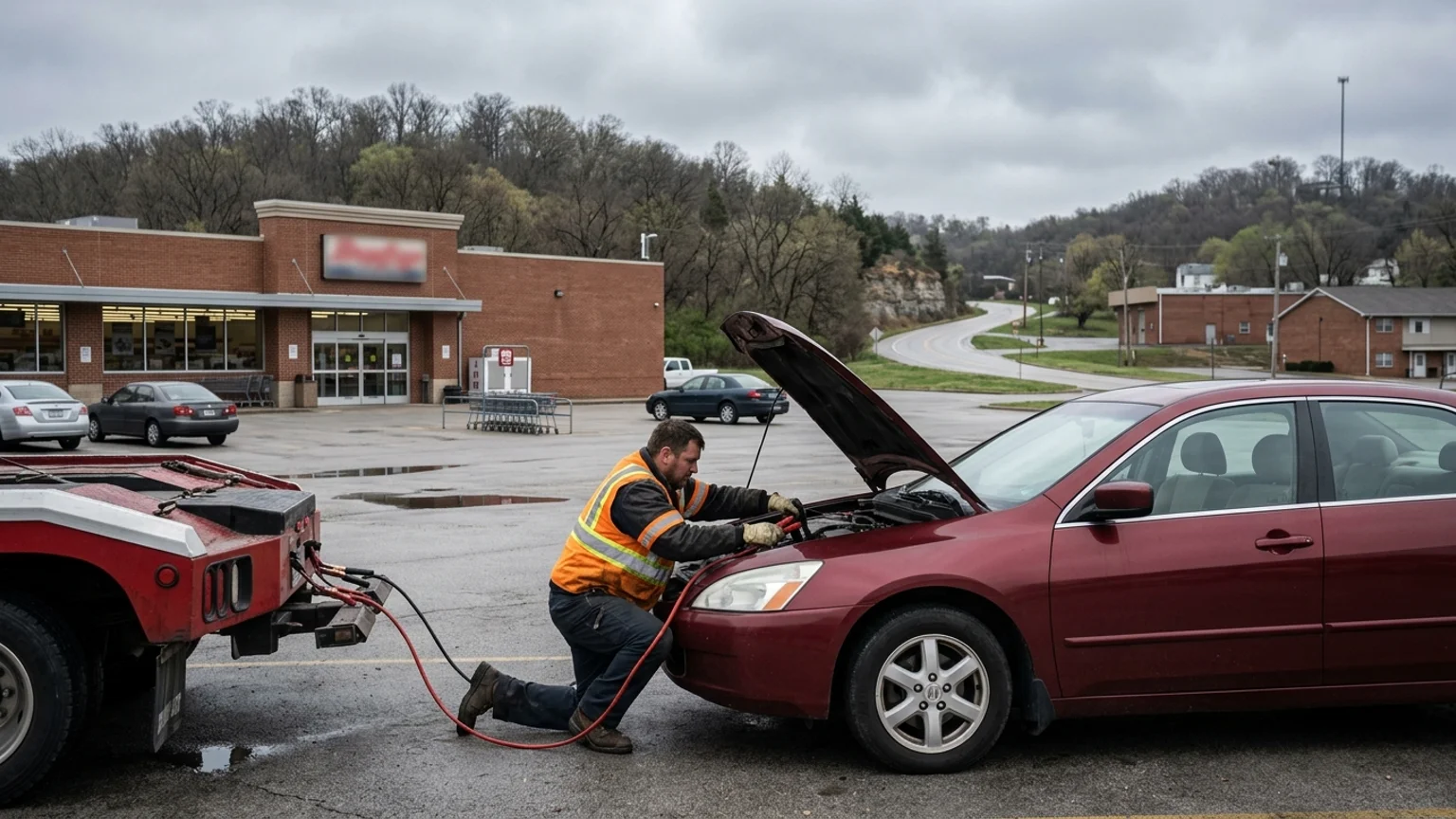
Weekend jump start service in Springfield is its own problem
A weekday jump often ends with a short drive to a repair shop. On weekends, that next step becomes less certain. Some service counters close earlier on Saturday, while others don’t open Sunday. Confirm the current hours before driving across Springfield.
That matters because a jump doesn’t repair the underlying problem. It supplies enough power to start a vehicle when the battery can’t do it alone. The engine may keep running afterward, but that doesn’t prove the battery or charging system is healthy.
Location also changes the decision. A dead car near downtown Springfield has different options than one outside Republic, Nixa, or Ozark. A driver near Branson may face a longer trip along US-65 before reaching an open destination. Someone parked near Missouri State University’s Springfield campus may be dealing with a crowded garage, limited clearance, or restricted access.
The operators we dispatch carry jump packs. Once an operator is on scene, the jump itself usually takes 5 to 10 minutes. That duration covers the work, not travel or arrival time.
Before requesting service, check whether you’re parked somewhere protected from traffic. An I-44 shoulder is different from a store parking space. If you’re exposed near moving traffic, stay clear of travel lanes and use the MoDOT Traveler Information Map to check incidents and current road conditions. MoDOT’s Motorist Assist and Emergency Response program is a scheduled freeway courtesy patrol, not a call-out towing service.
Our Springfield jump start service page explains how operator dispatch works across the metro.
When a jump is the wrong fix
Repeated clicking often points toward low battery power, but sound alone isn’t a diagnosis. A car that won’t start can have a failed alternator, a shorted battery cell, a parasitic electrical drain, or another fault. Adding outside power won’t repair those problems.
A failed alternator creates a common weekend trap. The engine may start with help, then stop after the remaining battery charge disappears. If the battery warning light stays on, the lights dim, or the car loses electrical functions, don’t assume a longer drive will solve it. The safer decision may be to stop driving and arrange transport.
A shorted cell can also make an ordinary jump ineffective. Watch for a battery case that appears damaged, swollen, leaking, or unusually hot. Don’t attach cables to a visibly damaged battery. Move away from the vehicle and describe what you see when requesting help.
A parasitic drain creates a different pattern. The vehicle starts after a jump, works normally for a while, then has another dead battery after sitting. The jump handles the immediate start. It doesn’t identify the circuit or component drawing power.
Hybrids and electric vehicles need special care. Their high-voltage traction batteries are separate from the 12-volt system that powers controls and wakes the vehicle. A depleted 12-volt battery may keep the car from entering its ready state. That doesn’t make the high-voltage system a do-it-yourself jump point. Use only the manufacturer-designated 12-volt connection procedure.
If the engine cranks normally but won’t fire, more battery power may not help. Check our guide to why a car won’t start before repeating the same attempt.
Where jumps go wrong on newer cars
Newer vehicles often hide the battery beneath covers, seats, cargo panels, or other components. Some provide remote positive and negative connection points under the hood. Those terminals exist so power can be connected without reaching the battery itself.
Guessing at connection points can damage the vehicle. A convenient-looking bolt isn’t automatically the correct ground. A covered terminal isn’t automatically meant for a jump. Check the owner’s manual for the exact vehicle before connecting anything.
Polarity matters too. Reversed connections can send current where it doesn’t belong. Modern vehicles contain control modules, sensors, entertainment systems, and safety electronics. A careless connection can turn a dead-battery problem into a larger electrical problem.
Start-stop vehicles add another wrinkle. They may use batteries designed for frequent restart cycles and a charging system that monitors battery condition. A hard, improvised jump isn’t a substitute for the procedure specified by the manufacturer. The battery may also require testing or replacement after the car starts.
Don’t keep making attempts if cables become hot, clamps spark heavily, or the vehicle behaves strangely. Stop and recheck the procedure. Smoke, a sharp chemical smell, visible leakage, or a changing battery case means you should back away.
Cheap jumper cables can also create trouble when their clamps don’t hold securely or their conductors can’t deliver steady power. A portable jump pack removes the need to position a second vehicle beside yours, but it still must be connected correctly.
Our safe jump start guide covers the basic sequence and the points that should stop a do-it-yourself attempt. The owner’s manual remains the authority for your specific car.
What we need to know when you call
Start with your exact location. A street address works well in town. In a large parking lot, add the store name, entrance, row, or nearby landmark. Along I-44 or US-65, provide the direction of travel and the nearest exit. Don’t cross traffic lanes to inspect a marker.
Next, share the vehicle’s year, make, model, and fuel type. Say whether it’s gasoline, diesel, hybrid, or electric. That information helps identify unusual battery placement, remote terminals, and the right type of equipment.
Describe what happens when you press the start button or turn the key. Useful details include clicking, slow cranking, normal cranking, silence, flashing dashboard lights, or a battery warning. Mention whether the headlights work and whether another jump was already attempted.
Tell us about the vehicle’s position. Operators need to know if it’s in a garage, behind a gate, nose-in against a wall, or boxed between other cars. Clearance matters in downtown garages and apartment lots. Access can also be different around crowded retail areas on Glenstone Avenue or Battlefield Road.
Mention visible battery damage, leaking fluid, smoke, unusual heat, or a strong odor before anyone touches the vehicle. Also say whether the car stopped while driving or simply failed after sitting. A shutdown in motion can point away from a simple depleted battery.
Price depends on the independent operator and the job. No jump-start price could be confirmed in the approved information for this service, so we won’t invent one. You’ll get the number before anyone is dispatched. Our guide to jump start costs in Springfield explains which job details can affect that number.
Cold snaps, ice, and the Ozarks battery season
Springfield weather can expose a weak battery quickly. Cold conditions reduce available battery output while the engine may demand more power to crank. A battery that seemed adequate during mild weather can fail after a cold night.
Ice creates a second problem. It can leave a vehicle inaccessible, block the hood, or make the ground around the car unsafe. Don’t stand where another vehicle could slide into you. Clear only what you can reach without entering moving traffic or working beneath unstable ice-loaded branches.
The January 2007 ice storm shows how widespread Ozarks conditions can become. From January 12 through 14, the National Weather Service in Springfield measured 1.5 inches of ice. Fourteen counties along the I-44 corridor received at least one inch. About 200,000 customers lost power within the affected region. That figure covers the NWS-scoped region, not the entire state.
A storm doesn’t need to reach that scale to disrupt a weekend plan. Overnight freezing, short trips, and long periods parked outside can reveal a battery that’s already losing capacity. Keep the owner’s manual accessible somewhere besides a locked glove box. Save the vehicle’s year, model, and roadside coverage details before severe weather arrives.
After a successful jump, don’t assume the battery is fixed. Watch the dashboard and listen for changes. If the engine stalls, electrical systems weaken, or warning lights remain on, stop treating the problem as a routine battery discharge. The vehicle may need testing or towing.
If you’re planning a do-it-yourself attempt, review the connection procedure before the weather turns. If the terminals are hidden, the battery is damaged, or the vehicle uses an unfamiliar electrical system, leave the connection to an operator.
When to call us
Call when the battery is damaged, the correct terminals aren’t clear, or the vehicle won’t stay running after a jump. Our line takes calls 24 hours a day, and calls are recorded after a notice so we can line up an independent local operator. Call us at (417) 221-8911.